
新型免疫球蛋白结构域蛋白为研究 SARS-CoV-2 相关病毒的进化和发病机制提供了线索。
Novel Immunoglobulin Domain Proteins Provide Insights into Evolution and Pathogenesis of SARS-CoV-2-Related Viruses.
机构信息
Department of Biology, College of Arts and Sciences, Saint Louis University, St. Louis, Missouri, USA.
School of Medicine, Saint Louis University, St. Louis, Missouri, USA.
出版信息
mBio. 2020 May 29;11(3):e00760-20. doi: 10.1128/mBio.00760-20.
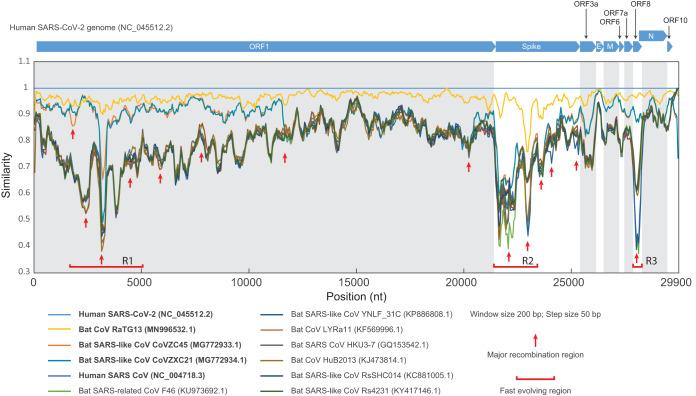
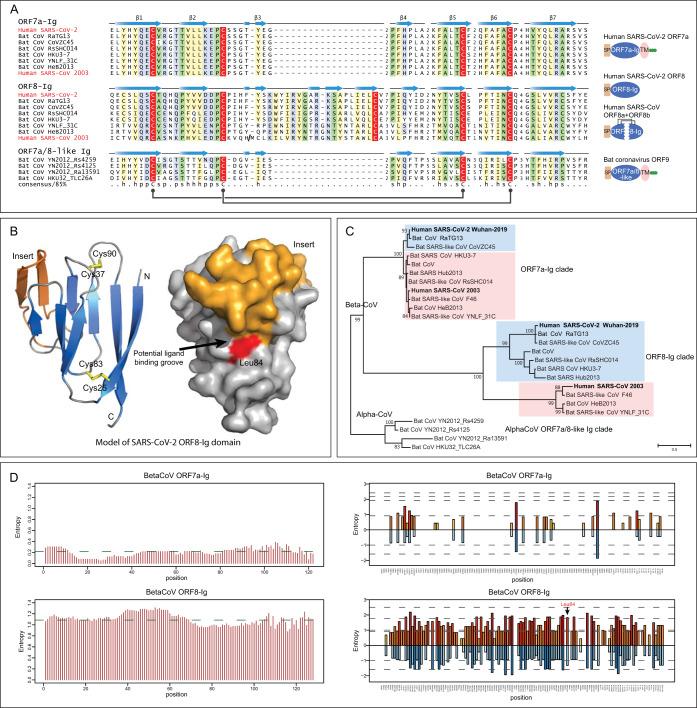
A novel coronavirus, severe acute respiratory syndrome coronavirus 2 (SARS-CoV-2), was recently identified as the causative agent for the coronavirus disease 2019 (COVID-19) outbreak that has generated a global health crisis. We use a combination of genomic analysis and sensitive profile-based sequence and structure analysis to understand the potential pathogenesis determinants of this virus. As a result, we identify several fast-evolving genomic regions that might be at the interface of virus-host interactions, corresponding to the receptor binding domain of the Spike protein, the three tandem Macro fold domains in ORF1a, and the uncharacterized protein ORF8. Further, we show that ORF8 and several other proteins from alpha- and beta-CoVs belong to novel families of immunoglobulin (Ig) proteins. Among them, ORF8 is distinguished by being rapidly evolving, possessing a unique insert, and having a hypervariable position among SARS-CoV-2 genomes in its predicted ligand-binding groove. We also uncover numerous Ig domain proteins from several unrelated metazoan viruses, which are distinct in sequence and structure but share comparable architectures to those of the CoV Ig domain proteins. Hence, we propose that SARS-CoV-2 ORF8 and other previously unidentified CoV Ig domain proteins fall under the umbrella of a widespread strategy of deployment of Ig domain proteins in animal viruses as pathogenicity factors that modulate host immunity. The rapid evolution of the ORF8 Ig domain proteins points to a potential evolutionary arms race between viruses and hosts, likely arising from immune pressure, and suggests a role in transmission between distinct host species. The ongoing COVID-19 pandemic strongly emphasizes the need for a more complete understanding of the biology and pathogenesis of its causative agent SARS-CoV-2. Despite intense scrutiny, several proteins encoded by the genomes of SARS-CoV-2 and other SARS-like coronaviruses remain enigmatic. Moreover, the high infectivity and severity of SARS-CoV-2 in certain individuals make wet-lab studies currently challenging. In this study, we used a series of computational strategies to identify several fast-evolving regions of SARS-CoV-2 proteins which are potentially under host immune pressure. Most notably, the hitherto-uncharacterized protein encoded by ORF8 is one of them. Using sensitive sequence and structural analysis methods, we show that ORF8 and several other proteins from alpha- and beta-coronavirus comprise novel families of immunoglobulin domain proteins, which might function as potential immune modulators to delay or attenuate the host immune response against the viruses.
一种新型冠状病毒,严重急性呼吸系统综合症冠状病毒 2(SARS-CoV-2),最近被确定为导致 2019 年冠状病毒病(COVID-19)爆发的病原体,这一爆发引发了全球健康危机。我们使用基因组分析和敏感的基于谱的序列和结构分析相结合的方法来了解这种病毒的潜在发病机制决定因素。结果,我们确定了几个快速进化的基因组区域,这些区域可能处于病毒-宿主相互作用的界面,对应于 Spike 蛋白的受体结合域、ORF1a 中的三个串联 Macro 折叠结构域和未表征的 ORF8 蛋白。此外,我们表明,ORF8 和来自 α 和 β-冠状病毒的几种其他蛋白质属于新型免疫球蛋白(Ig)蛋白家族。其中,ORF8 的特点是快速进化,具有独特的插入序列,并在其预测的配体结合槽中 SARS-CoV-2 基因组之间具有高度可变的位置。我们还从几种无亲缘关系的后生动物病毒中发现了许多 Ig 结构域蛋白,它们在序列和结构上是不同的,但与冠状病毒 Ig 结构域蛋白具有可比的结构。因此,我们提出 SARS-CoV-2 ORF8 和其他以前未识别的冠状病毒 Ig 结构域蛋白属于在动物病毒中作为致病性因子部署 Ig 结构域蛋白的广泛策略的保护伞,这些 Ig 结构域蛋白调节宿主免疫。ORF8 Ig 结构域蛋白的快速进化表明,病毒和宿主之间可能存在潜在的进化军备竞赛,这可能是由于免疫压力引起的,并表明在不同宿主物种之间传播的作用。正在发生的 COVID-19 大流行强烈强调需要更全面地了解其病原体 SARS-CoV-2 的生物学和发病机制。尽管受到了强烈关注,但 SARS-CoV-2 和其他 SARS 样冠状病毒基因组编码的几种蛋白质仍然是个谜。此外,SARS-CoV-2 在某些个体中的高传染性和严重性使得目前的湿实验室研究具有挑战性。在这项研究中,我们使用了一系列计算策略来识别 SARS-CoV-2 蛋白中几个可能受到宿主免疫压力的快速进化区域。值得注意的是,ORF8 编码的迄今未被描述的蛋白质就是其中之一。使用敏感的序列和结构分析方法,我们表明 ORF8 和来自 α 和 β-冠状病毒的几种其他蛋白质组成了新型免疫球蛋白结构域蛋白家族,它们可能作为潜在的免疫调节剂,以延迟或减弱宿主对病毒的免疫反应。

 Zotero 插件