
预防抗生素耐药性:一项流行病学范围界定综述,以确定研究类别和知识差距。
Prevention of antibiotic resistance - an epidemiological scoping review to identify research categories and knowledge gaps.
机构信息
Department of Epidemiology and Global Health, Umeå University , Umeå, Sweden.
出版信息
Glob Health Action. 2019 Dec 13;12(1):1756191. doi: 10.1080/16549716.2020.1756191.
BACKGROUND
Antibiotics have become the cornerstone for the treatment of infectious diseases and contributed significantly to the dramatic global health development during the last 70 years. Millions of people now survive what were previously life-threatening infections. But antibiotics are finite resources and misuse has led to antibiotic resistance and reduced efficacy within just a few years of introduction of each new antibiotic. The World Health Organization rates antibiotic resistance as a 'global security threat' impacting on global health, food security and development and as important as terrorism and climate change.
OBJECTIVES
This paper explores, through a scoping review of the literature published during the past 20 years, the magnitude of peer-reviewed and grey literature that addresses antibiotic resistance and specifically the extent to which "prevention" has been at the core. The ultimate aim is to identify know-do gaps and strategies to prevent ABR.
METHODS
The review covers four main data bases, Web of Science, Medline, Scopus and Ebsco searched for 2000-17. The broader research field "antibiotic OR antimicrobial resistance" gave 431,335 hits. Narrowing the search criteria to "Prevention of antibiotic OR antimicrobial resistance" resulted in 1062 remaining titles. Of these, 622 were unique titles. After screening of the 622 titles for relevance, 420 abstracts were read, and of these 282 papers were read in full. An additional 53 references were identified from these papers, and 64 published during 2018 and 2019 were also included. The final scoping review database thus consisted of 399 papers.
RESULTS
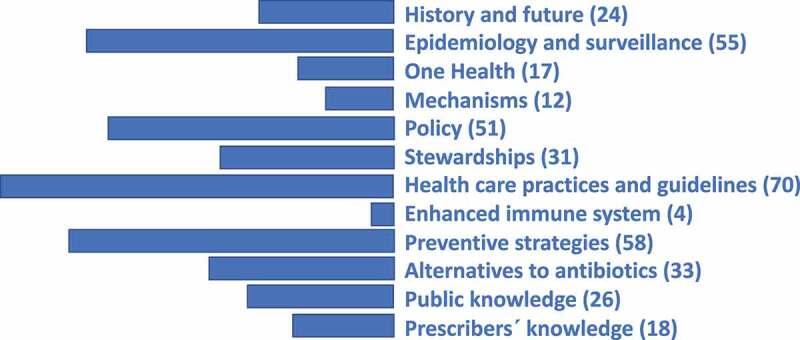
A thematic structure emerged when categorizing articles in different subject areas, serving as a proxy for interest expressed from the research community. The research area has been an evolving one with about half of the 399 papers published during the past four years of the study period. Epidemiological modelling needs strengthening and there is a need for more and better surveillance systems, especially in lower- and middle-income countries. There is a wealth of information on the local and national uses and misuses of antibiotics. Educational and stewardship programmes basically lack evidence. Several studies address knowledge of the public and prescribers. The lessons for policy are conveyed in many alarming reports from national and international organizations.
CONCLUSIONS
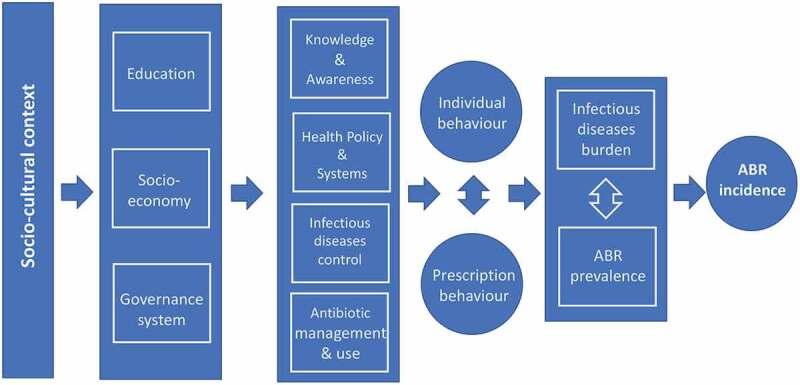
Descriptive rather than theoretical ambitions have characterized the literature. If we want to better understand and explain the antibiotic situation from a behavioural perspective, the required approaches are lacking. A framework for an epidemiological causal web behind ABR is suggested and may serve to identify entry points for potential interventions.
背景
抗生素已成为治疗传染病的基石,在过去 70 年里为全球健康的显著发展做出了重大贡献。数以百万计的人现在能够幸存以前危及生命的感染。但是抗生素是有限的资源,而且在每种新抗生素推出仅仅几年内,抗生素的滥用就导致了抗生素耐药性和疗效降低。世界卫生组织将抗生素耐药性评为“全球安全威胁”,影响全球健康、粮食安全和发展,与恐怖主义和气候变化同样重要。
目的
本研究通过对过去 20 年发表的文献进行范围综述,探讨了同行评议文献和灰色文献中解决抗生素耐药性问题的程度,特别是“预防”在其中的核心程度。最终目的是确定知识-实践差距和预防抗生素耐药性的策略。
方法
该综述涵盖了四个主要数据库,Web of Science、Medline、Scopus 和 Ebsco 对 2000-17 年的文献进行了搜索。更广泛的研究领域“抗生素或抗菌药物耐药性”产生了 431,335 个结果。将搜索标准缩小到“预防抗生素或抗菌药物耐药性”,剩余 1062 个标题。其中,有 622 个是唯一的标题。对 622 个标题进行相关性筛选后,阅读了 420 个摘要,其中 282 篇全文进行了阅读。从这些论文中又确定了另外 53 个参考文献,并纳入了 2018 年和 2019 年发表的 64 篇论文。最终的范围综述数据库由 399 篇论文组成。
结果
将文章归类到不同的学科领域时出现了一个主题结构,这可以作为研究社区表达兴趣的一个代表。该研究领域一直在不断发展,过去四年的研究期间有大约一半的 399 篇论文发表。流行病学模型的建立需要加强,还需要更多和更好的监测系统,特别是在中低收入国家。有大量关于当地和国家抗生素使用和滥用的信息。教育和管理方案基本上缺乏证据。一些研究涉及公众和处方者的知识。许多来自国家和国际组织的令人震惊的报告传达了政策方面的教训。
结论
文献的特点是描述性的,而不是理论性的。如果我们想从行为角度更好地理解和解释抗生素的情况,就需要采用所需的方法。本文提出了一个抗生素耐药性背后的流行病学因果网络框架,这可能有助于确定潜在干预措施的切入点。



 Zotero 插件