
评估绿茶多酚作为新型冠状病毒(SARS-CoV-2)主蛋白酶(Mpro)抑制剂的研究 - 对接和分子动力学模拟。
Evaluation of green tea polyphenols as novel corona virus (SARS CoV-2) main protease (Mpro) inhibitors - an docking and molecular dynamics simulation study.
机构信息
School of Basic Sciences, Indian Institute of Technology Bhubaneswar, Bhubaneswar, India.
出版信息
J Biomol Struct Dyn. 2021 Aug;39(12):4362-4374. doi: 10.1080/07391102.2020.1779818. Epub 2020 Jun 22.
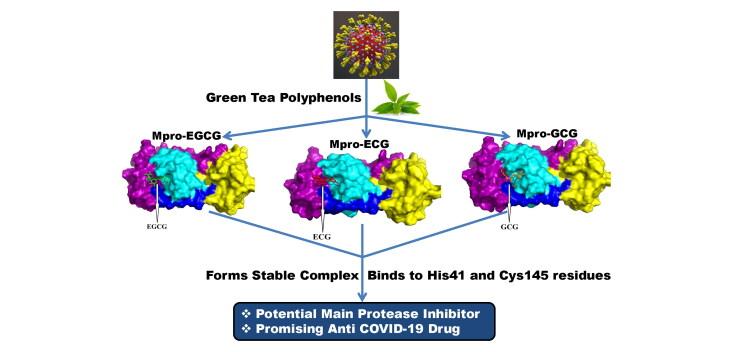
Coronavirus disease 2019 (COVID-19) is a viral respiratory disease which caused global health emergency and announced as pandemic disease by World Health Organization. Lack of specific drug molecules or treatment strategy against this disease makes it more devastating. Thus, there is an urgent need of effective drug molecules to fight against COVID-19. The main protease (Mpro) of SARS CoV-2, a key component of this viral replication, is considered as a prime target for anti-COVID-19 drug development. In order to find potent Mpro inhibitors, we have selected eight polyphenols from green tea, as these are already known to exert antiviral activity against many RNA viruses. We have elucidated the binding affinities and binding modes between these polyphenols including a well-known Mpro inhibitor N3 (having binding affinity -7.0 kcal/mol) and Mpro using molecular docking studies. All eight polyphenols exhibit good binding affinity toward Mpro (-7.1 to -9.0 kcal/mol). However, only three polyphenols (epigallocatechin gallate, epicatechingallate and gallocatechin-3-gallate) interact strongly with one or both catalytic residues (His41 and Cys145) of Mpro. Molecular dynamics simulations (100 ns) on these three Mpro-polyphenol systems further reveal that these complexes are highly stable, experience less conformational fluctuations and share similar degree of compactness. Estimation of total number of intermolecular H-bond and MM-GBSA analysis affirm the stability of these three Mpro-polyphenol complexes. Pharmacokinetic analysis additionally suggested that these polyphenols possess favorable drug-likeness characteristics. Altogether, our study shows that these three polyphenols can be used as potential inhibitors against SARS CoV-2 Mpro and are promising drug candidates for COVID-19 treatment.
新型冠状病毒病(COVID-19)是一种病毒性呼吸道疾病,已造成全球卫生紧急状态,并被世界卫生组织宣布为大流行病。由于缺乏针对该疾病的特定药物分子或治疗策略,使得情况更加严重。因此,急需有效的药物分子来对抗 COVID-19。SARS-CoV-2 的主要蛋白酶(Mpro)是该病毒复制的关键组成部分,被认为是抗 COVID-19 药物开发的主要靶点。为了寻找有效的 Mpro 抑制剂,我们从绿茶中选择了 8 种多酚,因为这些多酚已经被证明对许多 RNA 病毒具有抗病毒活性。我们通过分子对接研究阐明了这些多酚(包括一种已知的 Mpro 抑制剂 N3(结合亲和力为-7.0 kcal/mol)与 Mpro 之间的结合亲和力和结合模式。这 8 种多酚都表现出对 Mpro 的良好结合亲和力(-7.1 到-9.0 kcal/mol)。然而,只有 3 种多酚(表没食子儿茶素没食子酸酯、表儿茶素没食子酸酯和没食子儿茶素-3-没食子酸酯)与 Mpro 的一个或两个催化残基(His41 和 Cys145)强烈相互作用。对这三个 Mpro-多酚体系的分子动力学模拟(100 ns)进一步表明,这些复合物非常稳定,构象波动较小,紧凑程度相似。估计分子间氢键的总数和 MM-GBSA 分析证实了这三个 Mpro-多酚复合物的稳定性。药代动力学分析还表明,这些多酚具有良好的药物特性。总之,我们的研究表明,这三种多酚可以作为 SARS-CoV-2 Mpro 的潜在抑制剂,是治疗 COVID-19 的有前途的候选药物。
 Zotero 插件