
用于探索 COVID-19 干预和控制策略的灵活、免费的随机个体接触模型:开发和模拟。
Flexible, Freely Available Stochastic Individual Contact Model for Exploring COVID-19 Intervention and Control Strategies: Development and Simulation.
机构信息
Ingham Institute for Applied Medical Research, South Western Sydney Clinical School, Faculty of Medicine, University of New South Wales Sydney, Liverpool, Australia.
Centre for Big Data Research in Health, Faculty of Medicine, University of New South Wales Sydney, Randwick, Australia.
出版信息
JMIR Public Health Surveill. 2020 Sep 18;6(3):e18965. doi: 10.2196/18965.
BACKGROUND
Throughout March 2020, leaders in countries across the world were making crucial decisions about how and when to implement public health interventions to combat the coronavirus disease (COVID-19). They urgently needed tools to help them to explore what will work best in their specific circumstances of epidemic size and spread, and feasible intervention scenarios.
OBJECTIVE
We sought to rapidly develop a flexible, freely available simulation model for use by modelers and researchers to allow investigation of how various public health interventions implemented at various time points might change the shape of the COVID-19 epidemic curve.
METHODS
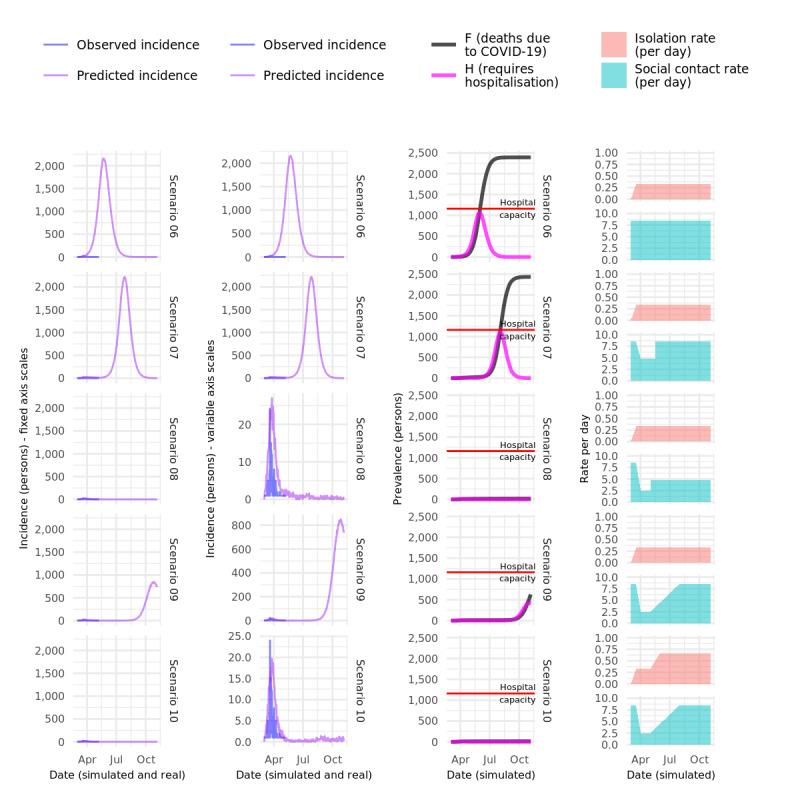
"COVOID" (COVID-19 Open-Source Infection Dynamics) is a stochastic individual contact model (ICM), which extends the ICMs provided by the open-source EpiModel package for the R statistical computing environment. To demonstrate its use and inform urgent decisions on March 30, 2020, we modeled similar intervention scenarios to those reported by other investigators using various model types, as well as novel scenarios. The scenarios involved isolation of cases, moderate social distancing, and stricter population "lockdowns" enacted over varying time periods in a hypothetical population of 100,000 people. On April 30, 2020, we simulated the epidemic curve for the three contiguous local areas (population 287,344) in eastern Sydney, Australia that recorded 5.3% of Australian cases of COVID-19 through to April 30, 2020, under five different intervention scenarios and compared the modeled predictions with the observed epidemic curve for these areas.
RESULTS
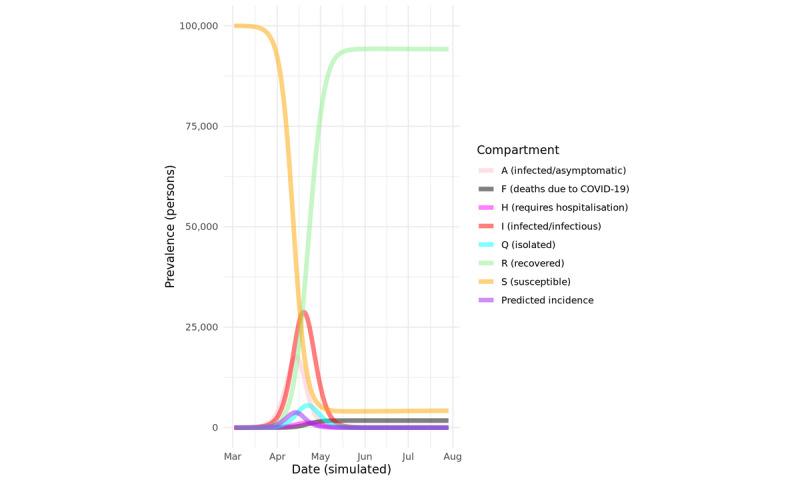
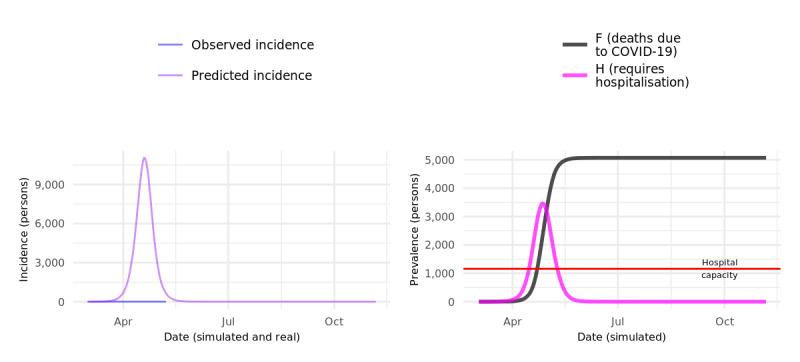
COVOID allocates each member of a population to one of seven compartments. The number of times individuals in the various compartments interact with each other and their probability of transmitting infection at each interaction can be varied to simulate the effects of interventions. Using COVOID on March 30, 2020, we were able to replicate the epidemic response patterns to specific social distancing intervention scenarios reported by others. The simulated curve for three local areas of Sydney from March 1 to April 30, 2020, was similar to the observed epidemic curve in terms of peak numbers of cases, total numbers of cases, and duration under a scenario representing the public health measures that were actually enacted, including case isolation and ramp-up of testing and social distancing measures.
CONCLUSIONS
COVOID allows rapid modeling of many potential intervention scenarios, can be tailored to diverse settings, and requires only standard computing infrastructure. It replicates the epidemic curves produced by other models that require highly detailed population-level data, and its predicted epidemic curve, using parameters simulating the public health measures that were enacted, was similar in form to that actually observed in Sydney, Australia. Our team and collaborators are currently developing an extended open-source COVOID package comprising of a suite of tools to explore intervention scenarios using several categories of models.
背景
2020 年 3 月期间,世界各国领导人正在做出有关如何以及何时实施公共卫生干预措施以抗击冠状病毒病(COVID-19)的关键决策。他们迫切需要工具来帮助他们探索在特定的疫情规模和传播情况下,哪些措施最有效,并制定可行的干预方案。
目的
我们旨在快速开发一种灵活的、免费的模拟模型,供建模者和研究人员使用,以研究在不同时间点实施的各种公共卫生干预措施如何改变 COVID-19 疫情曲线的形状。
方法
“COVOID”(COVID-19 开源感染动力学)是一种随机个体接触模型(ICM),它扩展了开源 EpiModel 软件包为 R 统计计算环境提供的 ICM。为了展示其用途并为 2020 年 3 月 30 日的紧急决策提供信息,我们使用各种模型类型以及新颖的场景模拟了与其他研究人员报告的类似干预场景。这些场景涉及对病例的隔离、适度的社会隔离以及在一个 10 万人的假想人群中不同时间段实施更严格的人口“封锁”。2020 年 4 月 30 日,我们模拟了澳大利亚东部悉尼三个连续地区(人口 287344 人)的疫情曲线,该地区记录了截至 2020 年 4 月 30 日澳大利亚 COVID-19 病例的 5.3%,使用了五种不同的干预场景,并将模拟预测与这些地区的实际疫情曲线进行了比较。
结果
COVOID 将人群中的每个成员分配到七个隔室之一。可以改变各隔室之间相互作用的次数以及每次相互作用时感染传播的概率,以模拟干预措施的效果。我们于 2020 年 3 月 30 日使用 COVOID,能够复制其他人报告的特定社会隔离干预场景的疫情反应模式。2020 年 3 月 1 日至 4 月 30 日期间,悉尼三个地区的模拟曲线在病例数量峰值、总病例数量和持续时间方面与观察到的疫情曲线相似,这与实际实施的公共卫生措施所代表的情景相似,包括病例隔离以及检测和社会隔离措施的逐步加强。
结论
COVOID 允许快速模拟许多潜在的干预方案,可以根据不同的情况进行调整,并且仅需要标准的计算基础设施。它复制了其他需要详细人口数据的模型产生的疫情曲线,并且使用模拟实际实施的公共卫生措施的参数进行预测的疫情曲线,其形式与澳大利亚悉尼实际观察到的曲线相似。我们的团队和合作者目前正在开发一个扩展的开源 COVOID 软件包,其中包含一套工具,用于使用几类模型探索干预方案。




 Zotero 插件