
抗生素作用 vB_AbaP_AGC01 噬菌体对人热失活血浆血液和模型的影响。
Antibiotics Act with vB_AbaP_AGC01 Phage against in Human Heat-Inactivated Plasma Blood and Models.
机构信息
Department of Laboratory Medicine, Pomeranian Medical University in Szczecin, Powstańców Wielkopolskich 72, 70-111 Szczecin, Poland.
Department of Molecular Virology, Institute of Microbiology, Faculty of Biology, University of Warsaw, Miecznikowa 1, 02-096 Warsaw, Poland.
出版信息
Int J Mol Sci. 2020 Jun 19;21(12):4390. doi: 10.3390/ijms21124390.
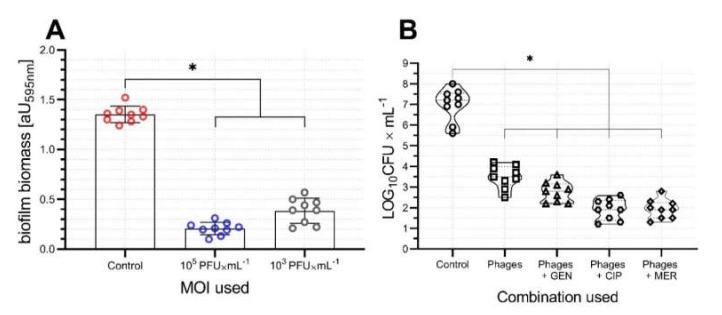
Increasing multidrug resistance has led to renewed interest in phage-based therapy. A combination of the bacteriophages and antibiotics presents a promising approach enhancing the phage therapy effectiveness. First, phage candidates for therapy should be deeply characterized. Here we characterize the bacteriophage vB_AbaP_AGC01 that poses antibacterial activity against clinical Acinetobacter baumannii strains. Moreover, besides genomic and phenotypic analysis our study aims to analyze phage-antibiotic combination effectiveness with the use of ex vivo and in vivo models. The phage AGC01 efficiently adsorbs to A. baumannii cells and possesses a bacteriolytic lifecycle resulting in high production of progeny phages (317 ± 20 PFU × cell). The broad host range (50.27%, 93 out of 185 strains) against A. baumannii isolates and the inability of AGC01 to infect other bacterial species show its high specificity. Genomic analysis revealed a high similarity of the AGC01 genome sequence with that of the genus from a subfamily of Autographivirinae. The AGC01 is able to significantly reduce the A. baumannii cell count in a human heat-inactivated plasma blood model (HIP-B), both alone and in combination with antibiotics (gentamicin (GEN), ciprofloxacin (CIP), and meropenem (MER)). The synergistic action was observed when a combination of phage treatment with CIP or MER was used. The antimicrobial activity of AGC01 and phage-antibiotic combinations was confirmed using an in vivo larva model. This study shows the greatest increase in survival of G. mellonella larvae when the combination of phage (MOI = 1) and MER was used, which increased larval survival from 35% to 77%. Hence, AGC01 represents a novel candidate for phage therapy. Additionally, our study suggests that phages and antibiotics can act synergistically for greater antimicrobial effect when used as combination therapy.
多药耐药性的增加促使人们重新关注基于噬菌体的治疗方法。噬菌体与抗生素的联合使用为提高噬菌体治疗效果提供了一种很有前途的方法。首先,需要对用于治疗的噬菌体进行深入的特性分析。在这里,我们对具有抗临床鲍曼不动杆菌活性的噬菌体 vB_AbaP_AGC01 进行了特性分析。此外,除了基因组和表型分析外,我们的研究还旨在使用离体和体内模型分析噬菌体-抗生素联合治疗的效果。噬菌体 AGC01 能有效地吸附到鲍曼不动杆菌细胞上,并具有溶菌生命周期,导致大量产生子代噬菌体(317±20PFU×细胞)。噬菌体 AGC01 对鲍曼不动杆菌分离株具有广泛的宿主范围(50.27%,185 株中有 93 株),并且不能感染其他细菌,这表明其具有很高的特异性。基因组分析表明,AGC01 基因组序列与 Autographivirinae 亚科的一个属的序列高度相似。AGC01 能够在人热灭活血浆血液模型(HIP-B)中显著减少鲍曼不动杆菌的细胞数,单独使用或与抗生素(庆大霉素(GEN)、环丙沙星(CIP)和美罗培南(MER))联合使用时均可。当使用噬菌体联合 CIP 或 MER 治疗时,观察到协同作用。使用体内幼虫模型证实了 AGC01 和噬菌体-抗生素组合的抗菌活性。这项研究表明,当使用噬菌体(MOI=1)和 MER 的组合时,对 G. mellonella 幼虫的存活率有最大的提高,将幼虫的存活率从 35%提高到 77%。因此,AGC01 是一种新型的噬菌体治疗候选物。此外,我们的研究表明,噬菌体和抗生素在联合治疗时可以协同作用,以获得更大的抗菌效果。


 Zotero 插件