
比较用于癌症风险预测的表观遗传有丝分裂样时钟。
A comparison of epigenetic mitotic-like clocks for cancer risk prediction.
机构信息
CAS Key Laboratory of Computational Biology, CAS-MPG Partner Institute for Computational Biology, Shanghai Institute of Nutrition and Health, Shanghai Institute for Biological Sciences, University of Chinese Academy of Sciences, Chinese Academy of Sciences, 320 Yue Yang Road, Shanghai, 200031, China.
UCL Cancer Institute, University College London, 72 Huntley Street, London, WC1E 6BT, UK.
出版信息
Genome Med. 2020 Jun 24;12(1):56. doi: 10.1186/s13073-020-00752-3.
BACKGROUND
DNA methylation changes that accrue in the stem cell pool of an adult tissue in line with the cumulative number of cell divisions may contribute to the observed variation in cancer risk among tissues and individuals. Thus, the construction of epigenetic "mitotic" clocks that can measure the lifetime number of stem cell divisions is of paramount interest.
METHODS
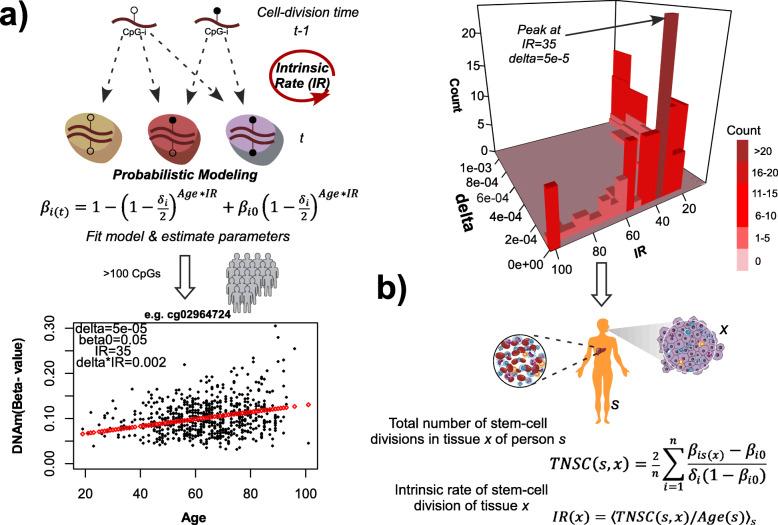
Building upon a dynamic model of DNA methylation gain in unmethylated CpG-rich regions, we here derive a novel mitotic clock ("epiTOC2") that can directly estimate the cumulative number of stem cell divisions in a tissue. We compare epiTOC2 to a different mitotic model, based on hypomethylation at solo-WCGW sites ("HypoClock"), in terms of their ability to measure mitotic age of normal adult tissues and predict cancer risk.
RESULTS
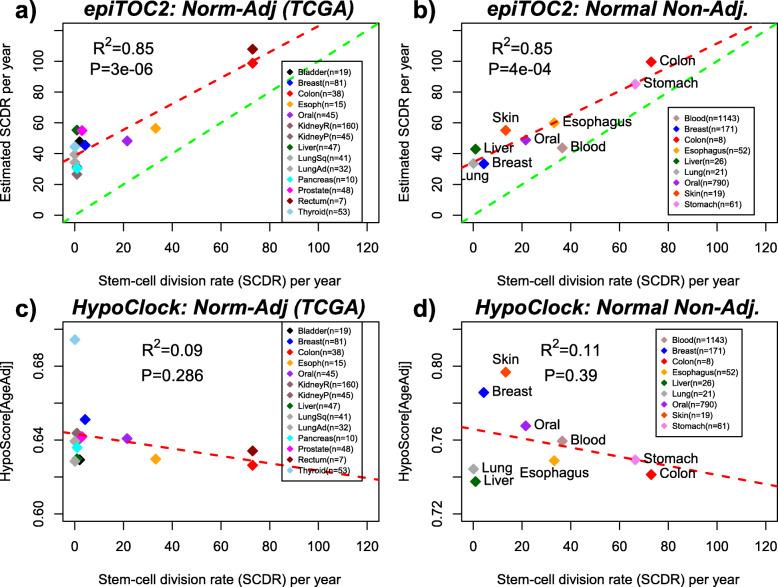
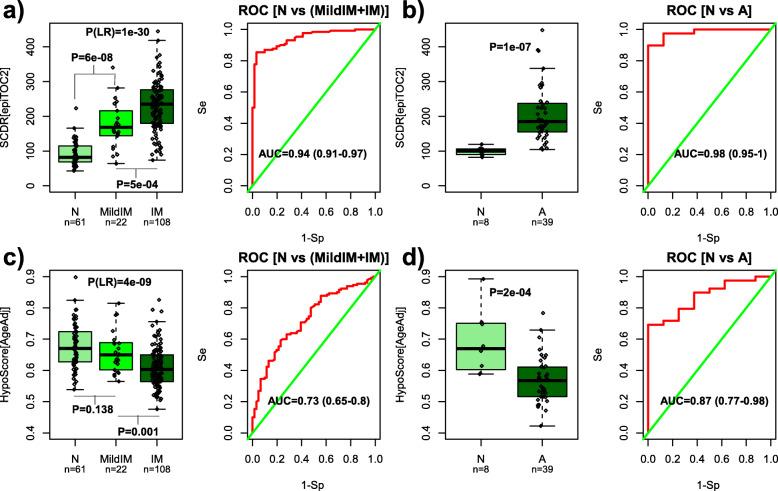
Using epiTOC2, we estimate the intrinsic stem cell division rate for different normal tissue types, demonstrating excellent agreement (Pearson correlation = 0.92, R = 0.85, P = 3e-6) with those derived from experiment. In contrast, HypoClock's estimates do not (Pearson correlation = 0.30, R = 0.09, P = 0.29). We validate these results in independent datasets profiling normal adult tissue types. While both epiTOC2 and HypoClock correctly predict an increased mitotic rate in cancer, epiTOC2 is more robust and significantly better at discriminating preneoplastic lesions characterized by chronic inflammation, a major driver of tissue turnover and cancer risk. Our data suggest that DNA methylation loss at solo-WCGWs is significant only when cells are under high replicative stress and that epiTOC2 is a better mitotic age and cancer risk prediction model for normal adult tissues.
CONCLUSIONS
These results have profound implications for our understanding of epigenetic clocks and for developing cancer risk prediction or early detection assays. We propose that measurement of DNAm at the 163 epiTOC2 CpGs in adult pre-neoplastic lesions, and potentially in serum cell-free DNA, could provide the basis for building feasible pre-diagnostic or cancer risk assays. epiTOC2 is freely available from https://doi.org/10.5281/zenodo.2632938.
背景
在与细胞分裂次数累积相符的成年组织干细胞池内发生的 DNA 甲基化改变,可能导致组织和个体间癌症风险的可观察到的差异。因此,构建能够测量干细胞分裂总数的表观遗传“有丝分裂”钟,是至关重要的。
方法
基于未甲基化富含 CpG 区域中 DNA 甲基化获得的动态模型,我们在此推导出一种新的有丝分裂钟(“epiTOC2”),可以直接估计组织中干细胞的总分裂次数。我们根据 solo-WCGW 位点的低甲基化(“HypoClock”),将 epiTOC2 与另一种有丝分裂模型进行比较,评估它们测量正常成年组织的有丝分裂年龄和预测癌症风险的能力。
结果
使用 epiTOC2,我们估计了不同正常组织类型的内在干细胞分裂率,与实验推导的结果非常吻合(Pearson 相关系数=0.92,R=0.85,P=3e-6)。相比之下,HypoClock 的估计并不吻合(Pearson 相关系数=0.30,R=0.09,P=0.29)。我们在独立的数据集对正常成年组织类型进行了验证。尽管 epiTOC2 和 HypoClock 都正确地预测了癌症中有丝分裂率的增加,但 epiTOC2 更稳健,并且在区分以慢性炎症为主要驱动力的组织更新和癌症风险的癌前病变时,表现更为出色。我们的数据表明,只有当细胞处于高复制应激下时,solo-WCGW 处的 DNA 甲基化丢失才具有显著意义,并且 epiTOC2 是一种更好的正常成年组织的有丝分裂年龄和癌症风险预测模型。
结论
这些结果对我们理解表观遗传钟具有深远的意义,并且对开发癌症风险预测或早期检测检测具有重要意义。我们提出,在成人癌前病变,以及潜在的血清无细胞游离 DNA 中测量 epiTOC2 的 163 个 CpG,可以为构建可行的预诊断或癌症风险检测提供基础。epiTOC2 可从 https://doi.org/10.5281/zenodo.2632938 免费获取。
 Zotero 插件