
纠结于裂变:定义主流和外来顶复门细胞分裂模式的多样性。
Fussing About Fission: Defining Variety Among Mainstream and Exotic Apicomplexan Cell Division Modes.
机构信息
Department of Biology, Boston College, Chestnut Hill, MA, United States.
Department of Immunology and Infectious Diseases, Harvard T. H. Chan School of Public Health, Harvard University, Boston, MA, United States.
出版信息
Front Cell Infect Microbiol. 2020 Jun 5;10:269. doi: 10.3389/fcimb.2020.00269. eCollection 2020.
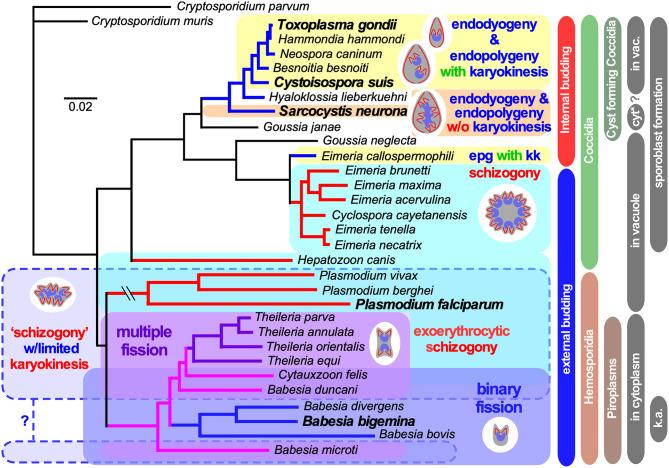
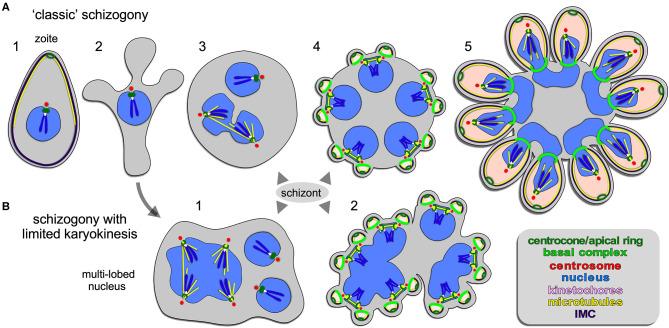
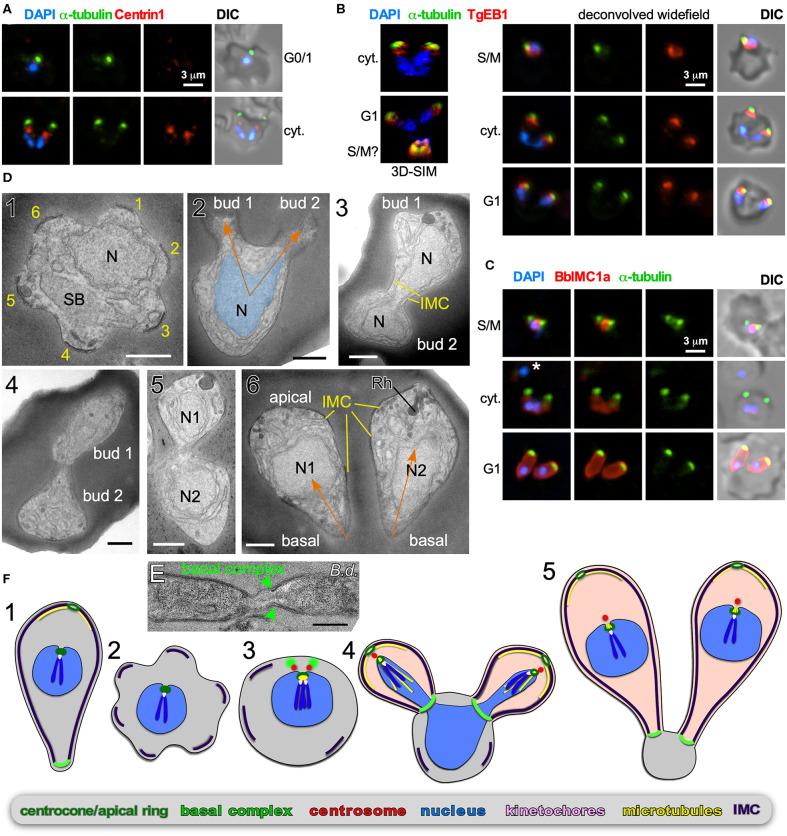
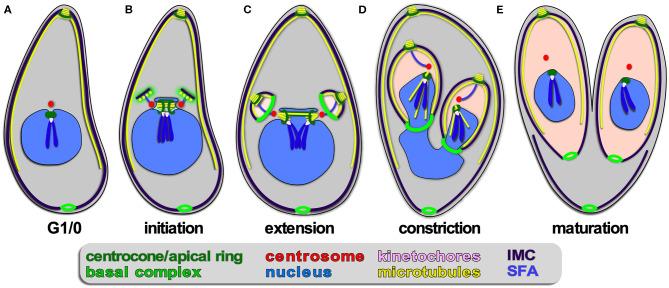
Cellular reproduction defines life, yet our textbook-level understanding of cell division is limited to a small number of model organisms centered around humans. The horizon on cell division variants is expanded here by advancing insights on the fascinating cell division modes found in the Apicomplexa, a key group of protozoan parasites. The Apicomplexa display remarkable variation in offspring number, whether karyokinesis follows each S/M-phase or not, and whether daughter cells bud in the cytoplasm or bud from the cortex. We find that the terminology used to describe the various manifestations of asexual apicomplexan cell division emphasizes either the number of offspring or site of budding, which are not directly comparable features and has led to confusion in the literature. Division modes have been primarily studied in two human pathogenic Apicomplexa, malaria-causing spp. and , a major cause of opportunistic infections. spp. divide asexually by schizogony, producing multiple daughters per division round through a cortical budding process, though at several life-cycle nuclear amplifications stages, are not followed by karyokinesis. divides by endodyogeny producing two internally budding daughters per division round. Here we add to this diversity in replication mechanisms by considering the cattle parasite and the pig parasite . produces two daughters per division round by a "binary fission" mechanism whereas produces daughters through both endodyogeny and multiple internal budding known as endopolygeny. In addition, we provide new data from the causative agent of equine protozoal myeloencephalitis (EPM), , which also undergoes endopolygeny but differs from by maintaining a single multiploid nucleus. Overall, we operationally define two principally different division modes: internal budding found in cyst-forming Coccidia (comprising endodyogeny and two forms of endopolygeny) and external budding found in the other parasites studied (comprising the two forms of schizogony, binary fission and multiple fission). Progressive insights into the principles defining the molecular and cellular requirements for internal vs. external budding, as well as variations encountered in sexual stages are discussed. The evolutionary pressures and mechanisms underlying apicomplexan cell division diversification carries relevance across Eukaryota.
细胞繁殖定义了生命,但我们对细胞分裂的教科书级理解仅限于以人类为中心的少数几种模式生物。通过推进对顶复门(Apicomplexa)中迷人的细胞分裂模式的深入了解,这里扩展了细胞分裂变体的视野。顶复门在后代数量上表现出显著的变化,核分裂是否紧跟每个 S/M 期,以及子细胞是在细胞质中出芽还是从皮层出芽。我们发现,用于描述有丝分裂的各种表现形式的术语强调后代的数量或出芽的部位,这两个特征不是直接可比的,并且在文献中导致了混淆。分裂模式主要在两种人类致病顶复门寄生虫中进行研究,疟疾寄生虫和 ,这是机会性感染的主要原因。通过裂殖产生后代,每个分裂轮产生多个后代通过皮层出芽过程,但在几个生命周期核扩增阶段,核分裂并不紧随其后。通过内出芽产生每个分裂轮的两个内部出芽的后代。在这里,我们通过考虑牛寄生虫 和猪寄生虫 来增加这种复制机制的多样性。通过“二分分裂”机制产生每个分裂轮的两个后代,而 则通过内出芽和多个内部出芽产生后代,称为内多殖。此外,我们提供了来自马原虫性脑脊髓炎(EPM)病原体的新数据,也经历了内多殖,但与 不同的是,它维持一个单一的多倍体核。总的来说,我们将两种主要不同的分裂模式定义为:在形成包囊的球虫中发现的内部出芽(包括内出芽和两种形式的内多殖)和在其他研究的寄生虫中发现的外部出芽(包括两种形式的裂殖、二分分裂和多次分裂)。讨论了深入了解定义内部出芽与外部出芽的分子和细胞要求的原则以及在有性阶段遇到的变化。顶复门细胞分裂多样化的进化压力和机制在真核生物中具有相关性。


 Zotero 插件