
桥接治疗在前体药物 axicabtagene ciloleucel 用于复发/难治性大 B 细胞淋巴瘤之前。
Bridging therapy prior to axicabtagene ciloleucel for relapsed/refractory large B-cell lymphoma.
机构信息
Department of Radiation Oncology and.
Department of Lymphoma/Myeloma, University of Texas MD Anderson Cancer Center, Houston, TX.
出版信息
Blood Adv. 2020 Jul 14;4(13):2871-2883. doi: 10.1182/bloodadvances.2020001837.
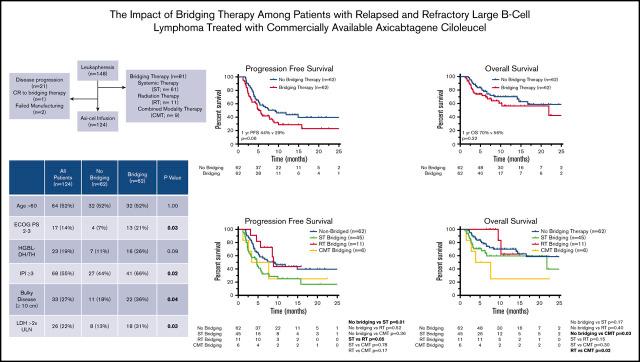
The impact of bridging therapy (BT) administered between leukapheresis and chimeric antigen receptor (CAR) T-cell therapy for large B-cell lymphoma (LBCL) is unclear. We evaluated the influence of BT (systemic therapy [ST], radiation therapy [RT], or combined-modality therapy [CMT]) on outcomes of 148 LBCL patients who underwent leukapheresis for planned axicabtagene ciloleucel (axi-cel) infusion. The 55% (n = 81) of patients who received BT were more likely to have international prognostic index (IPI) score ≥3 (P ≤ .01), bulky disease (P = .01), and elevated lactate dehydrogenase (LDH; P ≤ .01). The 1-year progression-free (PFS) and overall survival (OS) rates were 40% and 65% in non-BT patients vs 21% and 48% in BT patients (P = .01 and .05, respectively). Twenty-four patients (16%) did not receive axi-cel, most commonly because of lymphoma progression (88%), despite 80% (n = 19) receiving BT. Among 124 patients who received axi-cel, 50% (n = 62) received BT with ST (n = 45), RT (n = 11), or CMT (n = 6); 1-year PFS and OS rates were not significantly different between BT and non-BT cohorts (P = .06 and .21, respectively). There was no difference in proportion of patients with IPI ≥3, limited-stage disease, or elevated LDH between ST, RT, and CMT groups. Compared with non-BT patients, 1-year PFS was inferior for ST-bridged patients (P = .01). RT-bridged patients had improved PFS compared with ST-bridged patients (P = .05). Despite the poor prognosis associated with requiring BT, RT can be an effective bridging strategy. Future studies are necessary to identify strategies that may improve access to CAR T-cell therapy and outcomes.
桥接治疗(BT)在白血病分离术和嵌合抗原受体(CAR)T 细胞治疗大 B 细胞淋巴瘤(LBCL)之间的影响尚不清楚。我们评估了 BT(全身治疗[ST]、放射治疗[RT]或联合治疗[CMT])对 148 例计划接受 axicabtagene ciloleucel(axi-cel)输注的白血病分离术患者的影响。55%(n=81)接受 BT 的患者更有可能具有国际预后指数(IPI)评分≥3(P≤.01)、大肿块疾病(P=0.01)和乳酸脱氢酶(LDH)升高(P≤.01)。非 BT 患者的 1 年无进展生存(PFS)和总生存(OS)率分别为 40%和 65%,BT 患者分别为 21%和 48%(P=.01 和.05)。24 例(16%)患者未接受 axi-cel,最常见的原因是淋巴瘤进展(88%),尽管 80%(n=19)患者接受了 BT。在接受 axi-cel 的 124 例患者中,50%(n=62)接受了 BT,其中包括 ST(n=45)、RT(n=11)或 CMT(n=6);BT 和非 BT 队列的 1 年 PFS 和 OS 率无显著差异(P=.06 和.21)。ST、RT 和 CMT 组之间的 IPI≥3、局限性疾病或 LDH 升高患者的比例无差异。与非 BT 患者相比,接受 ST 桥接的患者 1 年 PFS 较差(P=.01)。与 ST 桥接患者相比,接受 RT 桥接的患者 PFS 得到改善(P=.05)。尽管需要 BT 与预后不良相关,但 RT 可以是一种有效的桥接策略。未来的研究需要确定可能改善 CAR T 细胞治疗机会和结果的策略。
 Zotero 插件