
薯蓣皂苷元和GSK126通过Rho/ROCK信号通路介导EZH2对胃癌细胞上皮-间质转化产生协同作用。
Diosgenin and GSK126 Produce Synergistic Effects on Epithelial-Mesenchymal Transition in Gastric Cancer Cells by Mediating EZH2 via the Rho/ROCK Signaling Pathway.
作者信息
Liu Shanshan, Rong Guihong, Li Xia, Geng Lijun, Zeng Zhineng, Jiang Dongxiang, Yang Jun, Wei Yesheng
机构信息
Department of Clinical Laboratory, The Affiliated Hospital of Guilin Medical University, Guilin, Guangxi 541001, People's Republic of China.
出版信息
Onco Targets Ther. 2020 Jun 8;13:5057-5067. doi: 10.2147/OTT.S237474. eCollection 2020.
BACKGROUND
Diosgenin, a natural steroidal saponin isolated from , has been reported to exert anti-cancer effects. Inhibitors of enhancer of zeste homology 2 (EZH2) have been widely used in treatment of cancers. However, the effects of combined treatment with diosgenin and an EZH2 inhibitor on gastric cancer (GC) cells, and the mechanism for those effects are not fully understood.
METHODS
AGS and SGC-7901 gastric cancer cells were treated with diosgenin (0 to 8 μM), followed by treatment with either diosgenin or an EZH2 inhibitor, GSK126 alone. Afterwards, an EZH2 overexpression plasmid and Rho inhibitor, GSK429286A was involved in cells. Cell proliferation, cell cycle distribution, and cell apoptosis, migration, and invasion were examined by CCK-8 assays, flow cytometry, and transwell assays. Western blotting was performed to detect the relative levels of protein expression.
RESULTS
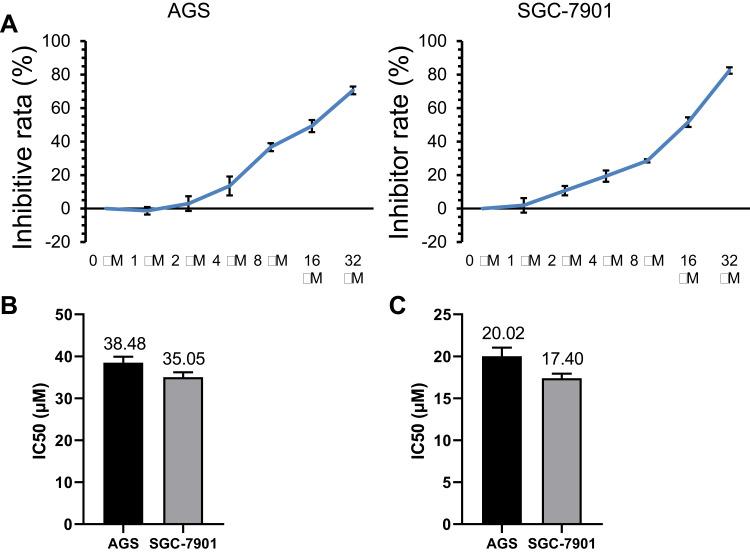
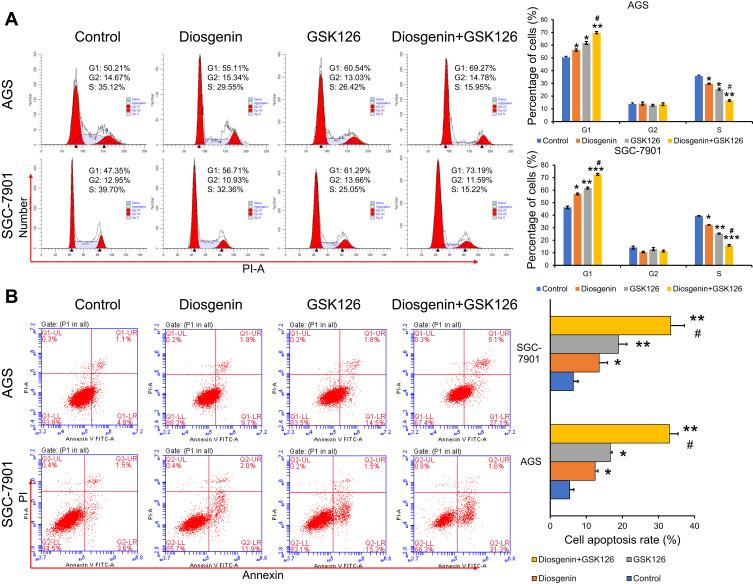
Treatment with diosgenin alone caused a dose-dependent decrease in the cell viability, and combined treatment with an EZH2 inhibitor plus GSK126 caused a further significant decrease. A further analysis revealed that treatment with either diosgenin or GSK126 alone induced significant increases in G0/G1 cell cycle arrest and apoptosis, and combined treatment with both agents induced further increases in those parameters. In addition, combined treatment with diosgenin and GSK126 synergistically induced even stronger effects on impaired cell proliferation, G0/G1 phase arrest, and cell apoptosis when compared to treatment with either diosgenin or GSK126 treatment alone. At the molecular level, we demonstrated that inhibition of Rho/ROCK signaling by combined treatment with diosgenin and GSK126 could downregulate the expression of epithelial-mesenchymal transition (EMT)-related molecules. We also found that EZH2 overexpression reversed the anti-tumor effect of diosgenin by inducing cell survival, blocking G1-phase arrest, and promoted EMT. While, these biological properties were further reversed by GSK429286A.
CONCLUSION
Collectively, combined treatment with diosgenin and GSK126 produced even more significant effects on GC cell inhibition by targeting EZH2 via Rho/ROCK signaling-mediated EMT, which might be a therapeutic strategy for improving the poor therapeutic outcomes obtained with GSK126 monotherapy.
背景
薯蓣皂苷元是一种从[具体来源未给出]中分离出的天然甾体皂苷,据报道具有抗癌作用。zeste同源物2(EZH2)增强子抑制剂已广泛用于癌症治疗。然而,薯蓣皂苷元与EZH2抑制剂联合治疗对胃癌(GC)细胞的影响及其作用机制尚未完全明确。
方法
用薯蓣皂苷元(0至8μM)处理AGS和SGC - 7901胃癌细胞,然后单独用薯蓣皂苷元或EZH2抑制剂GSK126处理。之后,将EZH2过表达质粒和Rho抑制剂GSK429286A引入细胞。通过CCK - 8测定、流式细胞术和Transwell测定检测细胞增殖、细胞周期分布以及细胞凋亡、迁移和侵袭情况。进行蛋白质印迹法检测蛋白质表达的相对水平。
结果
单独用薯蓣皂苷元处理导致细胞活力呈剂量依赖性下降,与EZH2抑制剂GSK126联合处理导致进一步显著下降。进一步分析表明,单独用薯蓣皂苷元或GSK126处理均可诱导G0/G1期细胞周期阻滞和凋亡显著增加,两种药物联合处理使这些参数进一步增加。此外,与单独用薯蓣皂苷元或GSK126处理相比,薯蓣皂苷元与GSK126联合处理对细胞增殖受损、G0/G1期阻滞和细胞凋亡具有更强的协同诱导作用。在分子水平上,我们证明薯蓣皂苷元与GSK126联合处理抑制Rho/ROCK信号传导可下调上皮 - 间质转化(EMT)相关分子的表达。我们还发现EZH2过表达通过诱导细胞存活、阻断G1期阻滞和促进EMT逆转了薯蓣皂苷元的抗肿瘤作用。而GSK429286A可进一步逆转这些生物学特性。
结论
总体而言,薯蓣皂苷元与GSK126联合处理通过Rho/ROCK信号传导介导的EMT靶向EZH2对GC细胞抑制产生更显著的效果,这可能是一种改善GSK126单药治疗不良疗效的治疗策略。





 Zotero 插件