
食源性病原体O157:H7活的非可培养状态的形成与控制
Formation and Control of the Viable but Non-culturable State of Foodborne Pathogen O157:H7.
作者信息
Li Yanmei, Huang Teng-Yi, Ye Congxiu, Chen Ling, Liang Yi, Wang Kan, Liu Junyan
机构信息
Department of Haematology, Guangzhou Women and Children's Medical Center, Guangzhou Medical University, Guangzhou, China.
Department of Laboratory Medicine, The Second Affiliated Hospital of Shantou University Medical College, Shantou, China.
出版信息
Front Microbiol. 2020 Jun 16;11:1202. doi: 10.3389/fmicb.2020.01202. eCollection 2020.
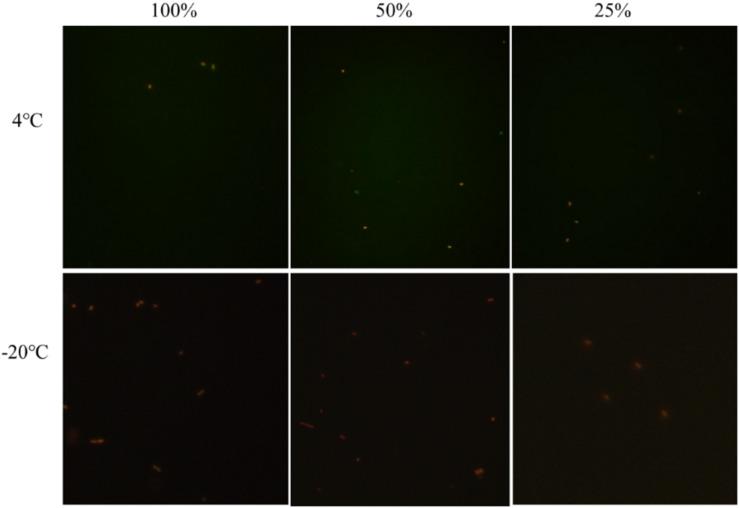
As a common foodborne pathogen, O157:H7 produces toxins causing serious diseases. However, traditional methods failed in detecting O157:H7 cells in the viable but non-culturable (VBNC) state, which poses a threat to food safety. This study aimed at investigating the formation, control, and detection of the VBNC state of O157:H7. Three factors including medium, salt, and acid concentrations were selected as a single variation. Orthogonal experiments were designed with three factors and four levels, and 16 experimental schemes were used. The formation of the VBNC state was examined by agar plate counting and LIVE/DEAD BacLight bacterial viability kit with fluorescence microscopy. According to the effects of environmental conditions on the formation of the VBNC state of O157:H7, the inhibition on VBNC state formation was investigated. In addition, in the VBNC state in food samples (crystal cake) was detected by propidium monoazide-polymerase chain reaction (PMA-PCR) assays. Acetic acid concentration showed the most impact on VBNC formation of O157:H7, followed by medium and salt concentration. The addition of 1.0% acetic acid could directly kill O157:H7 and eliminate its VBNC formation. In crystal cake, 25, 50, or 100% medium with 1.0% acetic acid could inhibit VBNC state formation and kill O157:H7 within 3 days. The VBNC cell number was reduced by adding 1.0% acetic acid. PMA-PCR assay could be used to detect VBNC cells in crystal cake with detection limit at 10 CFU/ml. The understanding on the inducing and inhibitory conditions for the VBNC state of O157:H7 in a typical food system, as well as the development of an efficient VBNC cell detection method might aid in the control of VBNC O157:H7 cells in the food industry.
作为一种常见的食源性病原体,O157:H7会产生导致严重疾病的毒素。然而,传统方法无法检测处于活的但不可培养(VBNC)状态的O157:H7细胞,这对食品安全构成了威胁。本研究旨在调查O157:H7的VBNC状态的形成、控制和检测。选择培养基、盐和酸浓度这三个因素作为单一变量。设计了具有三个因素和四个水平的正交实验,并使用了16种实验方案。通过琼脂平板计数和使用荧光显微镜的LIVE/DEAD BacLight细菌活力试剂盒检测VBNC状态的形成。根据环境条件对O157:H7的VBNC状态形成的影响,研究了对VBNC状态形成的抑制作用。此外,通过单叠氮基溴化丙锭 - 聚合酶链反应(PMA-PCR)测定法检测食品样品(水晶糕)中处于VBNC状态的细胞。乙酸浓度对O157:H7的VBNC形成影响最大,其次是培养基和盐浓度。添加1.0%的乙酸可直接杀死O157:H7并消除其VBNC形成。在水晶糕中,含有1.0%乙酸的25%、50%或100%培养基可在3天内抑制VBNC状态形成并杀死O157:H7。添加1.0%乙酸可减少VBNC细胞数量。PMA-PCR测定法可用于检测水晶糕中的VBNC细胞,检测限为10 CFU/ml。对典型食品体系中O157:H7的VBNC状态的诱导和抑制条件的了解,以及高效VBNC细胞检测方法的开发,可能有助于食品工业中对VBNC O157:H7细胞的控制。


 Zotero 插件