
吃、睡、循环往复:昼夜节律系统在平衡睡眠-觉醒控制与代谢需求中的作用。
Eat, sleep, repeat: the role of the circadian system in balancing sleep-wake control with metabolic need.
作者信息
Northeast Rebecca C, Vyazovskiy Vladyslav V, Bechtold David A
机构信息
Centre for Biological Timing, Faculty of Biology, Medicine and Health, University of Manchester, Manchester, M13 9PT, UK.
Department of Physiology, Anatomy and Genetics, University of Oxford, Parks Road, Oxford, OX1 3PT, UK.
出版信息
Curr Opin Physiol. 2020 Jun;15:183-191. doi: 10.1016/j.cophys.2020.02.003.
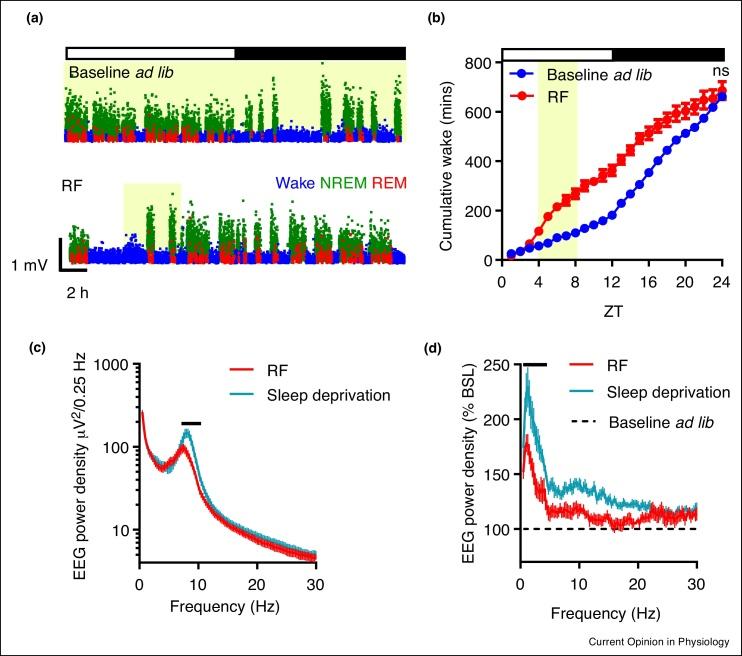
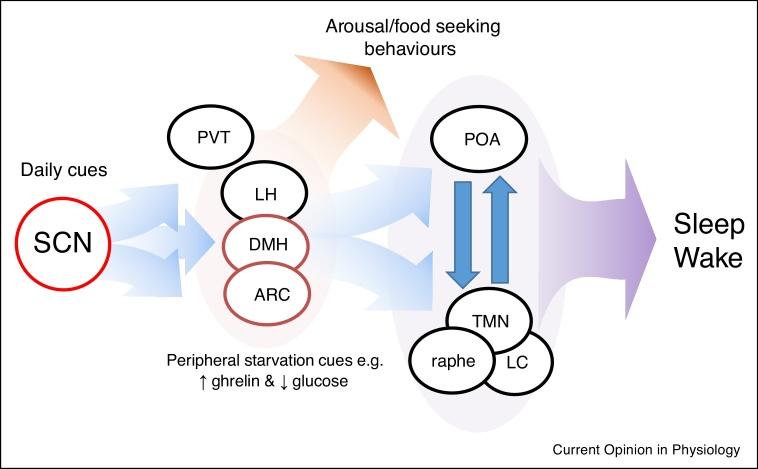
Feeding and sleep are behaviours fundamental to survival, and as such are subject to powerful homeostatic control. Of course, these are mutually exclusive behaviours, and therefore require coordinated temporal organisation to ensure that both energy demands and sleep need are met. Under optimal conditions, foraging/feeding and sleep can be simply partitioned to appropriate phases of the circadian cycle so that they are in suitable alignment with the external environment. However, under conditions of negative energy balance, increased foraging activity must be balanced against sleep requirements and energy conservation. In mammals and many other species, neural circuits that regulate sleep and energy balance are intimately and reciprocally linked. Here, we examine this circuitry, discuss how homeostatic regulation and temporal patterning of sleep are modulated by altered food availability, and describe the role of circadian system in adaptation to metabolic stress.
进食和睡眠是生存所必需的行为,因此受到强大的稳态控制。当然,这些行为是相互排斥的,因此需要协调的时间组织来确保能量需求和睡眠需求都能得到满足。在最佳条件下,觅食/进食和睡眠可以简单地划分到昼夜节律周期的适当阶段,以便它们与外部环境适当对齐。然而,在负能量平衡的情况下,增加的觅食活动必须与睡眠需求和能量保存相平衡。在哺乳动物和许多其他物种中,调节睡眠和能量平衡的神经回路紧密且相互关联。在这里,我们研究这种神经回路,讨论睡眠的稳态调节和时间模式如何受到食物供应变化的调节,并描述昼夜节律系统在适应代谢应激中的作用。

 Zotero 插件