
形态分析鉴定具有不同靶标的小分子的共同作用模式。
Morphological Profiling Identifies a Common Mode of Action for Small Molecules with Different Targets.
机构信息
Max-Planck Institute of Molecular Physiology, Department of Chemical Biology, Otto-Hahn-Strasse 11, Dortmund, 44227, Germany.
Technical University Dortmund, Faculty of Chemistry and Chemical Biology, Otto-Hahn-Strasse 6, Dortmund, 44227, Germany.
出版信息
Chembiochem. 2020 Nov 16;21(22):3197-3207. doi: 10.1002/cbic.202000381. Epub 2020 Jul 24.
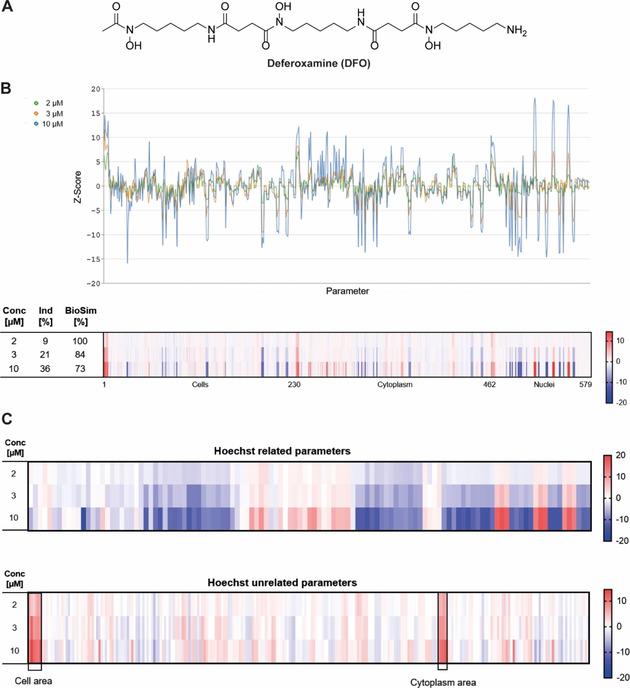
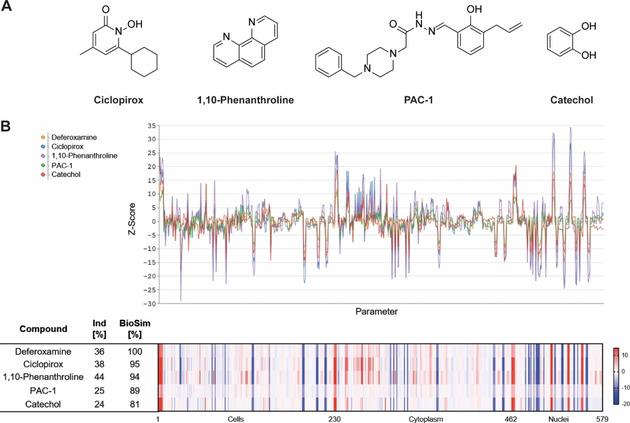
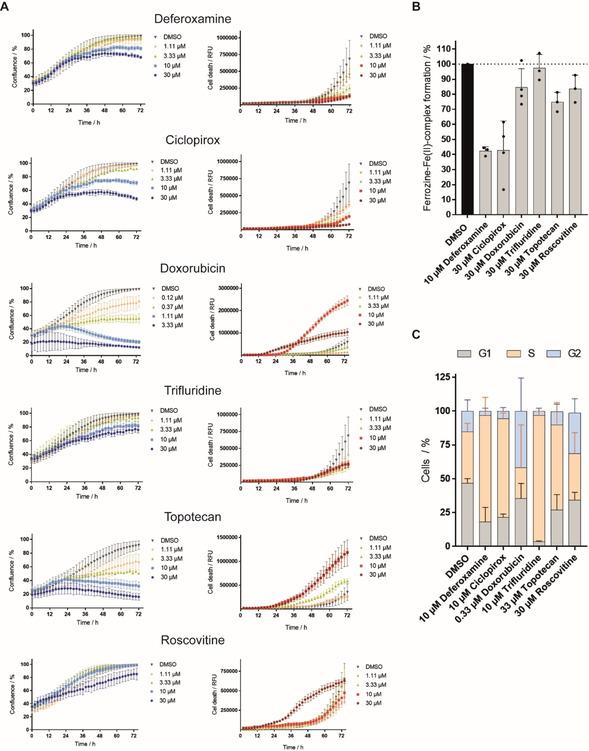
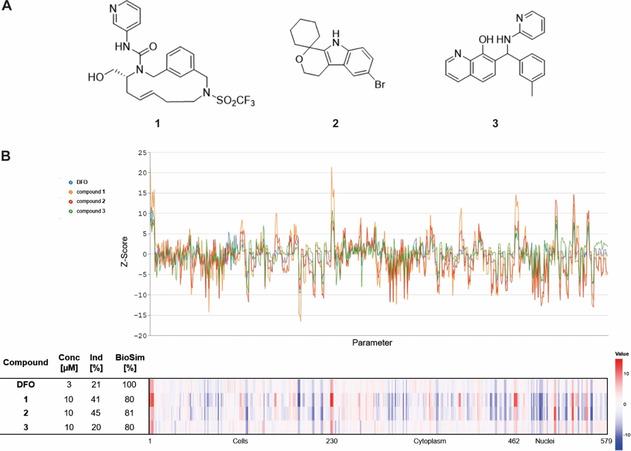
Unbiased morphological profiling of bioactivity, for example, in the cell painting assay (CPA), enables the identification of a small molecule's mode of action based on its similarity to the bioactivity of reference compounds, irrespective of the biological target or chemical similarity. This is particularly important for small molecules with nonprotein targets as these are rather difficult to identify with widely employed target-identification methods. We employed morphological profiling using the CPA to identify compounds that are biosimilar to the iron chelator deferoxamine. Structurally different compounds with different annotated cellular targets provoked a shared physiological response, thereby defining a cluster based on their morphological fingerprints. This cluster is based on a shared mode of action and not on a shared target, that is, cell-cycle modulation in the S or G2 phase. Hierarchical clustering of morphological fingerprints revealed subclusters that are based on the mechanism of action and could be used to predict target-related bioactivity.
无偏形态分析生物活性,例如在细胞染色分析(CPA)中,可以根据小分子与参考化合物生物活性的相似性来确定其作用模式,而无需考虑生物靶标或化学相似性。对于非蛋白质靶标的小分子来说,这一点尤为重要,因为这些小分子很难用广泛使用的靶标鉴定方法来鉴定。我们使用 CPA 进行形态分析,以鉴定与铁螯合剂去铁胺生物相似的化合物。具有不同注释细胞靶标的结构不同的化合物引起了相似的生理反应,从而根据其形态指纹定义了一个簇。该簇基于共同的作用模式,而不是共同的靶标,即 S 或 G2 期的细胞周期调节。形态指纹的层次聚类揭示了基于作用机制的亚簇,可用于预测与靶标相关的生物活性。




 Zotero 插件