
用于确定在基层医疗或医院门诊就诊的患者是否患有新冠病毒病的体征和症状。
Signs and symptoms to determine if a patient presenting in primary care or hospital outpatient settings has COVID-19 disease.
作者信息
Struyf Thomas, Deeks Jonathan J, Dinnes Jacqueline, Takwoingi Yemisi, Davenport Clare, Leeflang Mariska Mg, Spijker René, Hooft Lotty, Emperador Devy, Dittrich Sabine, Domen Julie, Horn Sebastiaan R A, Van den Bruel Ann
机构信息
Department of Public Health and Primary Care, KU Leuven, Leuven, Belgium.
Test Evaluation Research Group, Institute of Applied Health Research, University of Birmingham, Birmingham, UK.
出版信息
Cochrane Database Syst Rev. 2020 Jul 7;7(7):CD013665. doi: 10.1002/14651858.CD013665.
BACKGROUND
Some people with SARS-CoV-2 infection remain asymptomatic, whilst in others the infection can cause mild to moderate COVID-19 disease and COVID-19 pneumonia, leading some patients to require intensive care support and, in some cases, to death, especially in older adults. Symptoms such as fever or cough, and signs such as oxygen saturation or lung auscultation findings, are the first and most readily available diagnostic information. Such information could be used to either rule out COVID-19 disease, or select patients for further diagnostic testing.
OBJECTIVES
To assess the diagnostic accuracy of signs and symptoms to determine if a person presenting in primary care or to hospital outpatient settings, such as the emergency department or dedicated COVID-19 clinics, has COVID-19 disease or COVID-19 pneumonia.
SEARCH METHODS
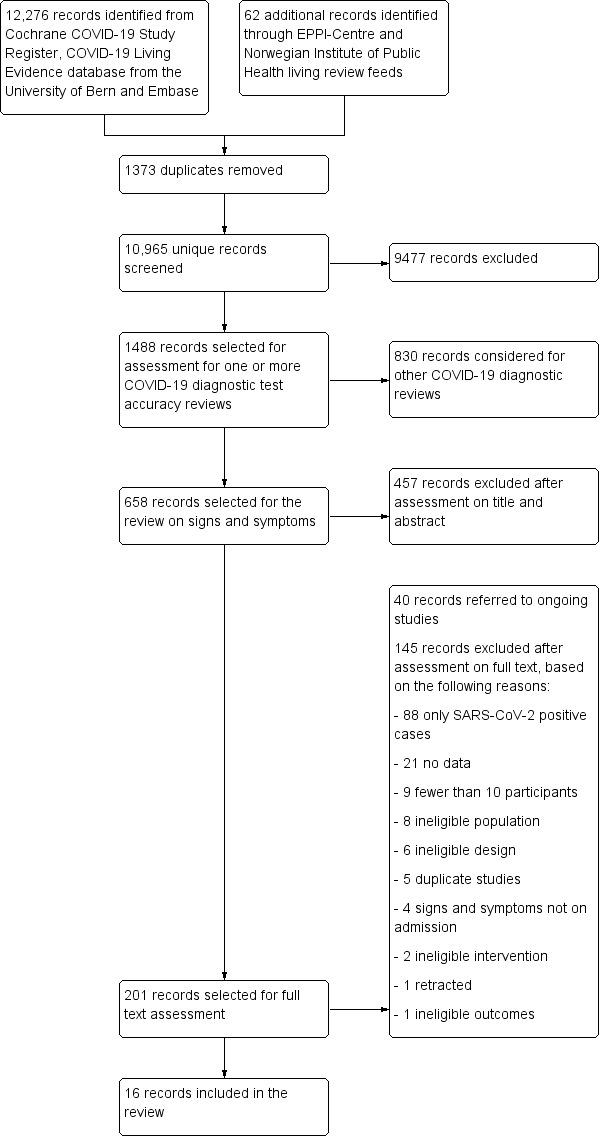
On 27 April 2020, we undertook electronic searches in the Cochrane COVID-19 Study Register and the University of Bern living search database, which is updated daily with published articles from PubMed and Embase and with preprints from medRxiv and bioRxiv. In addition, we checked repositories of COVID-19 publications. We did not apply any language restrictions.
SELECTION CRITERIA
Studies were eligible if they included patients with suspected COVID-19 disease, or if they recruited known cases with COVID-19 disease and controls without COVID-19. Studies were eligible when they recruited patients presenting to primary care or hospital outpatient settings. Studies including patients who contracted SARS-CoV-2 infection while admitted to hospital were not eligible. The minimum eligible sample size of studies was 10 participants. All signs and symptoms were eligible for this review, including individual signs and symptoms or combinations. We accepted a range of reference standards including reverse transcription polymerase chain reaction (RT-PCR), clinical expertise, imaging, serology tests and World Health Organization (WHO) or other definitions of COVID-19.
DATA COLLECTION AND ANALYSIS
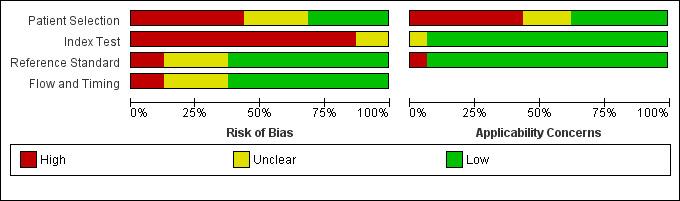
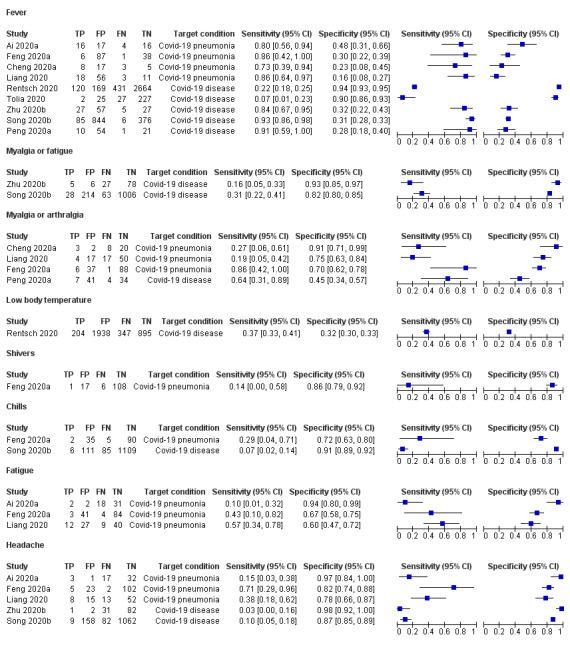
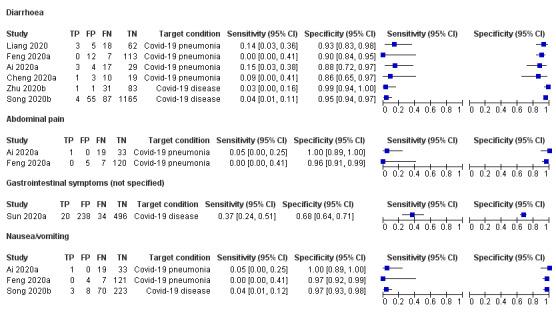
Pairs of review authors independently selected all studies, at both title and abstract stage and full-text stage. They resolved any disagreements by discussion with a third review author. Two review authors independently extracted data and resolved disagreements by discussion with a third review author. Two review authors independently assessed risk of bias using the QUADAS-2 checklist. Analyses were descriptive, presenting sensitivity and specificity in paired forest plots, in ROC (receiver operating characteristic) space and in dumbbell plots. We did not attempt meta-analysis due to the small number of studies, heterogeneity across studies and the high risk of bias.
MAIN RESULTS
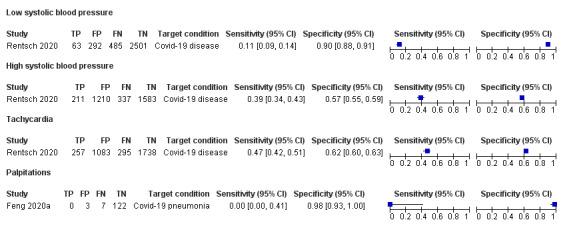
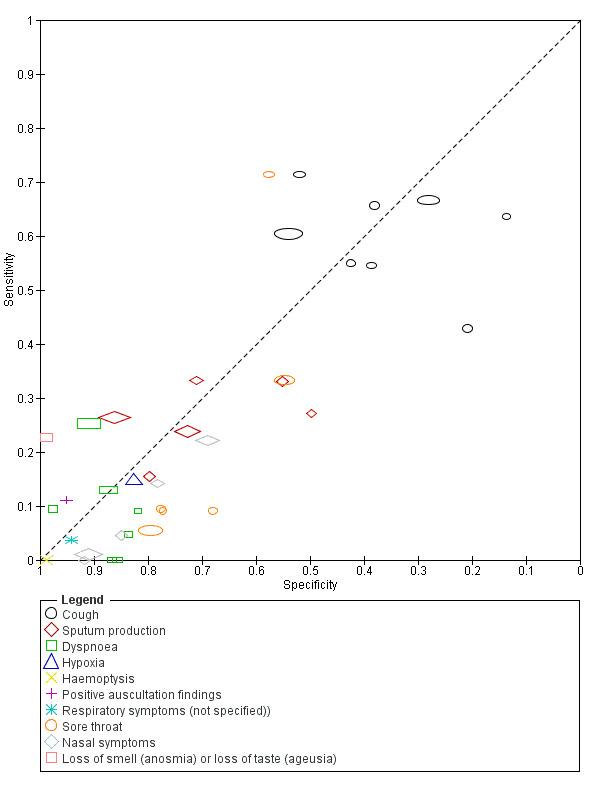
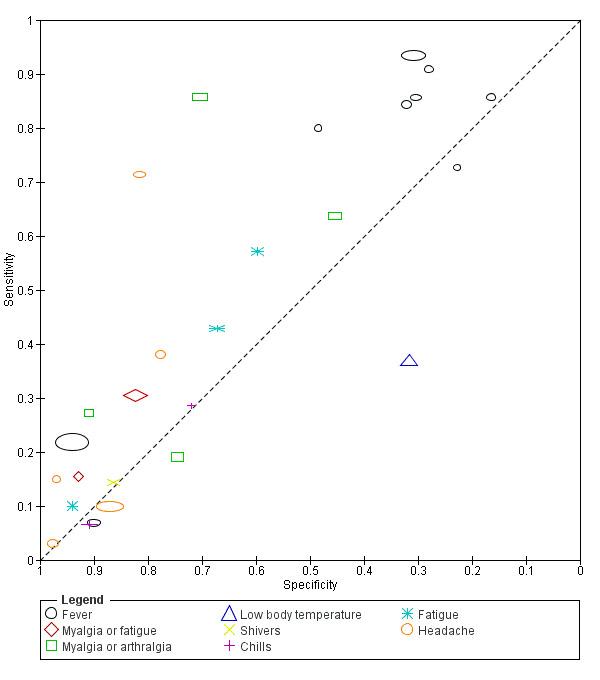
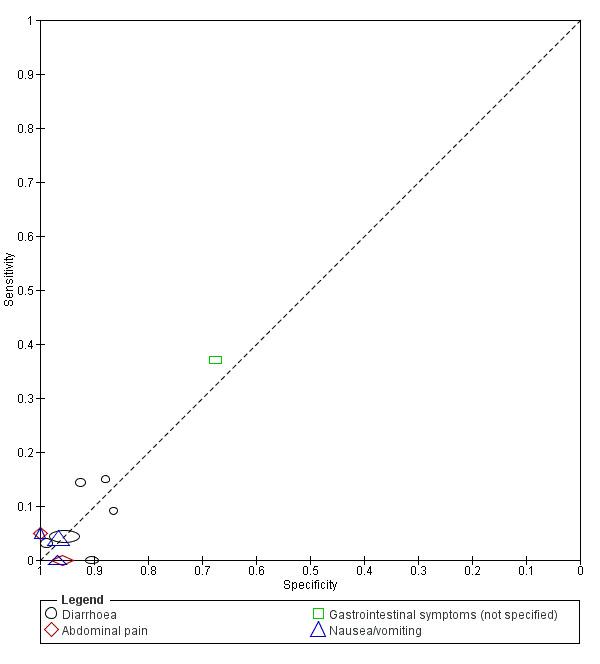
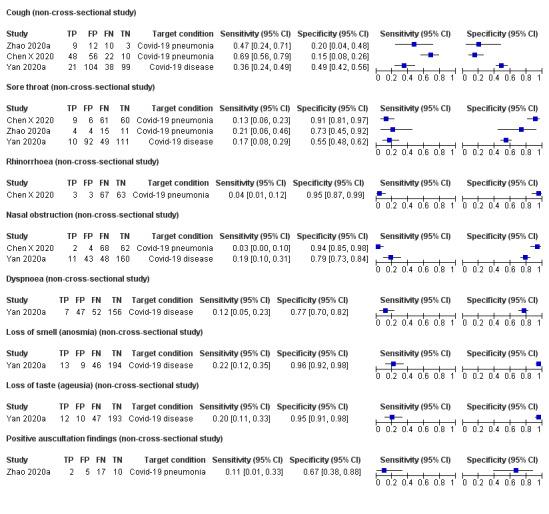
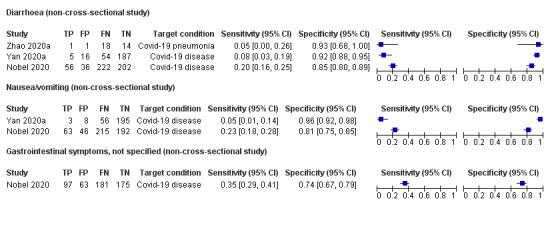
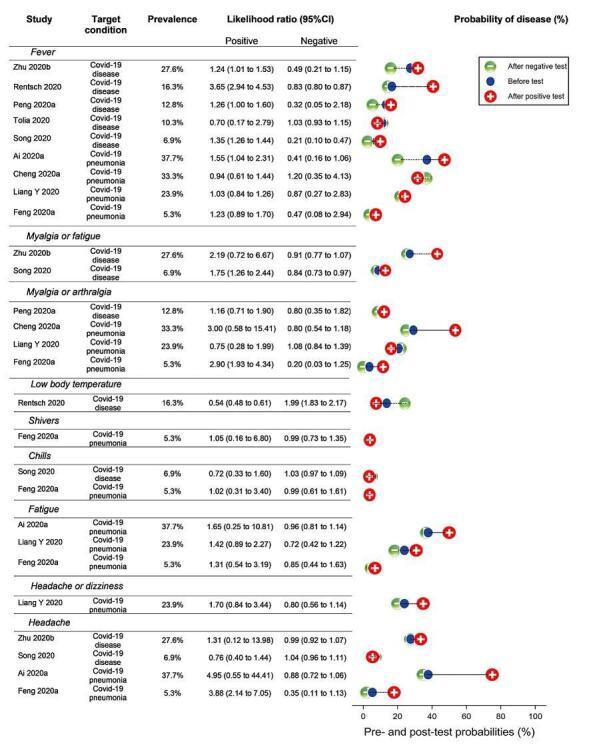
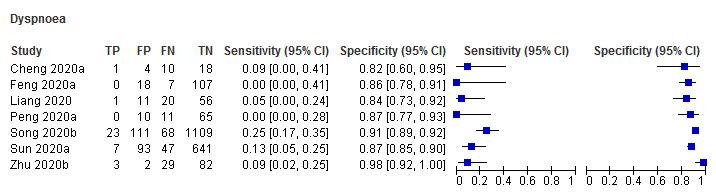
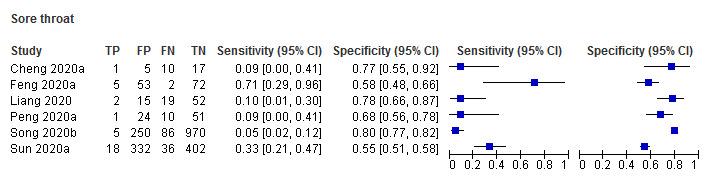
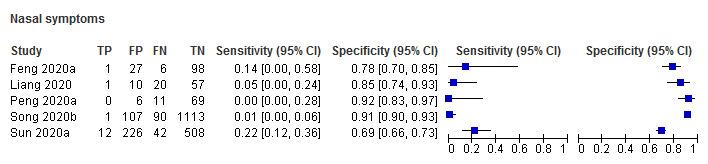
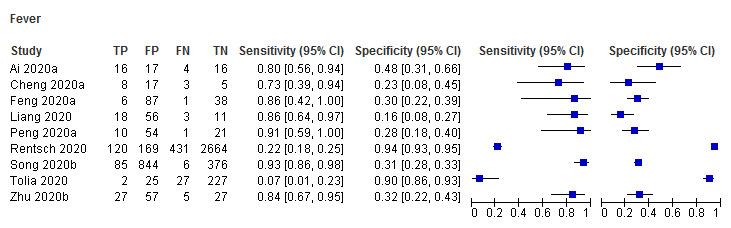
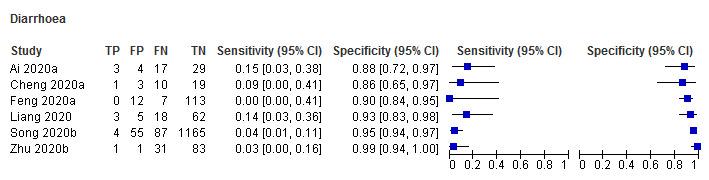
We identified 16 studies including 7706 participants in total. Prevalence of COVID-19 disease varied from 5% to 38% with a median of 17%. There were no studies from primary care settings, although we did find seven studies in outpatient clinics (2172 participants), and four studies in the emergency department (1401 participants). We found data on 27 signs and symptoms, which fall into four different categories: systemic, respiratory, gastrointestinal and cardiovascular. No studies assessed combinations of different signs and symptoms and results were highly variable across studies. Most had very low sensitivity and high specificity; only six symptoms had a sensitivity of at least 50% in at least one study: cough, sore throat, fever, myalgia or arthralgia, fatigue, and headache. Of these, fever, myalgia or arthralgia, fatigue, and headache could be considered red flags (defined as having a positive likelihood ratio of at least 5) for COVID-19 as their specificity was above 90%, meaning that they substantially increase the likelihood of COVID-19 disease when present. Seven studies carried a high risk of bias for selection of participants because inclusion in the studies depended on the applicable testing and referral protocols, which included many of the signs and symptoms under study in this review. Five studies only included participants with pneumonia on imaging, suggesting that this is a highly selected population. In an additional four studies, we were unable to assess the risk for selection bias. These factors make it very difficult to determine the diagnostic properties of these signs and symptoms from the included studies. We also had concerns about the applicability of these results, since most studies included participants who were already admitted to hospital or presenting to hospital settings. This makes these findings less applicable to people presenting to primary care, who may have less severe illness and a lower prevalence of COVID-19 disease. None of the studies included any data on children, and only one focused specifically on older adults. We hope that future updates of this review will be able to provide more information about the diagnostic properties of signs and symptoms in different settings and age groups.
AUTHORS' CONCLUSIONS: The individual signs and symptoms included in this review appear to have very poor diagnostic properties, although this should be interpreted in the context of selection bias and heterogeneity between studies. Based on currently available data, neither absence nor presence of signs or symptoms are accurate enough to rule in or rule out disease. Prospective studies in an unselected population presenting to primary care or hospital outpatient settings, examining combinations of signs and symptoms to evaluate the syndromic presentation of COVID-19 disease, are urgently needed. Results from such studies could inform subsequent management decisions such as self-isolation or selecting patients for further diagnostic testing. We also need data on potentially more specific symptoms such as loss of sense of smell. Studies in older adults are especially important.
背景
一些感染严重急性呼吸综合征冠状病毒2(SARS-CoV-2)的人没有症状,而在另一些人中,感染可导致轻度至中度的冠状病毒病2019(COVID-19)和COVID-19肺炎,导致一些患者需要重症监护支持,在某些情况下还会导致死亡,尤其是在老年人中。发热或咳嗽等症状,以及血氧饱和度或肺部听诊结果等体征,是首要且最容易获得的诊断信息。这些信息可用于排除COVID-19疾病,或选择患者进行进一步的诊断检测。
目的
评估体征和症状的诊断准确性,以确定在基层医疗或医院门诊环境(如急诊科或专门的COVID-19诊所)就诊的人是否患有COVID-19疾病或COVID-19肺炎。
检索方法
2020年4月27日,我们在Cochrane COVID-19研究注册库和伯尔尼大学实时搜索数据库中进行了电子检索,该数据库每天更新来自PubMed和Embase的已发表文章以及来自medRxiv和bioRxiv的预印本。此外,我们还检查了COVID-19出版物的存储库。我们没有设置任何语言限制。
入选标准
如果研究纳入了疑似COVID-19疾病的患者,或者招募了已知的COVID-19疾病病例和无COVID-19的对照,则该研究符合入选标准。当研究招募在基层医疗或医院门诊环境就诊的患者时,该研究符合入选标准。纳入住院期间感染SARS-CoV-2的患者的研究不符合入选标准。研究的最小合格样本量为10名参与者。所有体征和症状均符合本综述的要求,包括单个体征和症状或组合。我们接受了一系列参考标准,包括逆转录聚合酶链反应(RT-PCR)、临床专业知识、影像学、血清学检测以及世界卫生组织(WHO)对COVID-19的定义或其他定义。
数据收集与分析
两位综述作者在标题和摘要阶段以及全文阶段独立筛选所有研究。他们通过与第三位综述作者讨论解决任何分歧。两位综述作者独立提取数据,并通过与第三位综述作者讨论解决分歧。两位综述作者使用QUADAS-2清单独立评估偏倚风险。分析采用描述性方法,在配对森林图、ROC(受试者工作特征)空间和哑铃图中呈现敏感性和特异性。由于研究数量少、研究间存在异质性以及偏倚风险高,我们未尝试进行Meta分析。
主要结果
我们共识别出16项研究,总计7706名参与者。COVID-19疾病的患病率从5%到38%不等,中位数为17%。没有来自基层医疗环境的研究,不过我们确实在门诊诊所发现了7项研究(2172名参与者),在急诊科发现了4项研究(1401名参与者)。我们获取了关于27种体征和症状的数据,这些体征和症状可分为四类:全身症状、呼吸道症状、胃肠道症状和心血管症状。没有研究评估不同体征和症状的组合,且各研究结果差异很大。大多数症状敏感性非常低但特异性高;在至少一项研究中,只有六种症状的敏感性至少为50%:咳嗽、咽痛、发热、肌痛或关节痛、疲劳和头痛。其中发热、肌痛或关节痛、疲劳和头痛可被视为COVID-19的警示信号(定义为阳性似然比至少为5),因为它们特异性高于90%,这意味着当这些症状出现时,COVID-19疾病的可能性会大幅增加。7项研究在参与者选择方面存在高偏倚风险,因为纳入研究取决于适用的检测和转诊方案,其中包括本综述中研究的许多体征和症状。5项研究仅纳入了影像学显示有肺炎的参与者,这表明这是一个高度选择性的人群。在另外4项研究中,我们无法评估选择偏倚风险。这些因素使得很难从纳入的研究中确定这些体征和症状的诊断特性。我们还对这些结果的适用性表示担忧,因为大多数研究纳入的是已经住院或到医院就诊的参与者。这使得这些发现不太适用于到基层医疗就诊的人群,他们可能病情较轻且COVID-19疾病患病率较低。没有研究纳入任何关于儿童的数据,只有一项研究专门关注老年人。我们希望本综述的未来更新能够提供更多关于不同环境和年龄组体征和症状诊断特性的信息。
作者结论
本综述中纳入的个体体征和症状似乎诊断特性很差,不过这应结合研究间的选择偏倚和异质性来解读。基于现有数据,体征或症状的有无都不足以准确确诊或排除疾病。迫切需要对到基层医疗或医院门诊就诊的未选择人群进行前瞻性研究,检查体征和症状的组合以评估COVID-19疾病的综合征表现。此类研究结果可为后续管理决策提供依据,如自我隔离或选择患者进行进一步诊断检测。我们还需要关于潜在更具特异性症状的数据,如嗅觉丧失。针对老年人的研究尤为重要。



















 Zotero 插件