
嵌合抗原受体信号传导:功能后果及设计意义
Chimeric antigen receptor signaling: Functional consequences and design implications.
作者信息
Lindner S E, Johnson S M, Brown C E, Wang L D
机构信息
Department of Immuno-Oncology, Beckham Research Institute, City of Hope National Medical Center, Duarte, CA, USA.
Department of Hematology and Hematopoietic Cell Transplantation, Beckham Research Institute, City of Hope National Medical Center, Duarte, CA, USA.
出版信息
Sci Adv. 2020 May 20;6(21):eaaz3223. doi: 10.1126/sciadv.aaz3223. eCollection 2020 May.
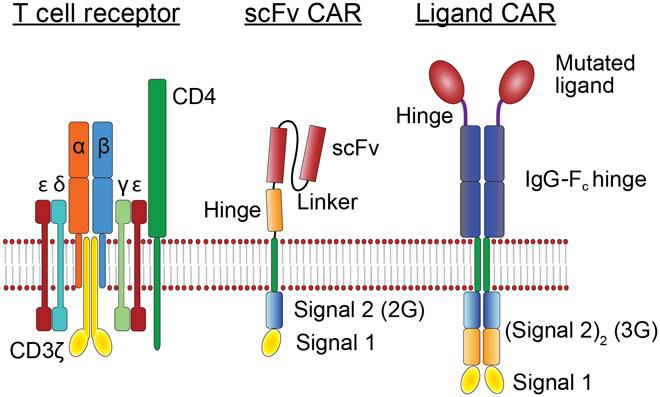
Chimeric antigen receptor (CAR) T cell therapy has transformed the care of refractory B cell malignancies and holds tremendous promise for many aggressive tumors. Despite overwhelming scientific, clinical, and public interest in this rapidly expanding field, fundamental inquiries into CAR T cell mechanistic functioning are still in their infancy. Because CAR T cells are manufactured from donor T lymphocytes, and because CARs incorporate well-characterized T cell signaling components, it has largely been assumed that CARs signal analogously to canonical T cell receptors (TCRs). However, recent studies demonstrate that many aspects of CAR signaling are unique, distinct from endogenous TCR signaling, and potentially even distinct among various CAR constructs. Thus, rigorous and comprehensive proteomic investigations are required for rational engineering of improved CARs. Here, we review what is known about proximal CAR signaling in T cells, compare it to conventional TCR signaling, and outline unmet challenges to improving CAR T cell therapy.
嵌合抗原受体(CAR)T细胞疗法已经改变了难治性B细胞恶性肿瘤的治疗方式,并为许多侵袭性肿瘤带来了巨大希望。尽管科学界、临床界和公众对这个迅速发展的领域有着浓厚的兴趣,但对CAR T细胞机制功能的基本探究仍处于起步阶段。由于CAR T细胞是由供体T淋巴细胞制造的,并且由于CAR包含了特征明确的T细胞信号成分,人们很大程度上认为CAR的信号传导与经典T细胞受体(TCR)类似。然而,最近的研究表明,CAR信号传导的许多方面是独特的,不同于内源性TCR信号传导,甚至在各种CAR构建体之间也可能有所不同。因此,需要进行严格而全面的蛋白质组学研究,以合理设计出改进的CAR。在这里,我们回顾了关于T细胞中近端CAR信号传导的已知情况,将其与传统TCR信号传导进行比较,并概述了改善CAR T细胞疗法尚未解决的挑战。


 Zotero 插件