
肺腺癌关键基因、关键微小RNA和关键转录因子的鉴定
Identification key genes, key miRNAs and key transcription factors of lung adenocarcinoma.
作者信息
Li Jinghang, Li Zhi, Zhao Sheng, Song Yuanyuan, Si Linjie, Wang Xiaowei
机构信息
Department of Cardiovascular Surgery, The First Affiliated Hospital of Nanjing Medical University, Nanjing 210029, China.
出版信息
J Thorac Dis. 2020 May;12(5):1917-1933. doi: 10.21037/jtd-19-4168.
BACKGROUND
Lung adenocarcinoma (LUAD) is one of the most common cancers worldwide. The etiology and pathophysiology of LUAD remain unclear. The aim of the present study was to identify the key genes, miRNAs and transcription factors (TFs) associated with the pathogenesis and prognosis of LUAD.
METHODS
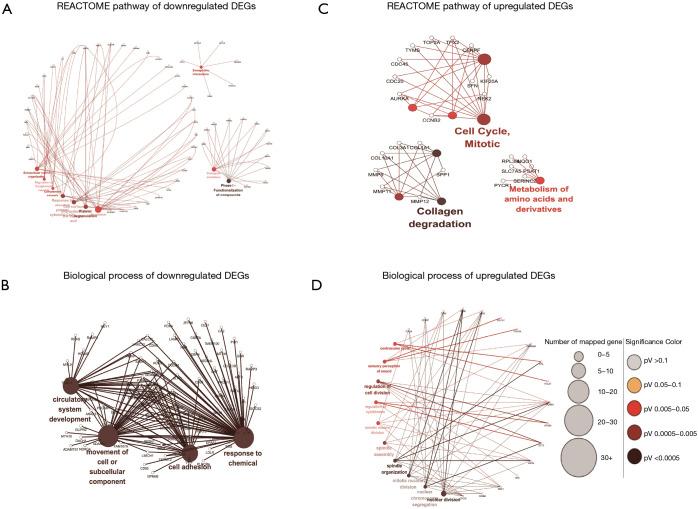
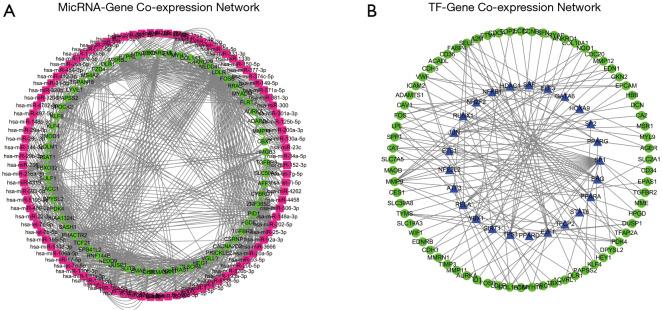
Three gene expression profiles (GSE43458, GSE32863, GSE74706) of LUAD were obtained from the Gene Expression Omnibus (GEO) database. Differentially expressed genes (DEGs) were identified by GEO2R.The Gene Ontology (GO) terms, pathways, and protein-protein interactions (PPIs) of these DEGs were analyzed. Bases on DEGs, the miRNAs and TFs were predicted. Furthermore, TF-gene-miRNA co-expression network was constructed to identify key genes, miRNAs and TFs by bioinformatic methods. The expressions and prognostic values of key genes, miRNAs and TFs were carried out through The Cancer Genome Atlas (TCGA) database and Kaplan Meier-plotter (KM) online dataset.
RESULTS
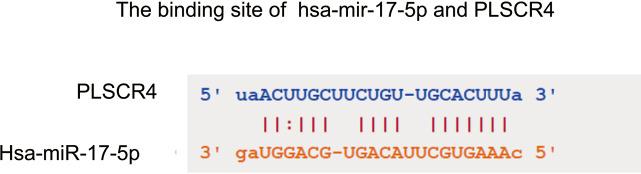
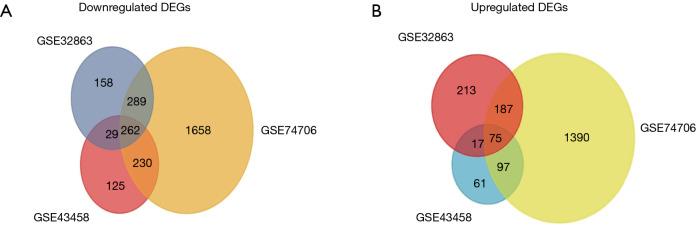
A total of 337 overlapped DEGs (75 upregulated and 262 downregulated) of LUAD were identified from the three GSE datasets. Moreover, 851 miRNAs and 29 TFs were identified to be associated with these DEGs. In total, 10 hub genes, 10 key miRNAs and 10 key TFs were located in the central hub of the TF-gene-miRNA co-expression network, and validated using The Cancer Genome Atlas (TCGA) database. Specifically, seven genes (), two miRNAs (hsa-let-7e-5p, hsa-miR-17-5p) and four TFs (STAT6, E2F1, ETS1, JUN) were identified to be associated with prognosis of LUAD, which have significantly different expressions between LUAD and normal lung tissue. Additionally, the miRNA/gene co-expression analysis also revealed that hsa-miR-17-5p and PLSCR4 have a significant negative co-expression relationship (r=-0.33, P=1.67e-14) in LUAD.
CONCLUSIONS
Our study constructed a regulatory network of TF-gene-miRNA in LUAD, which may provide new insights about the interaction between genes, miRNAs and TFs in the pathogenesis of LUAD, and identify potential biomarkers or therapeutic targets for LUAD.
背景
肺腺癌(LUAD)是全球最常见的癌症之一。LUAD的病因和病理生理学仍不清楚。本研究的目的是确定与LUAD发病机制和预后相关的关键基因、miRNA和转录因子(TFs)。
方法
从基因表达综合数据库(GEO)中获取三个LUAD的基因表达谱(GSE43458、GSE32863、GSE74706)。通过GEO2R鉴定差异表达基因(DEGs)。对这些DEGs的基因本体(GO)术语、通路和蛋白质-蛋白质相互作用(PPI)进行分析。基于DEGs预测miRNA和TFs。此外,构建TF-基因-miRNA共表达网络,通过生物信息学方法鉴定关键基因、miRNA和TFs。通过癌症基因组图谱(TCGA)数据库和Kaplan Meier绘图仪(KM)在线数据集分析关键基因、miRNA和TFs的表达及预后价值。
结果
从三个GSE数据集中鉴定出总共337个LUAD的重叠DEGs(75个上调和262个下调)。此外,鉴定出851个miRNA和29个TFs与这些DEGs相关。总共10个枢纽基因、10个关键miRNA和10个关键TFs位于TF-基因-miRNA共表达网络的中心枢纽,并使用癌症基因组图谱(TCGA)数据库进行了验证。具体而言,七个基因()、两个miRNA(hsa-let-7e-5p、hsa-miR-17-5p)和四个TFs(STAT6、E2F1、ETS1、JUN)被鉴定与LUAD的预后相关,它们在LUAD和正常肺组织之间具有显著不同的表达。此外,miRNA/基因共表达分析还显示,在LUAD中hsa-miR-17-5p和PLSCR4具有显著的负共表达关系(r = -0.33,P = 1.67e-14)。
结论
我们的研究构建了LUAD中TF-基因-miRNA的调控网络,这可能为LUAD发病机制中基因、miRNA和TFs之间的相互作用提供新的见解,并鉴定出LUAD的潜在生物标志物或治疗靶点。



 Zotero 插件