
基于计划行为理论和规范激活模型的农村户垃圾分类意愿研究——来自中国关中盆地的证据。
Investigating Rural Domestic Waste Sorting Intentions Based on an Integrative Framework of Planned Behavior Theory and Normative Activation Models: Evidence from Guanzhong Basin, China.
机构信息
College of Economics and Management, Northwest A&F University, 3 Taicheng Road, Yangling 712100, China.
出版信息
Int J Environ Res Public Health. 2020 Jul 7;17(13):4887. doi: 10.3390/ijerph17134887.
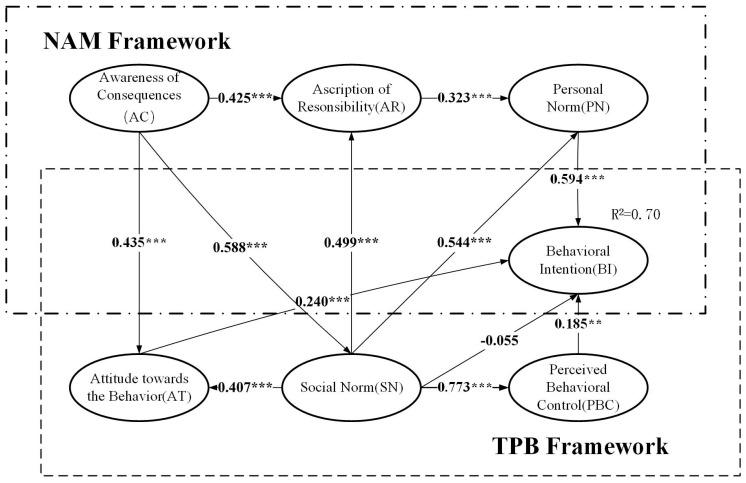
The sorting of domestic waste is the most effective way to alleviate the problem of mass garbage accumulation around the villages of rural China. Farmers are the creators of rural domestic waste as well as the direct beneficiaries of effective waste management. However, few studies have been conducted on the psychological determinants of farmers' intentions to sort domestic waste. This paper applies planned behavior theory (TPB) and normative activation theory (NAM), to analyze the domestic waste sorting intentions of rural residents in Guanzhong, China. Based on the micro-data of 327 rural households in Guanzhong, structural equation models of the factors influencing farmers' domestic waste sorting intentions were estimated. The results demonstrate the following. (1) Farmers' attitudes, perceived behavioral control, and personal norms have significant positive direct impacts on their domestic waste sorting intentions, with personal norms having the greatest direct impact. (2) Subjective norms have no direct impact on farmers' domestic waste sorting intentions but do have an indirect impact on them through personal norms, behavioral attitudes, and perceived behavior control. This article increases scholarly understanding of the psychosocial determinants of the environmentally friendly behavioral intention to sort domestic waste. The study also provides academic and theoretical support to policy makers in implementing relevant policy recommendations.
农村生活垃圾围村问题最有效的解决方式是进行垃圾分类,农民既是农村生活垃圾的产生者,也是农村生活垃圾分类管理的直接受益者。但是,目前很少有研究关注农民进行垃圾分类意愿的心理决定因素。本文运用计划行为理论(TPB)和规范性激活理论(NAM),对中国关中地区农村居民的垃圾分类意愿进行分析。基于关中 327 户农村家庭的微观数据,对影响农民垃圾分类意愿的因素进行了结构方程模型估计。结果表明:(1)农民的态度、感知行为控制和个人规范对其垃圾分类意愿有显著的正向直接影响,其中个人规范的直接影响最大;(2)主观规范对农民的垃圾分类意愿没有直接影响,但通过个人规范、行为态度和感知行为控制对其有间接影响。本文增加了对分类垃圾这一环保行为意图的社会心理决定因素的学术理解,也为政策制定者实施相关政策建议提供了学术和理论支持。

 Zotero 插件