
睡眠时间与健康成年人的白质微观结构和认知表现相关。
Sleep duration is associated with white matter microstructure and cognitive performance in healthy adults.
作者信息
Grumbach Pascal, Opel Nils, Martin Stella, Meinert Susanne, Leehr Elisabeth J, Redlich Ronny, Enneking Verena, Goltermann Janik, Baune Bernhard T, Dannlowski Udo, Repple Jonathan
机构信息
Department of Psychiatry, University of Münster, Münster, Germany.
Department of Economics, University of Münster, Münster, Germany.
出版信息
Hum Brain Mapp. 2020 Oct 15;41(15):4397-4405. doi: 10.1002/hbm.25132. Epub 2020 Jul 10.
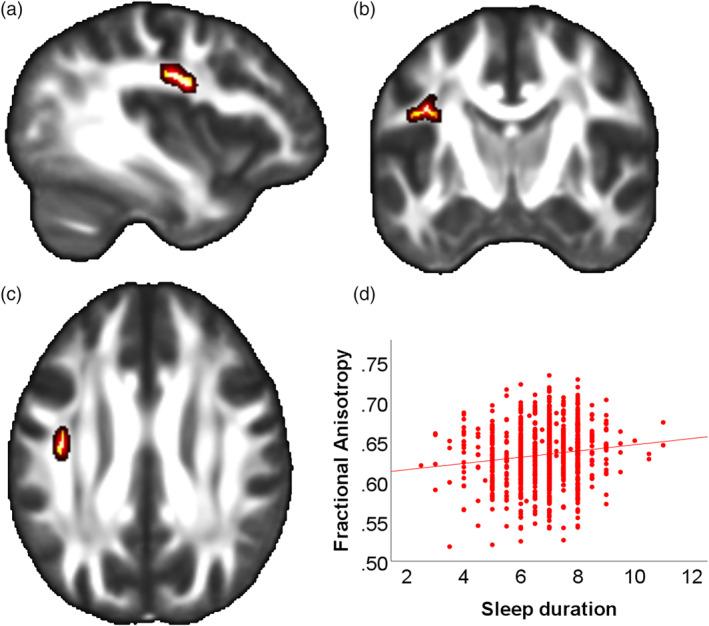
Reduced sleep duration and sleep deprivation have been associated with cognitive impairment as well as decreased white matter integrity as reported by experimental studies. However, it is largely unknown whether differences in sleep duration and sleep quality might affect microstructural white matter and cognition. Therefore, the present study aims to examine the cross-sectional relationship between sleep duration, sleep quality, and cognitive performance in a naturalistic study design, by focusing on the association with white matter integrity in a large sample of healthy, young adults. To address this, 1,065 participants, taken from the publicly available sample of the Human Connectome Project, underwent diffusion tensor imaging. Moreover, broad cognitive performance measures (NIH Cognition Toolbox) and sleep duration and quality (Pittsburgh Sleep Quality Index) were assessed. The results revealed a significant positive association between sleep duration and overall cognitive performance. Shorter sleep duration significantly correlated with fractional anisotropy (FA) reductions in the left superior longitudinal fasciculus (SLF). In turn, FA in this tract was related to measures of cognitive performance and was shown to significantly mediate the association of sleep duration and cognition. For cognition only, associations shift to a negative association of sleep duration and cognition for participants sleeping more than 8 hr a day. Investigations into subjective sleep quality showed no such associations. The present study showed that real-world differences in sleep duration, but not subjective sleep quality are related to cognitive performance measures and white matter integrity in the SLF in healthy, young adults.
实验研究表明,睡眠时间缩短和睡眠剥夺与认知障碍以及白质完整性降低有关。然而,睡眠时间和睡眠质量的差异是否会影响白质微观结构和认知,在很大程度上尚不清楚。因此,本研究旨在通过关注健康年轻成年人的大样本中睡眠时间、睡眠质量与白质完整性之间的关联,在自然主义研究设计中检验它们之间的横断面关系。为了解决这个问题,从人类连接体项目的公开样本中选取了1065名参与者,进行了扩散张量成像。此外,还评估了广泛的认知表现指标(美国国立卫生研究院认知工具箱)以及睡眠时间和质量(匹兹堡睡眠质量指数)。结果显示,睡眠时间与整体认知表现之间存在显著的正相关。较短的睡眠时间与左侧上纵束(SLF)的各向异性分数(FA)降低显著相关。反过来,该束中的FA与认知表现指标相关,并被证明显著介导了睡眠时间与认知之间的关联。仅就认知而言,对于每天睡眠超过8小时的参与者,睡眠时间与认知之间的关联转变为负相关。对主观睡眠质量的调查未发现此类关联。本研究表明,在健康年轻成年人中,现实世界中睡眠时间的差异而非主观睡眠质量与认知表现指标以及SLF中的白质完整性有关。
 Zotero 插件