
大规模评估抗菌药物耐药性标记数据库以进行遗传表型预测:系统评价。
Large-scale assessment of antimicrobial resistance marker databases for genetic phenotype prediction: a systematic review.
机构信息
Ares Genetics GmbH, Karl-Farkas-Gasse 18, Vienna 1030, Austria.
Center for Integrative Bioinformatics Vienna, Max Perutz Laboratories, University of Vienna and Medical University of Vienna, Vienna 1030, Austria.
出版信息
J Antimicrob Chemother. 2020 Nov 1;75(11):3099-3108. doi: 10.1093/jac/dkaa257.
BACKGROUND
Antimicrobial resistance (AMR) is a rising health threat with 10 million annual casualties estimated by 2050. Appropriate treatment of infectious diseases with the right antibiotics reduces the spread of antibiotic resistance. Today, clinical practice relies on molecular and PCR techniques for pathogen identification and culture-based antibiotic susceptibility testing (AST). Recently, WGS has started to transform clinical microbiology, enabling prediction of resistance phenotypes from genotypes and allowing for more informed treatment decisions. WGS-based AST (WGS-AST) depends on the detection of AMR markers in sequenced isolates and therefore requires AMR reference databases. The completeness and quality of these databases are material to increase WGS-AST performance.
METHODS
We present a systematic evaluation of the performance of publicly available AMR marker databases for resistance prediction on clinical isolates. We used the public databases CARD and ResFinder with a final dataset of 2587 isolates across five clinically relevant pathogens from PATRIC and NDARO, public repositories of antibiotic-resistant bacterial isolates.
RESULTS
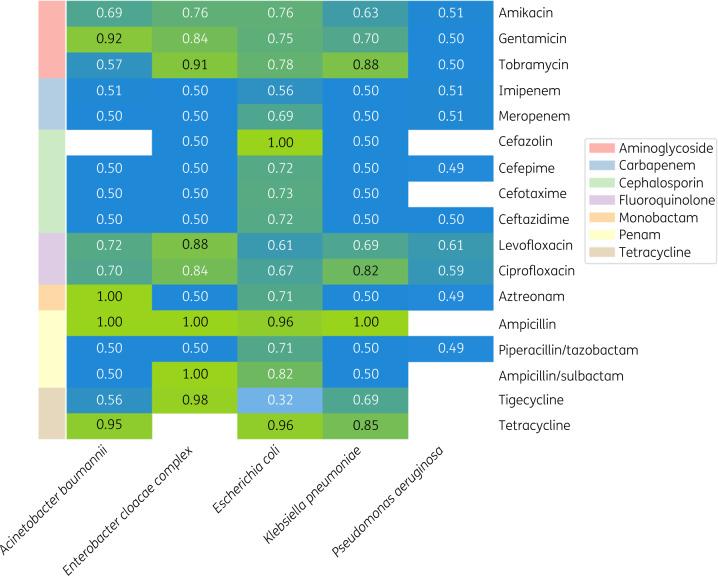
CARD and ResFinder WGS-AST performance had an overall balanced accuracy of 0.52 (±0.12) and 0.66 (±0.18), respectively. Major error rates were higher in CARD (42.68%) than ResFinder (25.06%). However, CARD showed almost no very major errors (1.17%) compared with ResFinder (4.42%).
CONCLUSIONS
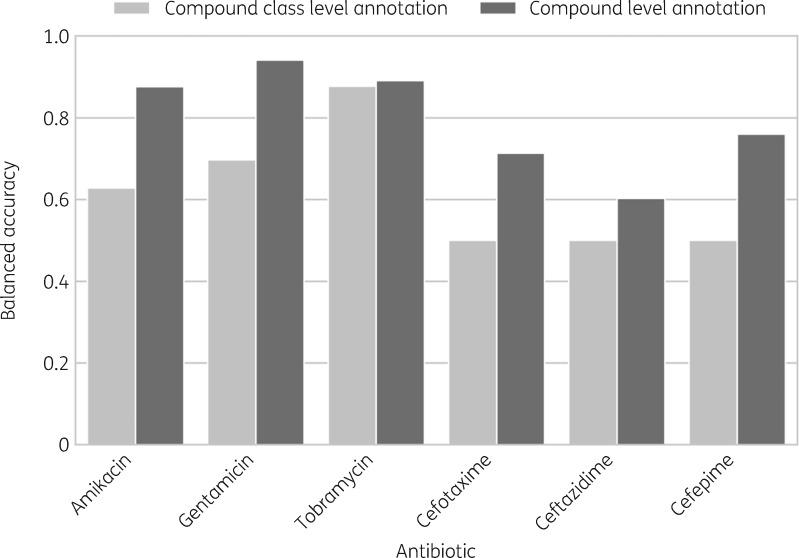
We show that AMR databases need further expansion, improved marker annotations per antibiotic rather than per antibiotic class and validated multivariate marker panels to achieve clinical utility, e.g. in order to meet performance requirements such as provided by the FDA for clinical microbiology diagnostic testing.
背景
抗菌药物耐药性(AMR)是一个日益严重的健康威胁,据估计到 2050 年每年将有 1000 万人因此丧生。适当使用合适的抗生素治疗传染病可以减少抗生素耐药性的传播。目前,临床实践依赖于分子和 PCR 技术进行病原体鉴定和基于培养的抗生素药敏试验(AST)。最近,WGS 开始改变临床微生物学,能够从基因型预测耐药表型,并允许做出更明智的治疗决策。基于 WGS 的 AST(WGS-AST)取决于在测序分离物中检测 AMR 标记,因此需要 AMR 参考数据库。这些数据库的完整性和质量对于提高 WGS-AST 性能至关重要。
方法
我们系统地评估了公开可用的 AMR 标记数据库在预测临床分离物耐药性方面的性能。我们使用了公共数据库 CARD 和 ResFinder,并使用了来自 PATRIC 和 NDARO 的五个临床相关病原体的 2587 个分离物的最终数据集,这两个数据库是抗生素耐药细菌分离物的公共存储库。
结果
CARD 和 ResFinder 的 WGS-AST 性能整体平衡准确性分别为 0.52(±0.12)和 0.66(±0.18)。CARD 的主要错误率(42.68%)高于 ResFinder(25.06%)。然而,CARD 的非常大错误率(1.17%)几乎为零,而 ResFinder 的非常大错误率为 4.42%。
结论
我们表明,AMR 数据库需要进一步扩展,每个抗生素而不是每个抗生素类别都需要改进标记注释,并验证多变量标记面板以实现临床实用性,例如为了满足 FDA 等机构为临床微生物学诊断测试提供的性能要求。


 Zotero 插件