
新冠疫情相关焦虑症状与中国成年人智能手机使用问题严重程度相关。
COVID-19 anxiety symptoms associated with problematic smartphone use severity in Chinese adults.
机构信息
Academy of Psychology and Behavior, Tianjin Normal University, No. 57-1 Wujiayao Street, Hexi District, Tianjin 300074, China; Department of Psychology, University of Toledo, 2801 West Bancroft Street, Toledo, OH 43606, USA; Department of Psychiatry, University of Toledo, 3000 Arlington Avenue, Toledo, OH 43614, USA.
Academy of Psychology and Behavior, Tianjin Normal University, No. 57-1 Wujiayao Street, Hexi District, Tianjin 300074, China.
出版信息
J Affect Disord. 2020 Sep 1;274:576-582. doi: 10.1016/j.jad.2020.05.080. Epub 2020 May 27.
BACKGROUND
COVID-19 is fast-spreading and potentially fatal, introducing home quarantine, social distancing, and increased internet usage globally. We investigated COVID-19 anxiety, general anxiety and depression symptoms, and their impact on problematic smartphone use (PSU) severity METHODS: Participants were 908 residents of a large Eastern Chinese city, surveyed from late-February to mid-March, 2020. We administered online measures including the Depression Anxiety Stress Scale-21, Smartphone Addiction Scale-Short Version, and items querying COVID-19-related news exposure and threat of death. Additionally, participants rated anxiety using the Generalized Anxiety Disorder Scale-7 with reference to COVID-19.
RESULTS
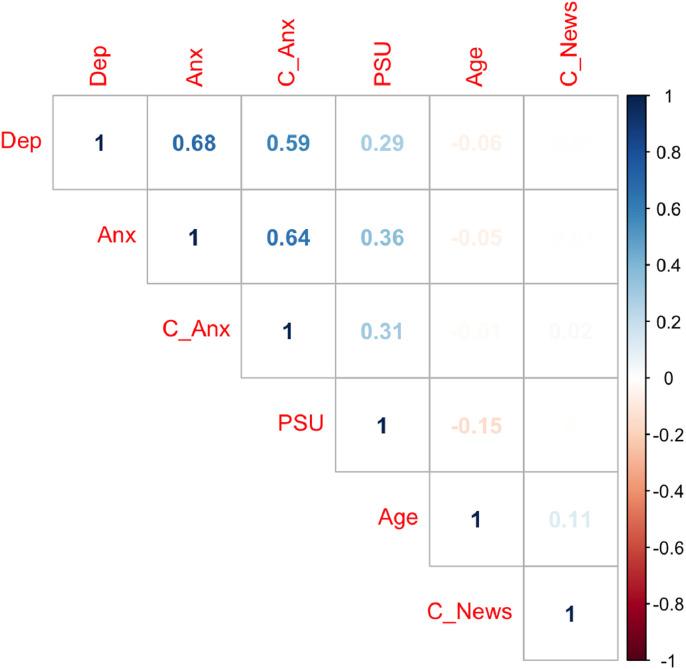
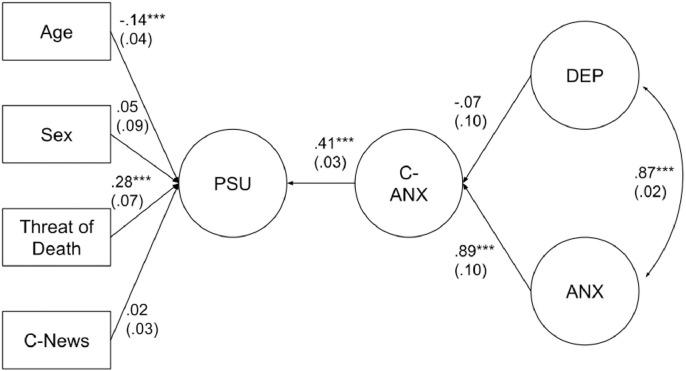
COVID-19 anxiety correlated with severity of PSU, depression and anxiety. Using established cut-off scores, 12% of participants were identified with at least moderate depression, and 24% with moderate anxiety. Using structural equation modeling, COVID-19 anxiety related to PSU severity, mediating relations between general anxiety and PSU severity. However, controlling PSU for general anxiety and depression severity, COVID-19 anxiety no longer predicted PSU severity.
LIMITATIONS
Limitations include the cross-sectional research design and reliance on data from only one country.
CONCLUSIONS
Results are discussed in context of the I-PACE model of excessive internet use. While COVID-19 anxiety is likely a global anxiety-provoking event, other everyday worries and anxiety are additionally clinically important in driving excessive internet use.
背景
COVID-19 传播迅速且可能致命,这导致了全球范围内的居家隔离、社交疏离和互联网使用的增加。我们研究了 COVID-19 焦虑、一般焦虑和抑郁症状,以及它们对智能手机使用问题(PSU)严重程度的影响。
方法
参与者是来自中国东部一个大城市的 908 名居民,他们在 2020 年 2 月下旬至 3 月中旬接受了在线调查。我们采用了包括抑郁焦虑压力量表 21 项、智能手机成瘾量表简短版以及询问与 COVID-19 相关的新闻曝光和死亡威胁的项目在内的在线测量方法。此外,参与者使用与 COVID-19 相关的一般焦虑障碍量表 7 项来评估焦虑程度。
结果
COVID-19 焦虑与 PSU 严重程度、抑郁和焦虑相关。使用既定的截断分数,12%的参与者被确定为至少有中度抑郁,24%的参与者有中度焦虑。使用结构方程模型,COVID-19 焦虑与 PSU 严重程度相关,调节了一般焦虑和 PSU 严重程度之间的关系。然而,在控制 PSU 对一般焦虑和抑郁严重程度的影响后,COVID-19 焦虑不再预测 PSU 严重程度。
局限性
研究的局限性包括横断面研究设计和仅依赖一个国家的数据。
结论
结果在过度互联网使用的 I-PACE 模型背景下进行了讨论。虽然 COVID-19 焦虑可能是一个全球性的焦虑诱发事件,但其他日常担忧和焦虑在驱动过度互联网使用方面也具有重要的临床意义。


 Zotero 插件