
人工智能和连续血糖监测传感器在糖尿病管理中的应用。
Advanced Diabetes Management Using Artificial Intelligence and Continuous Glucose Monitoring Sensors.
机构信息
Department of Information Engineering, University of Padova, 35131 Padova, Italy.
出版信息
Sensors (Basel). 2020 Jul 10;20(14):3870. doi: 10.3390/s20143870.
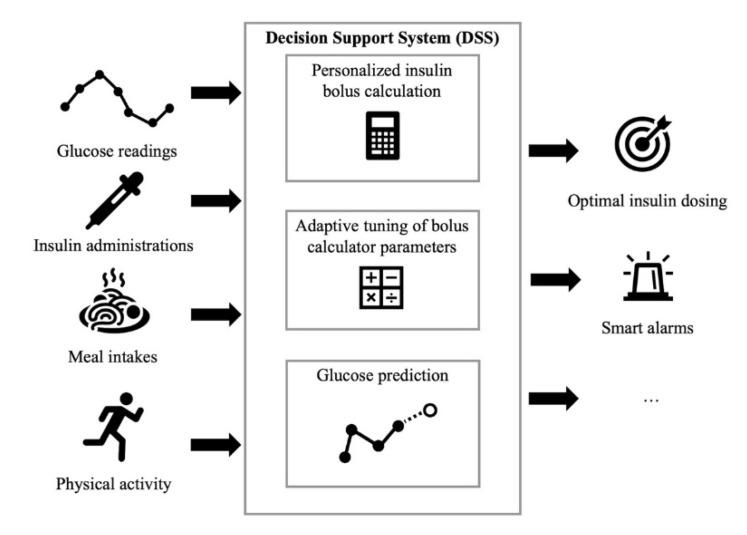
Wearable continuous glucose monitoring (CGM) sensors are revolutionizing the treatment of type 1 diabetes (T1D). These sensors provide in real-time, every 1-5 min, the current blood glucose concentration and its rate-of-change, two key pieces of information for improving the determination of exogenous insulin administration and the prediction of forthcoming adverse events, such as hypo-/hyper-glycemia. The current research in diabetes technology is putting considerable effort into developing decision support systems for patient use, which automatically analyze the patient's data collected by CGM sensors and other portable devices, as well as providing personalized recommendations about therapy adjustments to patients. Due to the large amount of data collected by patients with T1D and their variety, artificial intelligence (AI) techniques are increasingly being adopted in these decision support systems. In this paper, we review the state-of-the-art methodologies using AI and CGM sensors for decision support in advanced T1D management, including techniques for personalized insulin bolus calculation, adaptive tuning of bolus calculator parameters and glucose prediction.
可穿戴连续血糖监测 (CGM) 传感器正在彻底改变 1 型糖尿病 (T1D) 的治疗方式。这些传感器实时、每 1-5 分钟提供当前血糖浓度及其变化率,这是改善外源性胰岛素给药的确定和预测即将发生的不良事件(如低血糖/高血糖)的两个关键信息。当前的糖尿病技术研究正在投入大量精力开发供患者使用的决策支持系统,这些系统自动分析 CGM 传感器和其他便携式设备收集的患者数据,并为患者提供关于治疗调整的个性化建议。由于 T1D 患者收集的数据量很大且种类繁多,人工智能 (AI) 技术越来越多地被应用于这些决策支持系统中。在本文中,我们回顾了使用 AI 和 CGM 传感器进行高级 T1D 管理决策支持的最新方法,包括个性化胰岛素推注计算、推注计算器参数的自适应调整和血糖预测技术。



 Zotero 插件