
基于人群的研究中,2005 年前和后胶质母细胞瘤患者的长期(≥2 年)生存:系统评价和荟萃分析。
Longer-term (≥ 2 years) survival in patients with glioblastoma in population-based studies pre- and post-2005: a systematic review and meta-analysis.
机构信息
Usher Institute, University of Edinburgh, Edinburgh, UK.
Brain Tumour Centre of Excellence, Cancer Research UK Edinburgh Centre, University of Edinburgh, Edinburgh, UK.
出版信息
Sci Rep. 2020 Jul 15;10(1):11622. doi: 10.1038/s41598-020-68011-4.
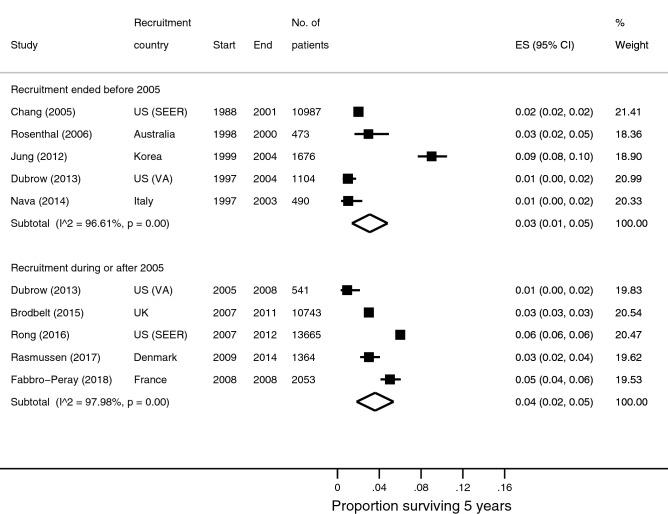
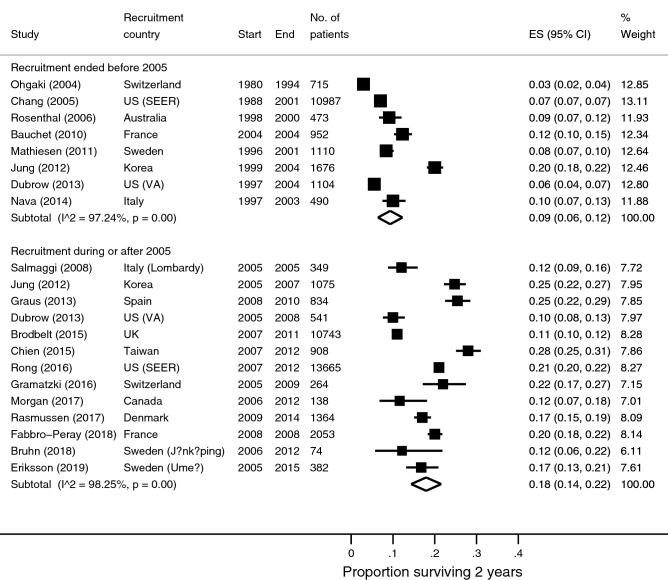
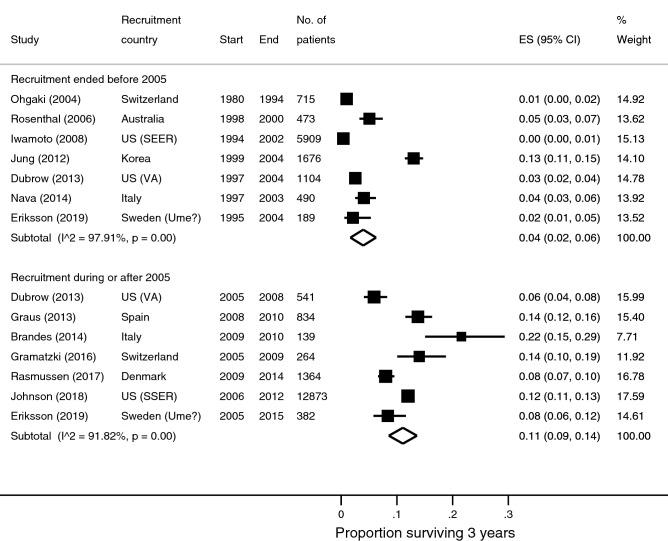
Translation of survival benefits observed in glioblastoma clinical trials to populations and to longer-term survival remains uncertain. We aimed to assess if ≥ 2-year survival has changed in relation to the trial of radiotherapy plus concomitant and adjuvant temozolomide published in 2005. We searched MEDLINE and Embase for population-based studies with ≥ 50 patients published after 2002 reporting survival at ≥ 2 years following glioblastoma diagnosis. Primary endpoints were survival at 2-, 3- and 5-years stratified by recruitment period. We meta-analysed survival estimates using a random effects model stratified according to whether recruitment ended before 2005 (earlier) or started during or after 2005 (later). PROSPERO registration number CRD42019130035. Twenty-three populations from 63 potentially eligible studies contributed to the meta-analyses. Pooled 2-year overall survival estimates for the earlier and later study periods were 9% (95% confidence interval [CI] 6-12%; n/N = 1,488/17,507) and 18% (95% CI 14-22%; n/N = 5,670/32,390), respectively. Similarly, pooled 3-year survival estimates increased from 4% (95% CI 2-6%; n/N = 325/10,556) to 11% (95% CI 9-14%; n/N = 1900/16,397). One study with a within-population comparison showed similar improvement in survival among the older population. Pooled 5-year survival estimates were 3% (95% CI 1-5%; n/N = 401/14,919) and 4% (95% CI 2-5%; n/N = 1,291/28,748) for the earlier and later periods, respectively. Meta-analyses of real-world data suggested a doubling of 2- and 3-year survival in glioblastoma patients since 2005. However, 5-year survival remains poor with no apparent improvement. Detailed clinically annotated population-based data and further molecular characterization of longer-term survivors may explain the unchanged survival beyond 5 years.
在胶质母细胞瘤临床试验中观察到的生存获益是否能转化为人群和更长期生存仍不确定。我们旨在评估 2005 年发表的放射治疗联合同期和辅助替莫唑胺临床试验后,≥2 年的生存是否发生了变化。我们检索了 MEDLINE 和 Embase 数据库,以获取 2002 年后发表的≥50 例患者的基于人群的研究,报告胶质母细胞瘤诊断后≥2 年的生存情况。主要终点是按招募期分层的 2 年、3 年和 5 年生存率。我们使用随机效应模型对生存估计值进行荟萃分析,根据招募是否在 2005 年前(早期)结束或在 2005 年期间或之后开始(晚期)进行分层。PROSPERO 注册号 CRD42019130035。来自 63 项潜在合格研究的 23 个人群为荟萃分析做出了贡献。早期和晚期研究期间的汇总 2 年总生存率估计值分别为 9%(95%置信区间 6-12%;n/N=1488/17507)和 18%(95%置信区间 14-22%;n/N=5670/32390)。同样,汇总的 3 年生存率估计值也从 4%(95%置信区间 2-6%;n/N=325/10556)增加到 11%(95%置信区间 9-14%;n/N=1900/16397)。一项具有人群内比较的研究表明,老年人群的生存也有类似的改善。汇总的 5 年生存率估计值分别为早期和晚期的 3%(95%置信区间 1-5%;n/N=401/14919)和 4%(95%置信区间 2-5%;n/N=1291/28748)。基于人群的真实世界数据的荟萃分析表明,自 2005 年以来,胶质母细胞瘤患者的 2 年和 3 年生存率增加了一倍。然而,5 年生存率仍然较差,没有明显改善。详细的临床注释人群数据和对长期幸存者的进一步分子特征分析可能解释了 5 年以上生存率没有变化的原因。

 Zotero 插件