
使用生物信息学分析鉴定细胞周期蛋白 20 作为膀胱癌的候选生物标志物和潜在治疗靶点。
Identification of cell division cycle 20 as a candidate biomarker and potential therapeutic target in bladder cancer using bioinformatics analysis.
机构信息
Department of Urology, The First Affiliated Hospital of Shantou University Medical College, Shantou, China.
The Second ward, Shantou University Mental Health Center, Shantou, China.
出版信息
Biosci Rep. 2020 Jul 31;40(7). doi: 10.1042/BSR20194429.
PURPOSE
As bladder cancer (BC) is very heterogeneous and complicated in the genetic level, exploring genes to serve as biomarkers and therapeutic targets is practical.
MATERIALS AND METHODS
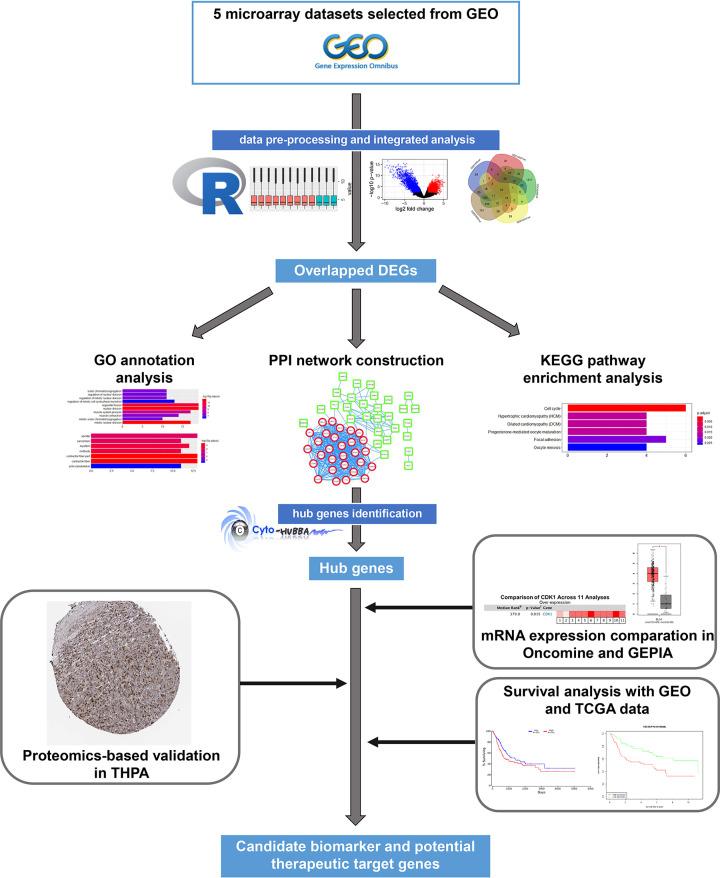
We searched Gene Expression Omnibus (GEO) and downloaded the eligible microarray datasets. After intersection analysis for identified differentially expressed genes (DEGs) of included datasets, overlapped DEGs were identified and subsequently analyzed with Gene Ontology (GO), Kyoto Encyclopedia of Genes and Genomes (KEGG), Protein-Protein Interaction (PPI) and hub genes identification. Hub genes were further analyzed with mRNA expression comparation in Oncomine and Gene Expression Profiling Interactive Analysis (GEPIA) database, proteomics-based validation in The Human Protein Atlas (THPA) and survival analysis in GEO and Oncolnc database.
RESULTS
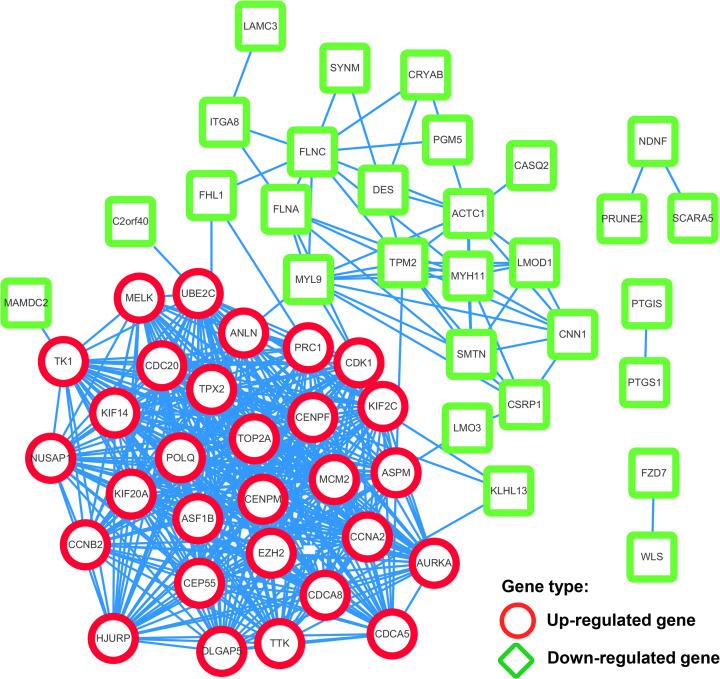
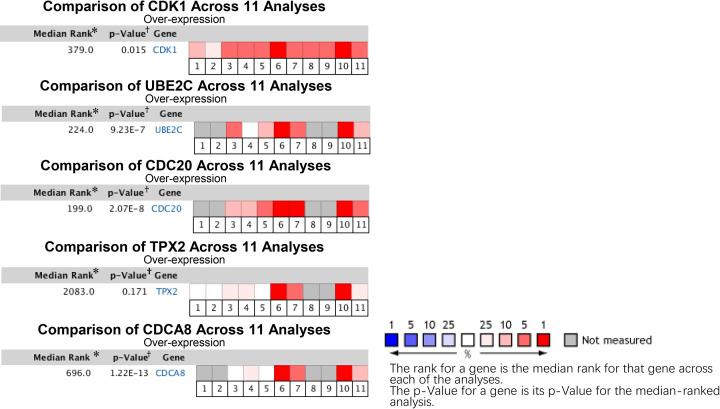
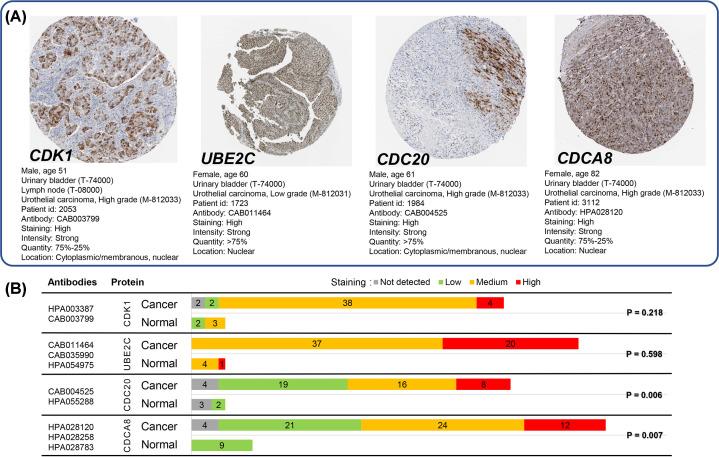
We analyzed five eligible GEO datasets and identified 76 overlapped DEGs mapped into PPI network with 459 edges which were mainly enriched in cell cycle pathway and related terms in GO and KEGG analysis. Among five identified hub genes, which are Cyclin-Dependent Kinase 1 (CDK1), Ubiquitin-Conjugating Enzyme E2 C (UBE2C), Cell Division Cycle 20 (CDC20), Microtubule Nucleation Factor (TPX2) and Cell Division Cycle Associated 8 (CDCA8); CDC20 and CDCA8 were confirmed as significant in mRNA expression comparation and proteomics-based validation. However, only CDC20 was considered prognostically significant in both GEO and Oncolnc database.
CONCLUSIONS
CDC20 and CDCA8 were identified as candidate diagnostic biomarkers for BC in the present study; however, only CDC20 was validated as prognostically valuable and may possibly serve as a candidate prognostic biomarker and potential therapeutic target. Still, further validation studies are essential and indispensable.
目的
由于膀胱癌(BC)在遗传水平上非常异质和复杂,因此探索可作为生物标志物和治疗靶点的基因是切实可行的。
材料与方法
我们在基因表达综合数据库(GEO)中进行了检索,并下载了符合条件的微阵列数据集。对纳入数据集的差异表达基因(DEGs)进行交集分析后,确定了重叠的 DEGs,并对其进行了基因本体论(GO)、京都基因与基因组百科全书(KEGG)、蛋白质-蛋白质相互作用(PPI)和枢纽基因识别分析。随后,我们在 Oncomine 和基因表达谱交互式分析(GEPIA)数据库中对枢纽基因进行了 mRNA 表达比较分析、在人类蛋白质图谱(THPA)中进行了蛋白质组学验证以及在 GEO 和 Oncolnc 数据库中进行了生存分析。
结果
我们分析了五个符合条件的 GEO 数据集,鉴定了 76 个重叠的 DEGs,它们映射到包含 459 个边的 PPI 网络中,这些基因主要富集在细胞周期途径和 GO 及 KEGG 分析中的相关术语。在鉴定的五个枢纽基因中,细胞周期蛋白依赖性激酶 1(CDK1)、泛素结合酶 E2 C(UBE2C)、细胞分裂周期 20(CDC20)、微管成核因子(TPX2)和细胞分裂周期相关蛋白 8(CDCA8);CDC20 和 CDCA8 在 mRNA 表达比较和蛋白质组学验证中被证实具有显著性。然而,只有 CDC20 在 GEO 和 Oncolnc 数据库中被认为具有预后意义。
结论
本研究中鉴定了 CDC20 和 CDCA8 作为膀胱癌的候选诊断生物标志物;然而,只有 CDC20 被验证为具有预后价值,并且可能作为候选预后生物标志物和潜在的治疗靶点。然而,仍需要进一步的验证研究。




 Zotero 插件