
糖尿病肾病的肾组织学改变可预测进展为终末期肾病,但不能预测肾功能下降的速度。
Renal histology in diabetic nephropathy predicts progression to end-stage kidney disease but not the rate of renal function decline.
机构信息
Division of Nephrology, St. Michael's Hospital, Unity Health Toronto and University of Toronto, 30 Bond St, Toronto, ON, M5B 1W8, Canada.
Department of Pathology and Laboratory Medicine, St. Michael's Hospital, Unity Health Toronto and University of Toronto, 30 Bond St, Toronto, ON, M5B 1W8, Canada.
出版信息
BMC Nephrol. 2020 Jul 18;21(1):285. doi: 10.1186/s12882-020-01943-1.
BACKGROUND
While histopathologic changes correlate with functional impairment in cross-sectional studies of diabetic nephropathy (DN), whether these findings predict future rate of kidney function loss remains uncertain. We thus sought to examine the relationship between kidney histopathology, incidence of end-stage kidney disease (ESKD), and rate of estimated glomerular filtration rate (eGFR) loss in DN.
METHODS
In this longitudinal cohort study, we studied 50 adults diagnosed with biopsy-proven DN. We analyzed the histopathologic parameters of each patient's kidney biopsy, as defined by the Renal Pathology Society classification system for DN, and tracked all available eGFR measurements post-biopsy. We additionally collected baseline clinical parameters (at the time of biopsy), including eGFR, albumin-to-creatinine ratio (ACR), and hemoglobin A. Multivariable linear regression was used to assess the relationship between histologic and clinical parameters at the time of the biopsy and eGFR slope. Kaplan-Meier curves and Cox regression were used to evaluate the association between histologic and clinical parameters and ESKD incidence.
RESULTS
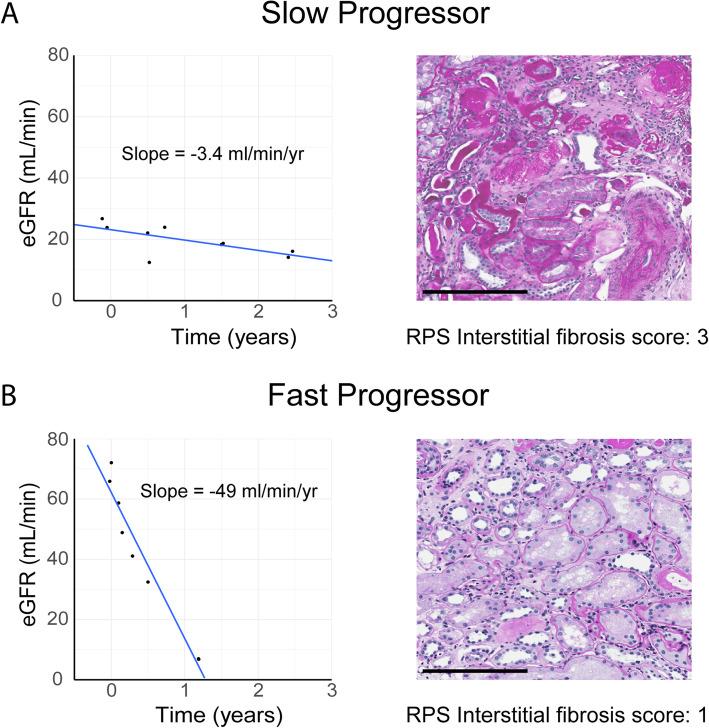
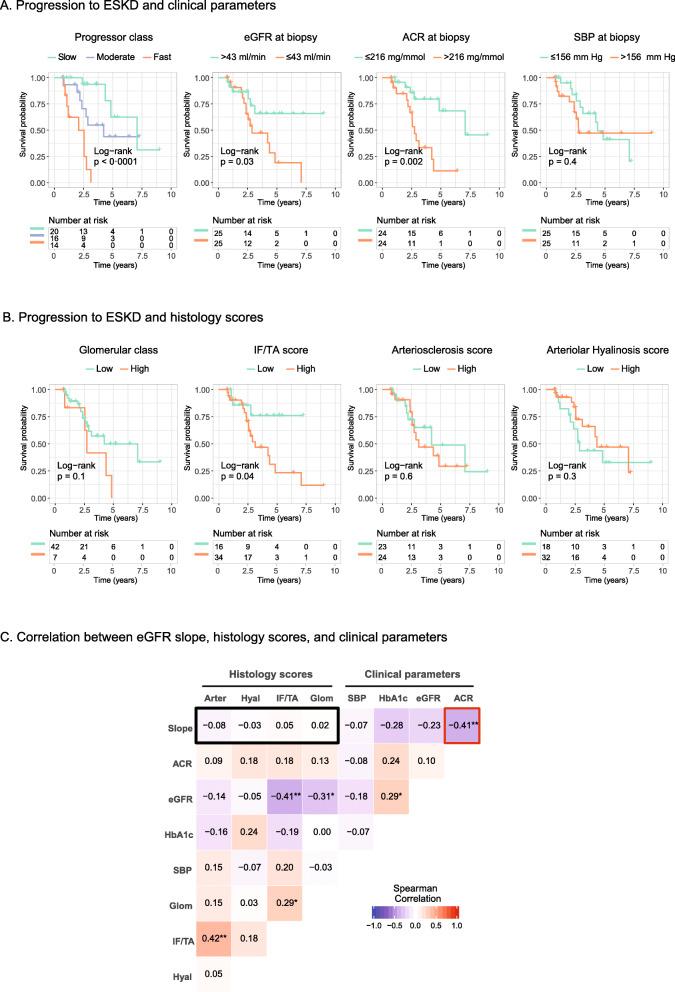
Progression to ESKD was associated with worsening interstitial fibrosis score (p = 0.05), lower baseline eGFR (p = 0.02), higher ACR (p = 0.001), and faster eGFR decline (p < 0.001). The rate of eGFR decline did not associate with any histologic parameter. Baseline ACR was the only studied variable correlating with eGFR slope (rho = - 0.41).
CONCLUSIONS
Renal histology predicts ultimate progression to ESKD, but not the rate of progression. Future work is required to identify novel predictors of rapid functional decline in patients with diabetic nephropathy.
背景
虽然横断面研究表明糖尿病肾病(DN)的组织病理学变化与功能障碍相关,但这些发现是否能预测未来肾功能丧失的速度尚不确定。因此,我们试图研究 DN 患者的肾脏组织病理学、终末期肾病(ESKD)的发生率和估算肾小球滤过率(eGFR)下降的速度之间的关系。
方法
在这项纵向队列研究中,我们研究了 50 名经活检证实患有 DN 的成年人。我们分析了每位患者肾脏活检的组织病理学参数,这些参数由 DN 的肾脏病理学会分类系统定义,并跟踪了活检后所有可用的 eGFR 测量值。我们还收集了基线临床参数(在活检时),包括 eGFR、白蛋白与肌酐比值(ACR)和血红蛋白 A。多变量线性回归用于评估活检时的组织学和临床参数与 eGFR 斜率之间的关系。Kaplan-Meier 曲线和 Cox 回归用于评估组织学和临床参数与 ESKD 发生率之间的关系。
结果
进展为 ESKD 与间质纤维化评分恶化相关(p=0.05),与基线 eGFR 降低相关(p=0.02),与 ACR 升高相关(p=0.001),与 eGFR 下降速度加快相关(p<0.001)。eGFR 下降的速度与任何组织学参数均无关。基线 ACR 是唯一与 eGFR 斜率相关的研究变量(rho=-0.41)。
结论
肾脏组织学预测最终进展为 ESKD,但不能预测进展速度。需要进一步研究以确定糖尿病肾病患者快速功能下降的新预测因子。


 Zotero 插件