
新冠病毒接触者追踪策略有效性延迟的影响:建模研究。
Impact of delays on effectiveness of contact tracing strategies for COVID-19: a modelling study.
机构信息
Julius Center for Health Sciences and Primary Care, Utrecht University, Utrecht, Netherlands.
Julius Center for Health Sciences and Primary Care, Utrecht University, Utrecht, Netherlands; BioISI-Biosystems & Integrative Sciences Institute, Faculdade de Ciências, Universidade de Lisboa, Lisboa, Portugal.
出版信息
Lancet Public Health. 2020 Aug;5(8):e452-e459. doi: 10.1016/S2468-2667(20)30157-2. Epub 2020 Jul 16.
BACKGROUND
In countries with declining numbers of confirmed cases of COVID-19, lockdown measures are gradually being lifted. However, even if most physical distancing measures are continued, other public health measures will be needed to control the epidemic. Contact tracing via conventional methods or mobile app technology is central to control strategies during de-escalation of physical distancing. We aimed to identify key factors for a contact tracing strategy to be successful.
METHODS
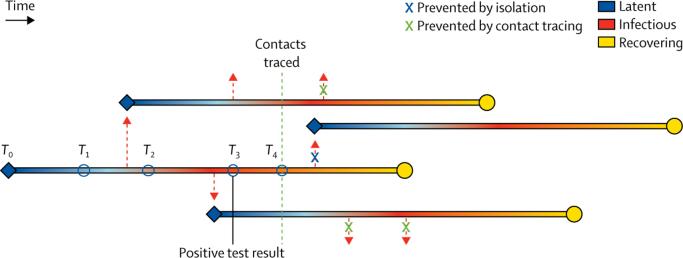
We evaluated the impact of timeliness and completeness in various steps of a contact tracing strategy using a stochastic mathematical model with explicit time delays between time of infection and symptom onset, and between symptom onset, diagnosis by testing, and isolation (testing delay). The model also includes tracing of close contacts (eg, household members) and casual contacts, followed by testing regardless of symptoms and isolation if testing positive, with different tracing delays and coverages. We computed effective reproduction numbers of a contact tracing strategy (R) for a population with physical distancing measures and various scenarios for isolation of index cases and tracing and quarantine of their contacts.
FINDINGS
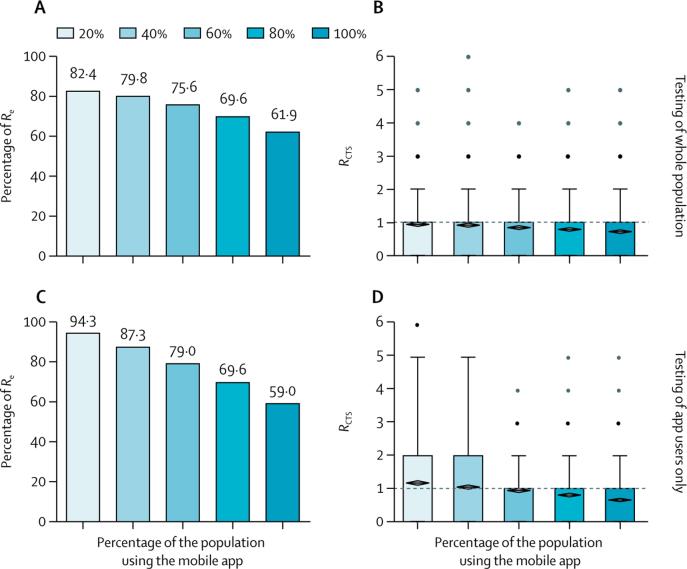
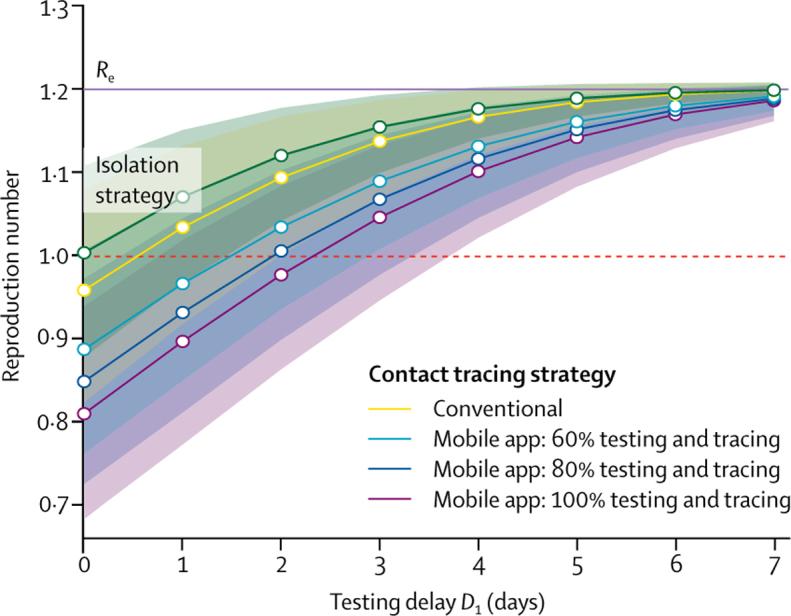
For the most optimistic scenario (testing and tracing delays of 0 days and tracing coverage of 100%), and assuming that around 40% of transmissions occur before symptom onset, the model predicts that the estimated effective reproduction number of 1·2 (with physical distancing only) will be reduced to 0·8 (95% CI 0·7-0·9) by adding contact tracing. The model also shows that a similar reduction can be achieved when testing and tracing coverage is reduced to 80% (R 0·8, 95% CI 0·7-1·0). A testing delay of more than 1 day requires the tracing delay to be at most 1 day or tracing coverage to be at least 80% to keep R below 1. With a testing delay of 3 days or longer, even the most efficient strategy cannot reach R values below 1. The effect of minimising tracing delay (eg, with app-based technology) declines with decreasing coverage of app use, but app-based tracing alone remains more effective than conventional tracing alone even with 20% coverage, reducing the reproduction number by 17·6% compared with 2·5%. The proportion of onward transmissions per index case that can be prevented depends on testing and tracing delays, and given a 0-day tracing delay, ranges from up to 79·9% with a 0-day testing delay to 41·8% with a 3-day testing delay and 4·9% with a 7-day testing delay.
INTERPRETATION
In our model, minimising testing delay had the largest impact on reducing onward transmissions. Optimising testing and tracing coverage and minimising tracing delays, for instance with app-based technology, further enhanced contact tracing effectiveness, with the potential to prevent up to 80% of all transmissions. Access to testing should therefore be optimised, and mobile app technology might reduce delays in the contact tracing process and optimise contact tracing coverage.
FUNDING
ZonMw, Fundação para a Ciência e a Tecnologia, and EU Horizon 2020 RECOVER.
背景
在 COVID-19 确诊病例数量下降的国家,封锁措施正在逐步放宽。然而,即使大多数身体距离措施得以继续实施,也需要其他公共卫生措施来控制疫情。通过传统方法或移动应用程序技术进行接触者追踪是降级身体距离控制策略的核心。我们旨在确定接触者追踪策略成功的关键因素。
方法
我们使用具有明确的时间延迟的随机数学模型评估了接触者追踪策略各个步骤的及时性和完整性,该模型中的时间延迟包括感染和症状出现之间的时间延迟,以及症状出现、通过检测诊断和隔离(检测延迟)之间的时间延迟。该模型还包括密切接触者(例如,家庭成员)和偶然接触者的追踪,然后无论症状如何进行检测,并对检测呈阳性的患者进行隔离,如果检测呈阳性,则进行隔离,追踪和隔离的时间延迟和覆盖率不同。我们为具有身体距离措施的人群计算了接触者追踪策略(R)的有效繁殖数,并为隔离指数病例和追踪隔离其接触者的各种情况进行了计算。
结果
对于最乐观的情况(检测和追踪延迟为 0 天,追踪覆盖率为 100%),并且假设大约 40%的传播发生在症状出现之前,那么模型预测,仅通过身体距离隔离预计有效繁殖数(R)将从 1.2(R)减少到 0.8(95%CI 0.7-0.9)。该模型还表明,当检测和追踪覆盖率降低到 80%时(R 0.8,95%CI 0.7-1.0),也可以实现类似的减少。检测延迟超过 1 天,则需要将追踪延迟最多设置为 1 天,或者将追踪覆盖率至少设置为 80%,以将 R 保持在 1 以下。如果检测延迟为 3 天或更长时间,则即使是最有效的策略也无法将 R 值降低到 1 以下。最小化追踪延迟的效果(例如,使用基于应用程序的技术)会随着应用程序使用覆盖率的降低而下降,但即使覆盖率为 20%,基于应用程序的追踪也仍然比传统的追踪更为有效,可将繁殖数降低 17.6%,与 2.5%相比,可减少 17.6%的传播。每个指数病例可以预防的传播次数取决于检测和追踪延迟,并且如果追踪延迟为 0 天,则从检测延迟为 0 天的情况下高达 79.9%到检测延迟为 3 天的情况下的 41.8%,检测延迟为 7 天的情况下为 4.9%。
解释
在我们的模型中,最小化检测延迟对减少传播的影响最大。优化检测和追踪覆盖率并最小化追踪延迟(例如,使用基于应用程序的技术)可以进一步提高接触者追踪的效果,有可能预防高达 80%的所有传播。因此,应优化检测的获取,并且移动应用程序技术可能会减少接触者追踪过程中的延迟并优化接触者追踪的覆盖率。
资助
ZonMw,Fundação para a Ciência e a Tecnologia 和欧盟地平线 2020 恢复计划。

 Zotero 插件