
急性髓细胞白血病的前沿分子治疗。
Cutting Edge Molecular Therapy for Acute Myeloid Leukemia.
机构信息
Department of Hematology, National Cancer Center Hospital East, Kashiwa 277-8577, Japan.
出版信息
Int J Mol Sci. 2020 Jul 20;21(14):5114. doi: 10.3390/ijms21145114.
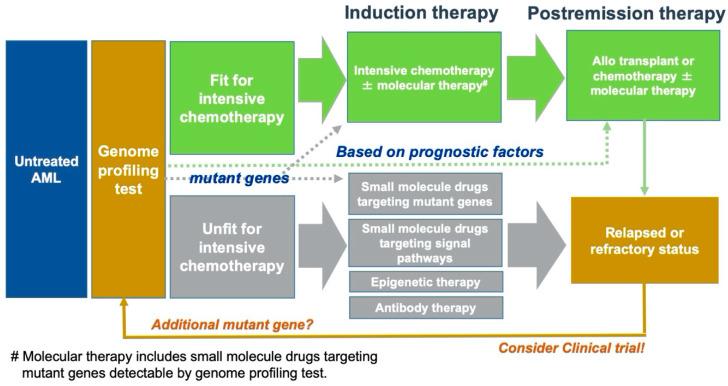
Recently, whole exome sequencing for acute myeloid leukemia (AML) has been performed by a next-generation sequencer in several studies. It has been revealed that a few gene mutations are identified per AML patient. Some of these mutations are actionable mutations that affect the response to an approved targeted treatment that is available for off-label treatment or that is available in clinical trials. The era of precision medicine for AML has arrived, and it is extremely important to detect actionable mutations relevant to treatment decision-making. However, the percentage of actionable mutations found in AML is about 50% at present, and therapeutic development is also needed for AML patients without actionable mutations. In contrast, the newly approved drugs are less toxic than conventional intensive chemotherapy and can be combined with low-intensity treatments. These combination therapies can contribute to the improvement of prognosis, especially in elderly AML patients who account for more than half of all AML patients. Thus, the treatment strategy for leukemia is changing drastically and showing rapid progress. In this review, we present the latest information regarding the recent development of treatment for AML.
最近,在几项研究中,下一代测序仪已对急性髓系白血病(AML)进行了全外显子组测序。结果表明,每个 AML 患者都能检测到少数基因突变。其中一些突变是可操作的突变,会影响对已批准的靶向治疗的反应,这些靶向治疗可用于超适应证治疗或临床试验中。AML 的精准医学时代已经到来,检测与治疗决策相关的可操作突变极为重要。然而,目前在 AML 中发现的可操作突变的比例约为 50%,并且对于没有可操作突变的 AML 患者也需要进行治疗开发。相比之下,新批准的药物比传统强化化疗毒性更小,并且可以与低强度治疗联合使用。这些联合疗法有助于改善预后,特别是在占所有 AML 患者一半以上的老年 AML 患者中。因此,白血病的治疗策略正在发生巨大变化并取得快速进展。在本文中,我们将介绍 AML 治疗的最新进展。

 Zotero 插件