
抗 PD-1 抗体在 EGFR 突变和高 PD-L1 表达的 NSCLC 患者中的疗效。
Efficacy of anti-PD-1 antibodies in NSCLC patients with an EGFR mutation and high PD-L1 expression.
机构信息
Department of Thoracic Oncology, National Cancer Center Hospital, 5-1-1 Tsukiji, Chuo-ku, Tokyo, 104-0045, Japan.
Department of Experimental Therapeutics, National Cancer Center Hospital, Tokyo, Japan.
出版信息
J Cancer Res Clin Oncol. 2021 Jan;147(1):245-251. doi: 10.1007/s00432-020-03329-0. Epub 2020 Jul 23.
INTRODUCTION
Several studies have demonstrated that non-small cell lung cancer patients (NSCLCs) harboring epidermal growth factor receptor (EGFR) mutations have poor clinical outcomes in response to treatment with programmed death-1 (PD-1) inhibitors. However, it remains unclear whether EGFR-mutated NSCLCs with a high programmed death-ligand-1 (PD-L1) expression (tumor proportion score ≥ 50%) respond to PD-1 inhibitors.
METHODS
We retrospectively investigated the NSCLCs who had received PD-1 inhibitors between January 2016 and December 2018 to assess the efficacy of PD-1 inhibitors in patients with an EGFR mutation and high PD-L1 expression.
RESULTS
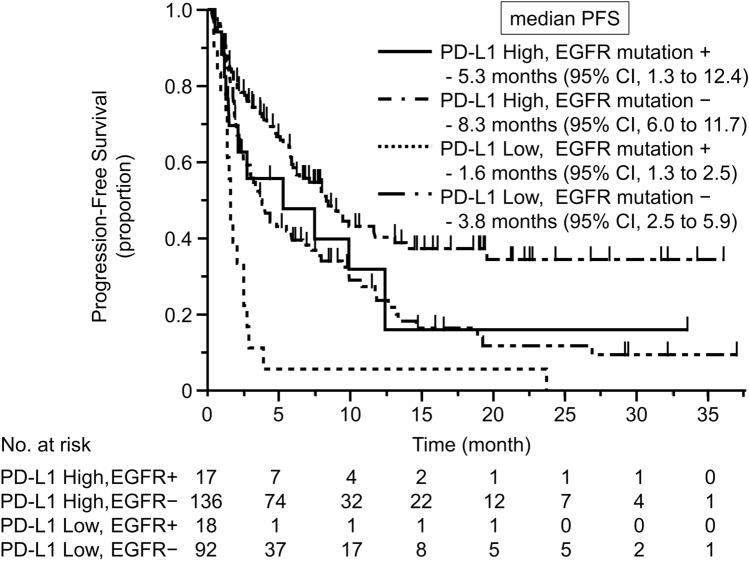
There were 153 patients with a high PD-L1 expression level, and the median progression-free survival (mPFS) was 5.3 months [95% confidence interval (CI) 1.3-12.4 months] in the patients with EGFR mutations (n = 17) and 8.3 months (95% CI 6.0-11.7 months) in those with wild-type EGFR (n = 136; hazard ratio (HR) 1.62; 95% CI 0.83-2.87). Among the 110 patients in the low PD-L1 expression group, the mPFS was 1.6 months (95% CI 1.3-5.9 months) in the patients with EGFR mutations (n = 18) and 3.8 months (95% CI 2.5-5.9 months) in those with wild-type EGFR (n = 92; HR 2.59; 95% CI 1.48-4.31). The HR for PFS in the group with EGFR mutations and high PD-L1 expression was 0.97 (95% CI 0.56-1.59) compared to the group with wild-type EGFR and low PD-L1 expression.
CONCLUSIONS
PD-1 inhibitors can serve as one of the treatment options for NSCLCs with an EGFR mutation and high PD-L1 expression.
简介
多项研究表明,表皮生长因子受体(EGFR)突变的非小细胞肺癌(NSCLC)患者对程序性死亡受体-1(PD-1)抑制剂的治疗反应不佳。然而,EGFR 突变的 NSCLC 患者中高程序性死亡配体-1(PD-L1)表达(肿瘤比例评分≥50%)是否对 PD-1 抑制剂有反应尚不清楚。
方法
我们回顾性调查了 2016 年 1 月至 2018 年 12 月期间接受 PD-1 抑制剂治疗的 NSCLC 患者,以评估 PD-1 抑制剂在 EGFR 突变和高 PD-L1 表达患者中的疗效。
结果
共有 153 例患者 PD-L1 表达水平较高,其中 EGFR 突变患者(n=17)的中位无进展生存期(mPFS)为 5.3 个月(95%置信区间 1.3-12.4 个月),野生型 EGFR 患者(n=136)为 8.3 个月(95%置信区间 6.0-11.7 个月)(风险比(HR)1.62;95%置信区间 0.83-2.87)。在低 PD-L1 表达组的 110 例患者中,EGFR 突变患者的 mPFS 为 1.6 个月(95%置信区间 1.3-5.9 个月)(n=18),野生型 EGFR 患者为 3.8 个月(95%置信区间 2.5-5.9 个月)(n=92;HR 2.59;95%置信区间 1.48-4.31)。与野生型 EGFR 且低 PD-L1 表达组相比,EGFR 突变且高 PD-L1 表达组的 PFS 风险比为 0.97(95%置信区间 0.56-1.59)。
结论
PD-1 抑制剂可作为 EGFR 突变且高 PD-L1 表达的 NSCLC 的治疗选择之一。

 Zotero 插件