
循环肿瘤 DNA 的纵向监测可改善胃食管腺癌的预后和复发检测。
Longitudinal monitoring of circulating tumour DNA improves prognostication and relapse detection in gastroesophageal adenocarcinoma.
机构信息
Leicester Cancer Research Centre, University of Leicester, Leicester, UK.
出版信息
Br J Cancer. 2020 Oct;123(8):1271-1279. doi: 10.1038/s41416-020-1002-8. Epub 2020 Jul 28.
BACKGROUND
Gastroesophageal adenocarcinoma (GOA) has poor clinical outcomes and lacks reliable blood markers. Here we present circulating tumour DNA (ctDNA) as an emerging biomarker.
METHODS
Forty patients (17 palliative and 23 curative) were followed by serial plasma monitoring. Primary tumour DNA was analysed by targeted next-generation sequencing to identify somatic single-nucleotide variants (SNVs), and Nanostring nCounter to detect copy number alterations (CNAs). Patient-specific SNVs and CNA amplifications (CNA) were analysed in plasma using digital droplet PCR and quantitative PCR, respectively.
RESULTS
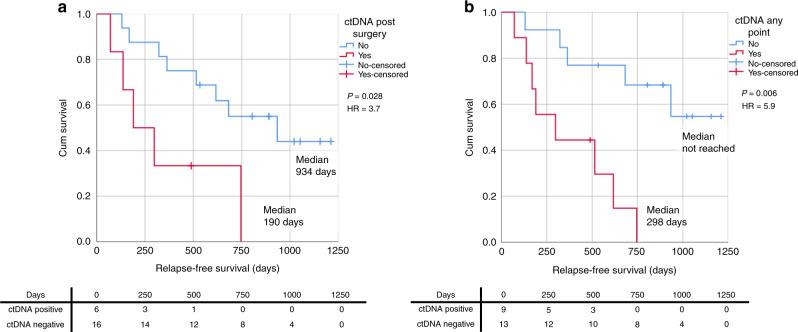
Thirty-five patients (13 palliative, 22 curative) had ≥1 SNVs and/or CNA detected in primary tumour DNA suitable for tracking in plasma. Eighteen of 35 patients (nine palliative, nine curative) had ≥1 ctDNA-positive plasma sample. Detection of postoperative ctDNA predicted short RFS (190 vs 934 days, HR = 3.7, p = 0.028) and subsequent relapse (PPV for relapse 0.83). High ctDNA levels (>60.5 copies/ml) at diagnosis of metastatic disease predicted poor OS (90 vs 372 days, HR = 11.7 p < 0.001).
CONCLUSION
Sensitive ctDNA detection allows disease monitoring and prediction of short OS in metastatic patients. Presence of ctDNA postoperatively predicts relapse and defines a 'molecular relapse' before overt clinical disease. This lead time defines a potential therapeutic window for additional anticancer therapy.
背景
胃食管腺癌(GOA)临床预后较差,缺乏可靠的血液标志物。本文提出循环肿瘤 DNA(ctDNA)作为一种新兴的生物标志物。
方法
40 名患者(17 名姑息性和 23 名根治性)进行了连续血浆监测。通过靶向下一代测序分析原发肿瘤 DNA,以鉴定体细胞单核苷酸变异(SNV),并通过 Nanostring nCounter 检测拷贝数改变(CNA)。使用数字液滴 PCR 和定量 PCR 分别分析患者特异性 SNV 和 CNA 扩增(CNA)在血浆中的情况。
结果
35 名患者(13 名姑息性,22 名根治性)在原发肿瘤 DNA 中检测到≥1 个适合于在血浆中追踪的 SNV 和/或 CNA。35 名患者中有 18 名(9 名姑息性,9 名根治性)有≥1 个 ctDNA 阳性血浆样本。术后 ctDNA 的检测预测了较短的 RFS(190 天与 934 天,HR=3.7,p=0.028)和随后的复发(复发的 PPV 为 0.83)。转移性疾病诊断时高 ctDNA 水平(>60.5 拷贝/ml)预测了较差的 OS(90 天与 372 天,HR=11.7,p<0.001)。
结论
敏感的 ctDNA 检测可实现疾病监测,并预测转移性患者的短 OS。术后存在 ctDNA 预测复发,并在明显临床疾病之前定义了“分子复发”。这一前置时间为额外的抗癌治疗提供了潜在的治疗窗口。


 Zotero 插件