
树突状细胞生物学及其在肿瘤免疫治疗中的作用。
Dendritic cell biology and its role in tumor immunotherapy.
机构信息
State Key Laboratory of Respiratory Disease, Affiliated Cancer Hospital & Institute of Guangzhou Medical University, Guangzhou, 510095, China.
Laboratory of Oncology, Center for Molecular Medicine, School of Basic Medicine, Faculty of Medicine, Yangtze University, 1 Nanhuan Road, Jingzhou, 434023, Hubei, China.
出版信息
J Hematol Oncol. 2020 Aug 3;13(1):107. doi: 10.1186/s13045-020-00939-6.
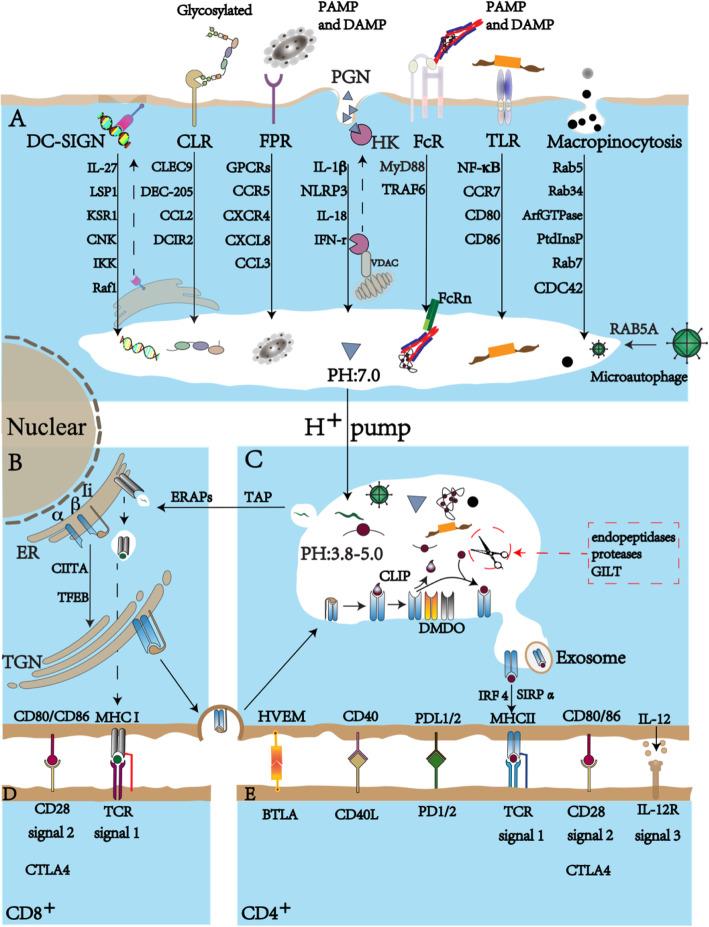
As crucial antigen presenting cells, dendritic cells (DCs) play a vital role in tumor immunotherapy. Taking into account the many recent advances in DC biology, we discuss how DCs (1) recognize pathogenic antigens with pattern recognition receptors through specific phagocytosis and through non-specific micropinocytosis, (2) process antigens into small peptides with proper sizes and sequences, and (3) present MHC-peptides to CD4 and CD8 T cells to initiate immune responses against invading microbes and aberrant host cells. During anti-tumor immune responses, DC-derived exosomes were discovered to participate in antigen presentation. T cell microvillar dynamics and TCR conformational changes were demonstrated upon DC antigen presentation. Caspase-11-driven hyperactive DCs were recently reported to convert effectors into memory T cells. DCs were also reported to crosstalk with NK cells. Additionally, DCs are the most important sentinel cells for immune surveillance in the tumor microenvironment. Alongside DC biology, we review the latest developments for DC-based tumor immunotherapy in preclinical studies and clinical trials. Personalized DC vaccine-induced T cell immunity, which targets tumor-specific antigens, has been demonstrated to be a promising form of tumor immunotherapy in patients with melanoma. Importantly, allogeneic-IgG-loaded and HLA-restricted neoantigen DC vaccines were discovered to have robust anti-tumor effects in mice. Our comprehensive review of DC biology and its role in tumor immunotherapy aids in the understanding of DCs as the mentors of T cells and as novel tumor immunotherapy cells with immense potential.
作为关键的抗原呈递细胞,树突状细胞(DCs)在肿瘤免疫治疗中起着至关重要的作用。考虑到 DC 生物学的许多最新进展,我们讨论了 DCs 如何(1)通过特异性吞噬作用和非特异性微吞噬作用,利用模式识别受体识别病原体抗原,(2)将抗原加工成具有适当大小和序列的小肽,以及(3)将 MHC 肽呈递给 CD4 和 CD8 T 细胞,以启动针对入侵微生物和异常宿主细胞的免疫反应。在抗肿瘤免疫反应中,发现 DC 衍生的外泌体参与抗原呈递。在 DC 抗原呈递时,T 细胞微绒毛动力学和 TCR 构象变化得到了证实。最近有报道称, caspase-11 驱动的过度活跃的 DC 可将效应器转化为记忆 T 细胞。DC 还被报道与 NK 细胞相互作用。此外,DC 是肿瘤微环境中免疫监视的最重要的哨兵细胞。除了 DC 生物学,我们还综述了临床前研究和临床试验中基于 DC 的肿瘤免疫治疗的最新进展。针对肿瘤特异性抗原的个性化 DC 疫苗诱导的 T 细胞免疫已被证明是黑色素瘤患者有前途的肿瘤免疫治疗形式。重要的是,发现负载同种型 IgG 和 HLA 限制性新抗原的 DC 疫苗在小鼠中具有强大的抗肿瘤作用。我们对 DC 生物学及其在肿瘤免疫治疗中的作用的全面综述有助于理解 DC 作为 T 细胞的指导者以及作为具有巨大潜力的新型肿瘤免疫治疗细胞。

 Zotero 插件