
羟氯喹-阿奇霉素治疗 COVID-19 感染期间的急性 QT 间期改变。
Acute QT Interval Modifications During Hydroxychloroquine-Azithromycin Treatment in the Context of COVID-19 Infection.
机构信息
Department of Internal Medicine, Groupe hospitalier Paris Saint-Joseph, Paris, France.
Department of Internal Medicine, Groupe hospitalier Paris Saint-Joseph, Paris, France.
出版信息
Mayo Clin Proc. 2020 Aug;95(8):1696-1700. doi: 10.1016/j.mayocp.2020.05.005. Epub 2020 May 20.
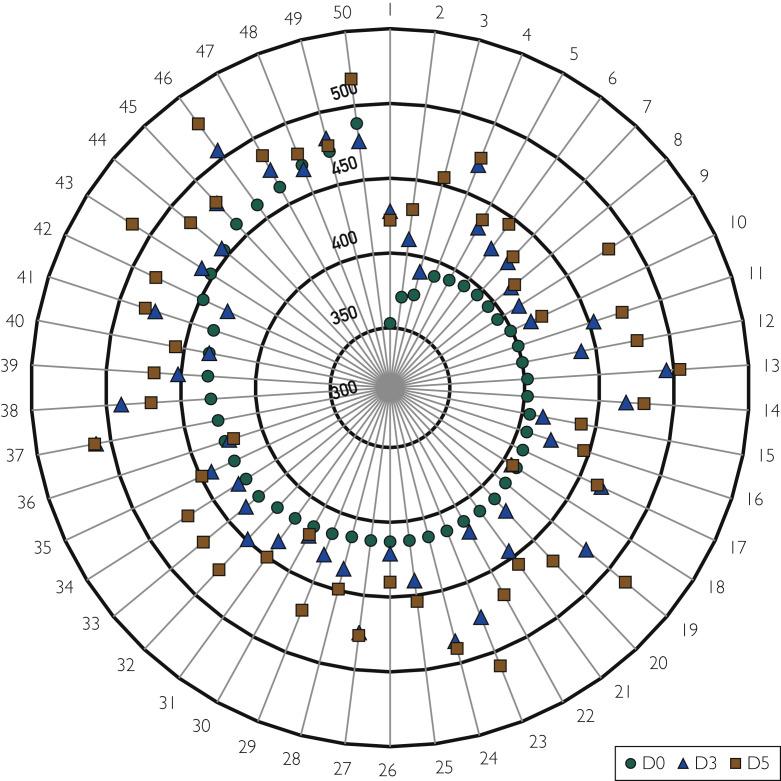
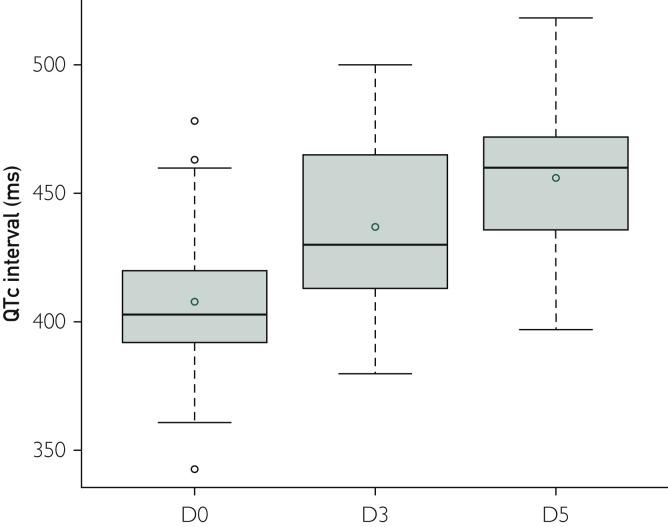
Among candidate drugs to treat coronavirus disease 2019 (COVID-19), the combination of hydroxychloroquine (HCQ) and azithromycin (AZ) has received intense worldwide attention. Even as the efficacy of this combination is under evaluation, clinicians have begun to use it largely. As these medications are known to prolong the QT interval, we analyzed serial electrocardiograms recorded in patients hospitalized for COVID-19 pneumonia and treated with HCQ + AZ. Fifty consecutive patients received the combination of HCQ (600 mg/d for 10 days) and AZ (500 mg/d on day 1 and 250 mg/d from day 2 to day 5). Twelve-lead electrocardiograms were recorded before treatment, at day 3, at day 5, and at discharge. The median age of patients was 68 years (interquartile range, 53-81 years); 28 (56%) were men. The main comorbidities were hypertension (36%; n=18) and diabetes (16%; n=8). The mean corrected QT (QTc) interval was 408 ms at baseline and increased up to 437 ms at day 3 and to 456 ms at day 5. Thirty-eight patients (76%) presented short-term modifications of the QTc duration (>30 ms). Treatment discontinuation was decided in 6 patients (12%), leading to QTc normalization in 5 of them. No deaths and no cardiac arrhythmic events were observed in this cohort. Our report confirms that a short duration treatment with HCQ + AZ modifies the QTc interval. The treatment had to be discontinued for QTc modifications in 12% of patients. Nevertheless, in inpatients hospitalized for COVID-19, we did not observe any clinically relevant consequences of these transitory modifications. In conclusion, when patients are treated with HCQ + AZ, cardiac monitoring should be regularly performed and hospital settings allow monitoring under in safe conditions.
在治疗 2019 年冠状病毒病(COVID-19)的候选药物中,羟氯喹(HCQ)和阿奇霉素(AZ)的联合用药受到了全球的高度关注。尽管这种联合用药的疗效仍在评估中,临床医生已经开始广泛使用。由于这些药物已知会延长 QT 间期,我们分析了因 COVID-19 肺炎住院并接受 HCQ+AZ 治疗的患者的连续心电图记录。连续 50 例患者接受 HCQ(600mg/d,连用 10 天)和 AZ(第 1 天和第 2 天 500mg/d,第 2 天至第 5 天 250mg/d)联合治疗。在治疗前、第 3 天、第 5 天和出院时记录 12 导联心电图。患者的中位年龄为 68 岁(四分位距,53-81 岁);28 例(56%)为男性。主要合并症为高血压(36%;n=18)和糖尿病(16%;n=8)。基础校正 QT(QTc)间期为 408ms,第 3 天增至 437ms,第 5 天增至 456ms。38 例(76%)患者的 QTc 间期出现短期变化(>30ms)。有 6 例(12%)患者决定停止治疗,其中 5 例 QTc 恢复正常。该队列中未观察到死亡和心律失常事件。本报告证实,HCQ+AZ 的短期治疗会改变 QTc 间期。有 12%的患者因 QTc 改变而停止治疗。然而,在因 COVID-19 住院的患者中,我们没有观察到这些短暂改变的任何临床相关后果。总之,当患者接受 HCQ+AZ 治疗时,应定期进行心脏监测,并且医院环境应允许在安全条件下进行监测。
 Zotero 插件