
温度应激会促使螨虫通过消灭竞争的丽蝇来帮助它们的尸体埋葬甲虫宿主。
Temperature stress induces mites to help their carrion beetle hosts by eliminating rival blowflies.
机构信息
Department of Zoology, University of Cambridge, Cambridge, United Kingdom.
Institute of Ecology and Evolutionary Biology, National Taiwan University, Taipei, Taiwan.
出版信息
Elife. 2020 Aug 5;9:e55649. doi: 10.7554/eLife.55649.
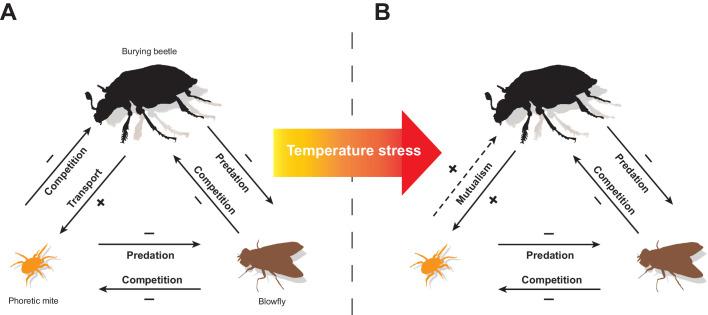
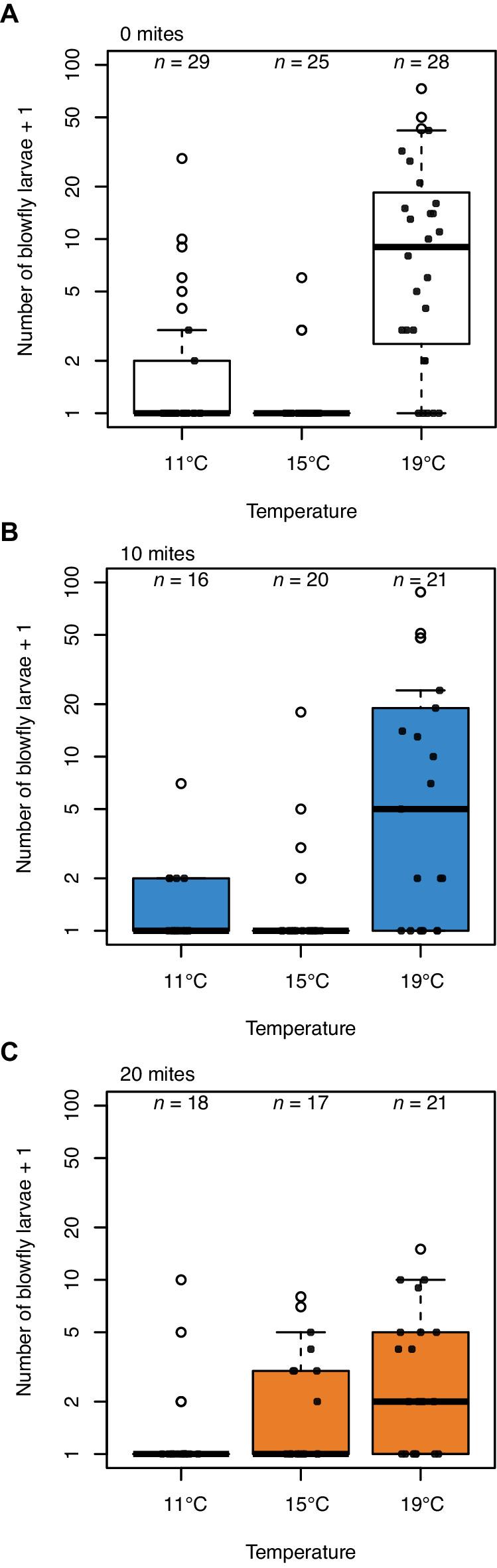
Ecological conditions are known to change the expression of mutualisms though the causal agents driving such changes remain poorly understood. Here we show that temperature stress modulates the harm threatened by a common enemy, and thereby induces a phoretic mite to become a protective mutualist. Our experiments focus on the interactions between the burying beetle , an associated mite species and their common enemy, blowflies, when all three species reproduce on the same small vertebrate carrion. We show that mites compete with beetle larvae for food in the absence of blowflies, and reduce beetle reproductive success. However, when blowflies breed on the carrion too, mites enhance beetle reproductive success by eating blowfly eggs. High densities of mites are especially effective at promoting beetle reproductive success at higher and lower natural ranges in temperature, when blowfly larvae are more potent rivals for the limited resources on the carcass.
生态条件已知会改变共生关系的表达,尽管导致这种变化的因果因素仍了解甚少。在这里,我们表明温度应激会调节共同天敌所带来的危害,从而使一种寄生螨变成一种保护性共生体。我们的实验主要集中在埋葬虫、一种相关的螨种及其共同天敌——蝇类在同一种小型脊椎动物尸体上繁殖时的相互作用上。我们表明,在没有蝇类的情况下,螨虫与幼虫争夺食物,并降低了幼虫的繁殖成功率。然而,当蝇类也在腐肉上繁殖时,螨虫通过食用蝇类的卵来提高幼虫的繁殖成功率。当温度处于自然范围的较高和较低水平时,高密度的螨虫尤其能有效地促进幼虫的繁殖成功率,因为此时蝇类幼虫对尸体上有限的资源构成了更强有力的竞争。




 Zotero 插件