
确定英国学校重新开放的最佳策略、检测和追踪干预措施的影响,以及发生第二波 COVID-19 疫情的风险:一项建模研究。
Determining the optimal strategy for reopening schools, the impact of test and trace interventions, and the risk of occurrence of a second COVID-19 epidemic wave in the UK: a modelling study.
机构信息
Department of Applied Health Research and Institute for Global Health, University College London, London, UK; The Queen's College, University of Oxford, Oxford, UK.
Institute for Disease Modeling, Bellevue, WA, USA; Complex Systems Group, School of Physics, University of Sydney, Sydney, NSW, Australia.
出版信息
Lancet Child Adolesc Health. 2020 Nov;4(11):817-827. doi: 10.1016/S2352-4642(20)30250-9. Epub 2020 Aug 3.
BACKGROUND
As lockdown measures to slow the spread of severe acute respiratory syndrome coronavirus 2 (SARS-CoV-2) infection begin to ease in the UK, it is important to assess the impact of any changes in policy, including school reopening and broader relaxation of physical distancing measures. We aimed to use an individual-based model to predict the impact of two possible strategies for reopening schools to all students in the UK from September, 2020, in combination with different assumptions about relaxation of physical distancing measures and the scale-up of testing.
METHODS
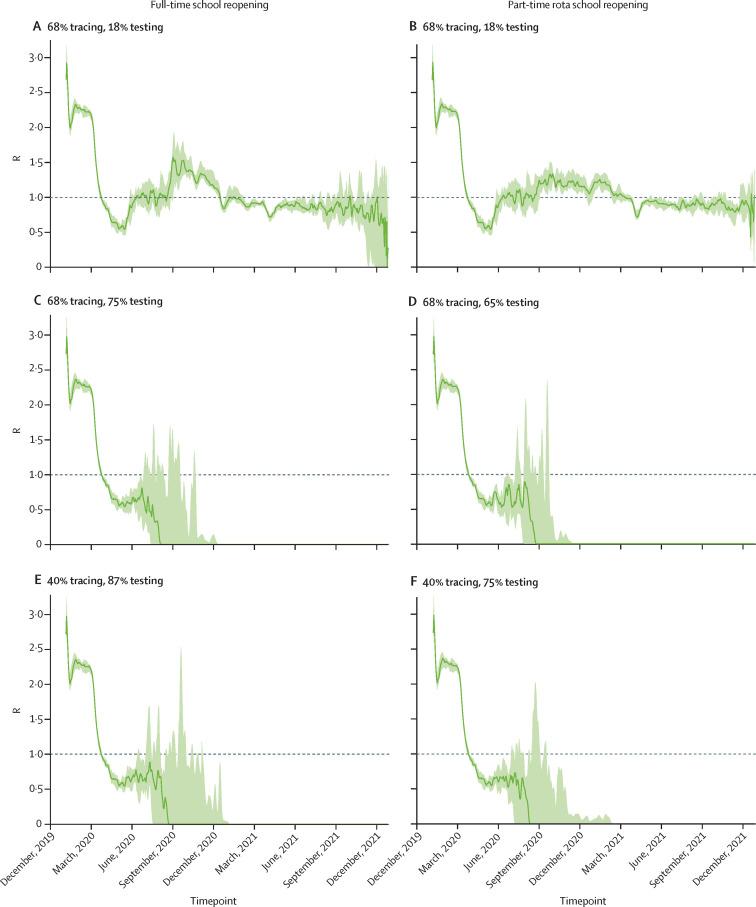
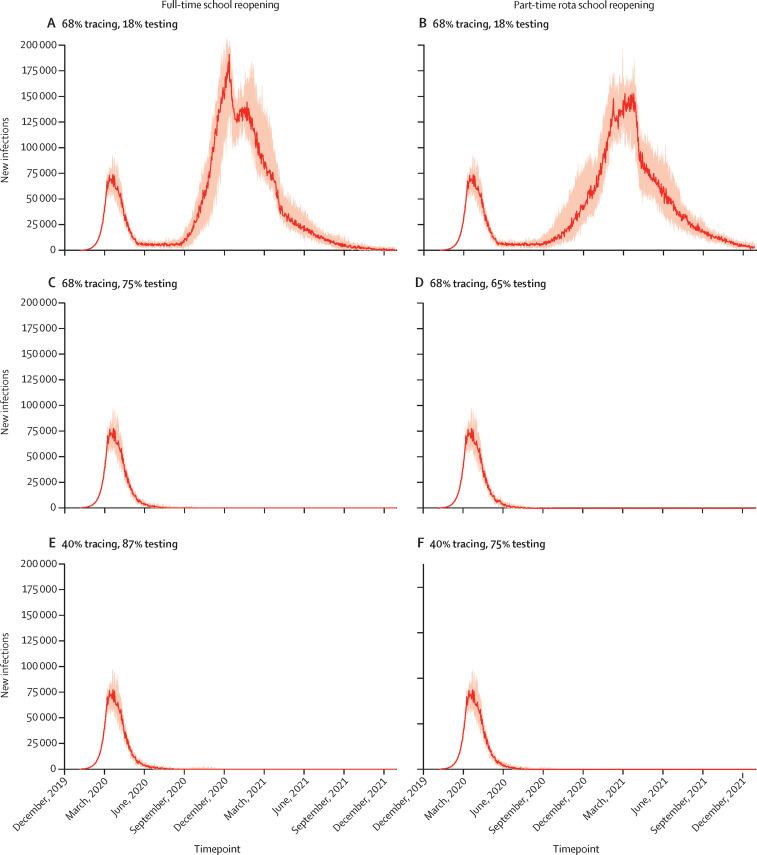
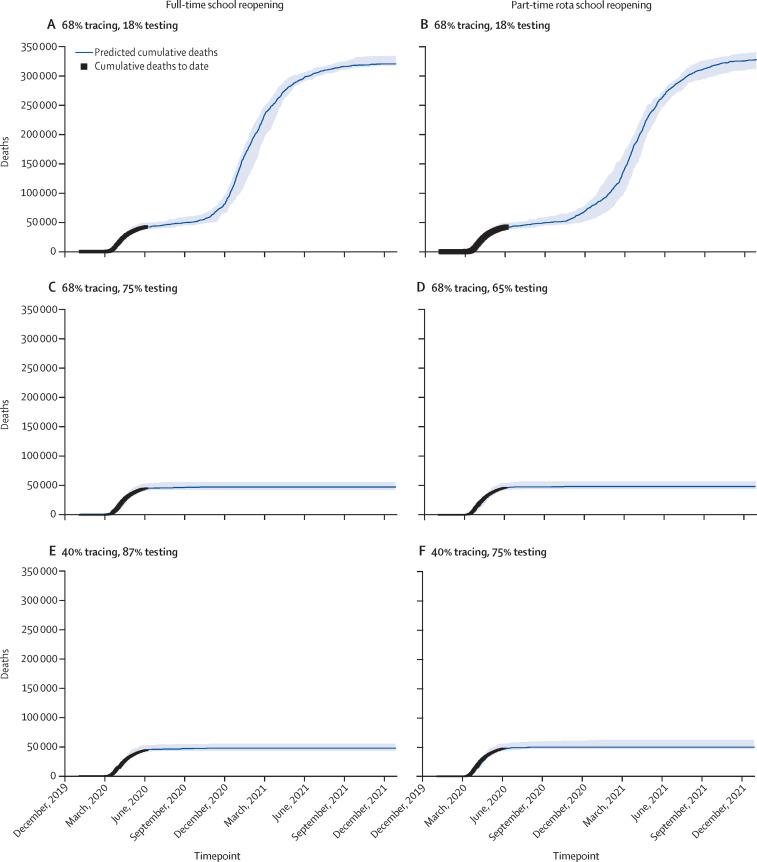
In this modelling study, we used Covasim, a stochastic individual-based model for transmission of SARS-CoV-2, calibrated to the UK epidemic. The model describes individuals' contact networks stratified into household, school, workplace, and community layers, and uses demographic and epidemiological data from the UK. We simulated six different scenarios, representing the combination of two school reopening strategies (full time and a part-time rota system with 50% of students attending school on alternate weeks) and three testing scenarios (68% contact tracing with no scale-up in testing, 68% contact tracing with sufficient testing to avoid a second COVID-19 wave, and 40% contact tracing with sufficient testing to avoid a second COVID-19 wave). We estimated the number of new infections, cases, and deaths, as well as the effective reproduction number (R) under different strategies. In a sensitivity analysis to account for uncertainties within the stochastic simulation, we also simulated infectiousness of children and young adults aged younger than 20 years at 50% relative to older ages (20 years and older).
FINDINGS
With increased levels of testing (between 59% and 87% of symptomatic people tested at some point during an active SARS-CoV-2 infection, depending on the scenario), and effective contact tracing and isolation, an epidemic rebound might be prevented. Assuming 68% of contacts could be traced, we estimate that 75% of individuals with symptomatic infection would need to be tested and positive cases isolated if schools return full-time in September, or 65% if a part-time rota system were used. If only 40% of contacts could be traced, these figures would increase to 87% and 75%, respectively. However, without these levels of testing and contact tracing, reopening of schools together with gradual relaxing of the lockdown measures are likely to induce a second wave that would peak in December, 2020, if schools open full-time in September, and in February, 2021, if a part-time rota system were adopted. In either case, the second wave would result in R rising above 1 and a resulting second wave of infections 2·0-2·3 times the size of the original COVID-19 wave. When infectiousness of children and young adults was varied from 100% to 50% of that of older ages, we still found that a comprehensive and effective test-trace-isolate strategy would be required to avoid a second COVID-19 wave.
INTERPRETATION
To prevent a second COVID-19 wave, relaxation of physical distancing, including reopening of schools, in the UK must be accompanied by large-scale, population-wide testing of symptomatic individuals and effective tracing of their contacts, followed by isolation of diagnosed individuals.
FUNDING
None.
背景
随着英国减缓严重急性呼吸系统综合症冠状病毒 2 型(SARS-CoV-2)感染传播的封锁措施开始放宽,评估任何政策变化的影响非常重要,包括学校重新开放和更广泛的身体距离措施放松。我们旨在使用基于个体的模型预测 2020 年 9 月在英国所有学生全面重新开放学校的两种可能策略的影响,同时还假设身体距离措施的放松和检测规模的扩大不同。
方法
在这项建模研究中,我们使用了 Covasim,这是一种用于 SARS-CoV-2 传播的随机基于个体的模型,根据英国的疫情进行了校准。该模型描述了个体的接触网络,分为家庭、学校、工作场所和社区层,并使用来自英国的人口统计学和流行病学数据。我们模拟了六个不同的场景,代表了两种学校重新开放策略(全日制和每周隔周上学的部分时间轮换系统)和三种检测场景(68%的接触者追踪,不扩大检测,68%的接触者追踪有足够的检测以避免第二波 COVID-19,40%的接触者追踪有足够的检测以避免第二波 COVID-19)的组合。我们根据不同的策略估计了新感染、病例和死亡的数量,以及有效繁殖数(R)。为了应对随机模拟中的不确定性,在敏感性分析中,我们还模拟了年龄在 20 岁以下的儿童和年轻人的传染性,相对年龄在 20 岁以上的传染性降低 50%。
发现
随着检测水平的提高(取决于场景,在 SARS-CoV-2 感染的活跃期,约有 59%至 87%的有症状者接受了检测),以及有效的接触者追踪和隔离,可能会防止疫情反弹。如果 68%的接触者可以被追踪,我们估计如果学校在 9 月全面重新开放,需要对 75%的有症状感染者进行检测和阳性病例隔离,如果采用部分时间轮换系统,则需要对 65%的感染者进行检测和阳性病例隔离。如果只能追踪 40%的接触者,这两个数字将分别增加到 87%和 75%。然而,如果没有这些检测和接触者追踪水平,随着封锁措施的逐步放宽,重新开放学校可能会导致第二波疫情,这波疫情将在 9 月学校全面重新开放的情况下在 2020 年 12 月达到高峰,如果采用部分时间轮换系统,则将在 2021 年 2 月达到高峰。在任何一种情况下,第二波疫情都会导致 R 值上升到 1 以上,导致第二波感染是原始 COVID-19 波的 2.0-2.3 倍。当儿童和年轻人的传染性从 100%降至年长人群的 50%时,我们仍然发现,必须采取全面有效的测试-追踪-隔离策略,以避免第二波 COVID-19。
解释
为了防止第二波 COVID-19,英国必须在放宽身体距离,包括重新开放学校的同时,进行大规模的、全民性的对有症状者的检测,并有效地追踪他们的接触者,然后对确诊者进行隔离。
资助
无。

 Zotero 插件