
BRAF 突变型黑色素瘤的靶向治疗现状
Current State of Target Treatment in BRAF Mutated Melanoma.
作者信息
Tanda Enrica Teresa, Vanni Irene, Boutros Andrea, Andreotti Virginia, Bruno William, Ghiorzo Paola, Spagnolo Francesco
机构信息
Medical Oncology, IRCCS Ospedale Policlinico San Martino, Genoa, Italy.
Genetics of Rare Cancers, IRCCS Ospedale Policlinico San Martino, Genoa, Italy.
出版信息
Front Mol Biosci. 2020 Jul 14;7:154. doi: 10.3389/fmolb.2020.00154. eCollection 2020.
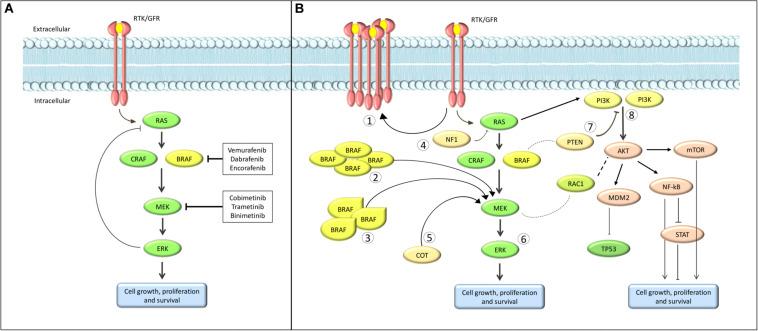
Incidence of melanoma has been constantly growing during the last decades. Although most of the new diagnoses are represented by thin melanomas, the number of melanoma-related deaths in 2018 was 60,712 worldwide (Global Cancer Observatory, 2019). Until 2011, no systemic therapy showed to improve survival in patients with advanced or metastatic melanoma. At that time, standard of care was chemotherapy, with very limited results. The identification of V600 mutation, and the subsequent introduction of targeting drugs, radically changed the clinical practice and dramatically improved outcomes. In this review, we will retrace the development of molecular-target drugs and the current therapeutic scenario for patients with mutated melanoma, from the introduction of inhibitors as single agents to modern clinical practice. We will also discuss the resistance mechanisms identified so far, and the future therapeutic perspectives in mutated melanoma.
在过去几十年中,黑色素瘤的发病率一直在持续上升。尽管大多数新诊断出的病例为薄型黑色素瘤,但2018年全球黑色素瘤相关死亡人数达60,712人(全球癌症观测站,2019年)。直到2011年,尚无全身治疗方法显示可改善晚期或转移性黑色素瘤患者的生存率。当时,标准治疗方法是化疗,效果非常有限。V600突变的发现以及随后靶向药物的引入,彻底改变了临床实践并显著改善了治疗结果。在本综述中,我们将追溯分子靶向药物的发展历程以及V600E突变型黑色素瘤患者的当前治疗情况,从抑制剂作为单一药物的引入到现代临床实践。我们还将讨论目前已确定的耐药机制以及V600E突变型黑色素瘤的未来治疗前景。
 Zotero 插件