
生物信息学分析表明,TOP2A作为宫颈癌进展中的关键候选基因发挥作用。
Bioinformatics analysis shows that TOP2A functions as a key candidate gene in the progression of cervical cancer.
作者信息
Zhao Qinfei, Li Huaying, Zhu Longyu, Hu Suping, Xi Xuxiang, Liu Yanmei, Liu Jianfeng, Zhong Tianyu
机构信息
Department of Laboratory Medicine, First Affiliated Hospital of Gannan Medical University, Ganzhou, Jiangxi 341000, P.R. China.
Department of Clinical College, Xiangtan Medicine and Health Vocational College, Xiangtan, Hunan 411104, P.R. China.
出版信息
Biomed Rep. 2020 Oct;13(4):21. doi: 10.3892/br.2020.1328. Epub 2020 Jul 9.
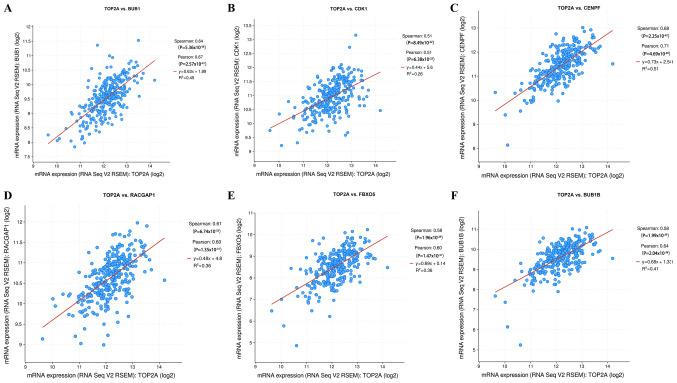
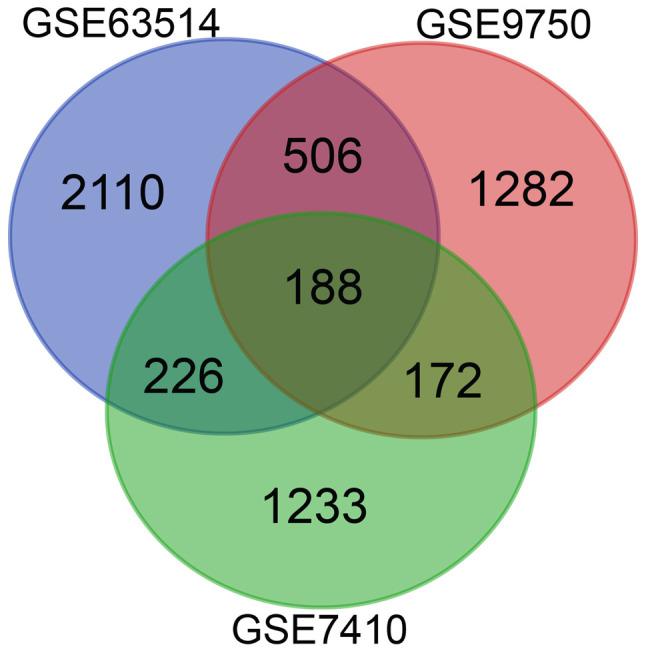
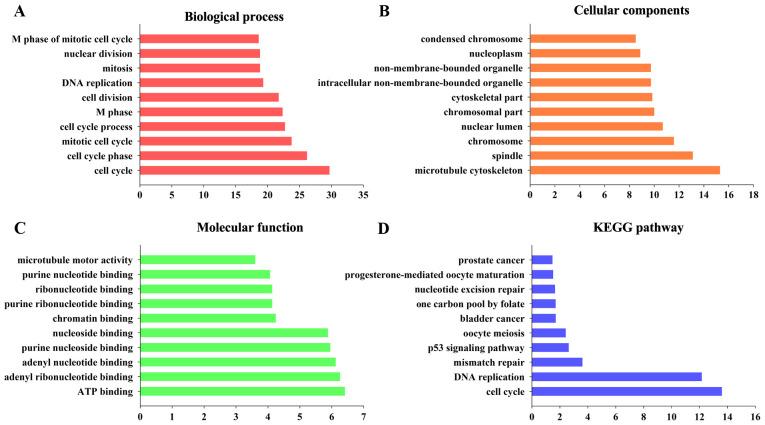
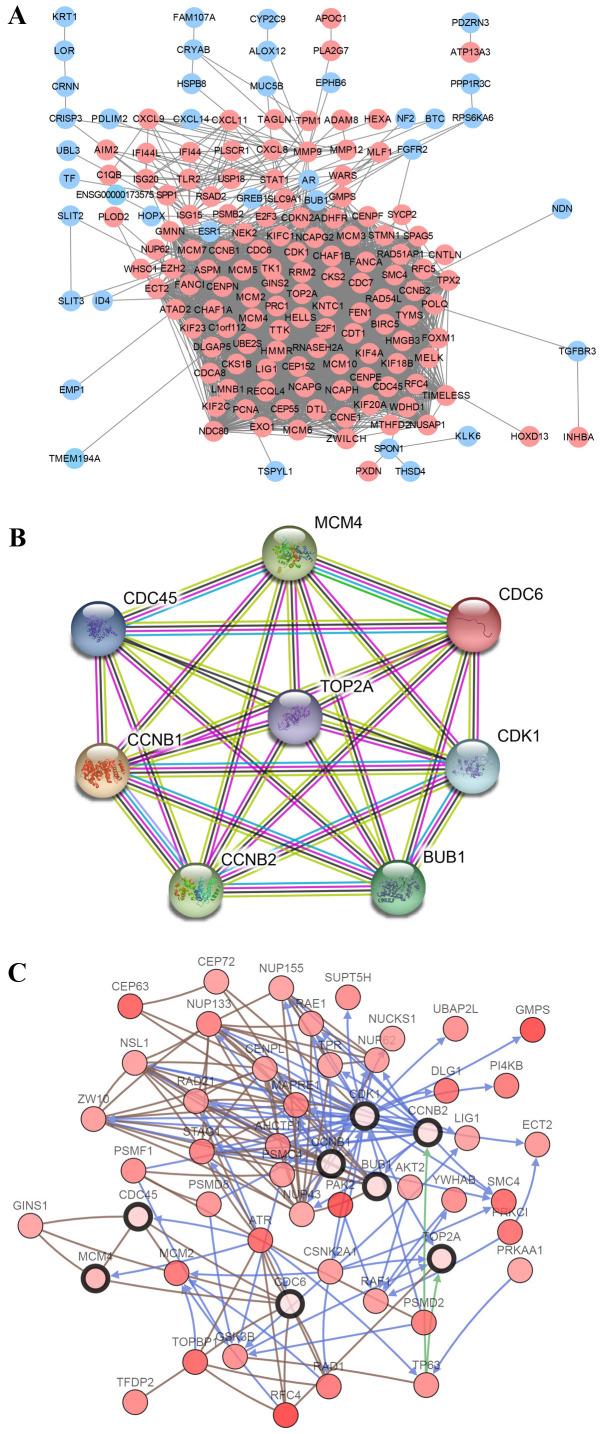
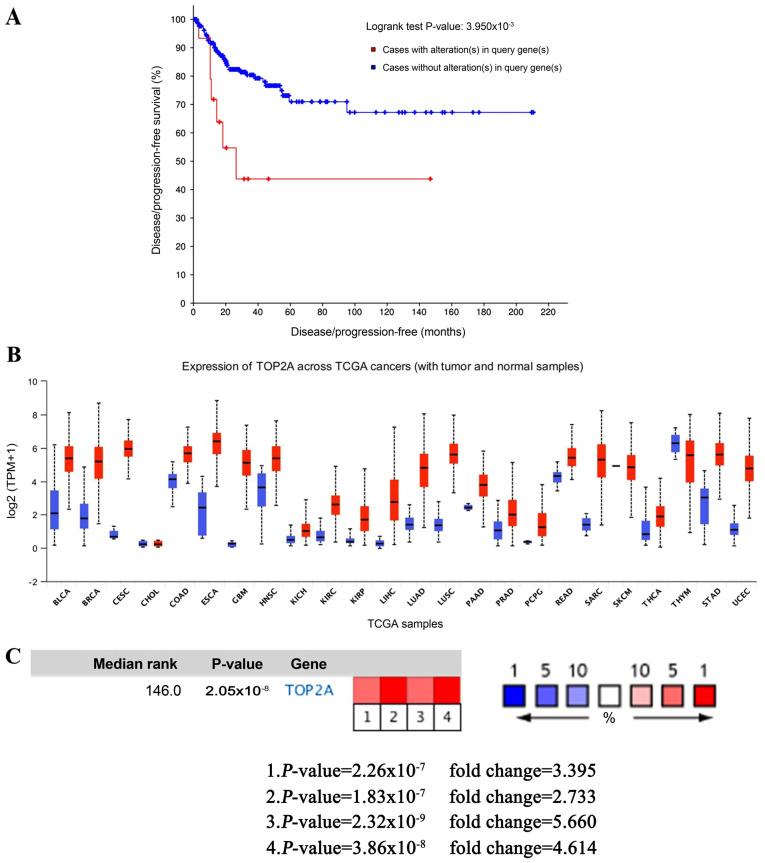
Cervical cancer (CC) is one of the most prevalent types of cancer affecting females worldwide. However, the molecular mechanisms underlying the development and progression of CC remains to be elucidated. Taking the high incidence and mortality rates amongst women into consideration, the identification of novel biomarkers to prevent CC is of great significance and required to improve diagnosis. Using three raw microarray datasets from the Gene Expression Omnibus database, 188 differentially expressed genes (DEGs) were identified. Gene Ontology and pathway analyses were performed on the DEGs. Through protein-protein interaction network construction and module analysis, eight hub genes [cell division cycle 6, cyclin-dependent kinase 1 (CDK1), cell division control protein 45, budding uninhibited by benzimidazoles 1 (BUB1), DNA topoisomerase II α (TOP2A) and minichromosome maintenance complex component 4, CCNB2 and CCNB1] were identified, but only TOP2A was considered a prognostic factor in survival analysis. There were strong positive correlations between TOP2A and BUB1 (P<0.0001, rs=0.635), CDK1 (P<0.0001, rs=0.511), centromere protein F (CENPF) (P<0.0001, rs=0.677), Rac GTPase activating protein 1 (RACGAP1) (P<0.0001, rs=0.612), F-box protein 5 (FBXO5) (P<0.0001, rs=0.585) and BUB1 mitotic checkpoint serine/threonine kinase B (BUB1B) (P<0.0001, rs=0.584). Additionally, BUB1, CDK1, CENPF, RACGAP1, FBXO5 and BUB1B are all potentially suitable candidate targets for the diagnosis and treatment of CC. In conclusion, the present study identified TOP2A as a potential tumor oncogene and a biomarker for the prognosis of CC.
宫颈癌(CC)是全球影响女性的最常见癌症类型之一。然而,CC发生和发展的分子机制仍有待阐明。考虑到女性中的高发病率和死亡率,鉴定预防CC的新型生物标志物具有重要意义,并且对于改善诊断是必需的。使用来自基因表达综合数据库的三个原始微阵列数据集,鉴定出188个差异表达基因(DEG)。对这些DEG进行了基因本体论和通路分析。通过蛋白质-蛋白质相互作用网络构建和模块分析,鉴定出八个枢纽基因[细胞分裂周期6、细胞周期蛋白依赖性激酶1(CDK1)、细胞分裂控制蛋白45、苯并咪唑不抑制的芽殖1(BUB1)、DNA拓扑异构酶IIα(TOP2A)和微小染色体维持复合体成分4、CCNB2和CCNB1],但在生存分析中只有TOP2A被认为是一个预后因素。TOP2A与BUB1(P<0.0001,rs=0.635)、CDK1(P<0.0001,rs=0.511)、着丝粒蛋白F(CENPF)(P<0.0001,rs=0.677)、Rac GTP酶激活蛋白1(RACGAP1)(P<0.0001,rs=0.612)、F-box蛋白5(FBXO5)(P<0.0001,rs=0.585)和BUB1有丝分裂检查点丝氨酸/苏氨酸激酶B(BUB1B)(P<0.0001,rs=0.584)之间存在强正相关。此外,BUB1、CDK1、CENPF、RACGAP1、FBXO5和BUB1B均可能是CC诊断和治疗的合适候选靶点。总之,本研究确定TOP2A为潜在的肿瘤癌基因和CC预后的生物标志物。

 Zotero 插件