
使用开源 AutoML 工具自动编目 CNMF-E 提取的 ROI 空间足迹和钙轨迹。
Automated Curation of CNMF-E-Extracted ROI Spatial Footprints and Calcium Traces Using Open-Source AutoML Tools.
机构信息
Hospital for Sick Children, Neurosciences and Mental Health, Toronto, ON, Canada.
Department of Physiology, University of Toronto, Toronto, ON, Canada.
出版信息
Front Neural Circuits. 2020 Jul 15;14:42. doi: 10.3389/fncir.2020.00042. eCollection 2020.
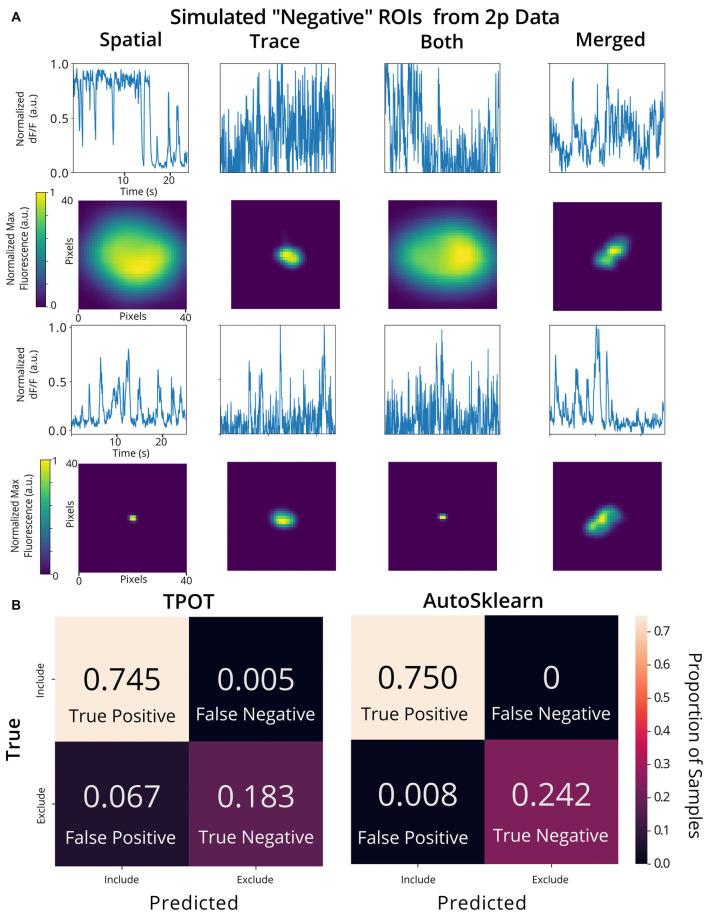
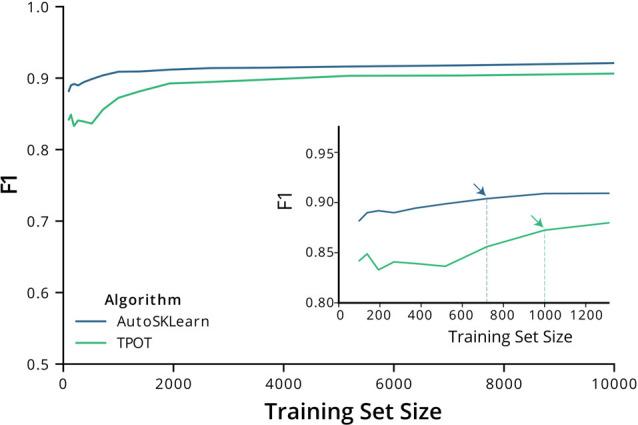
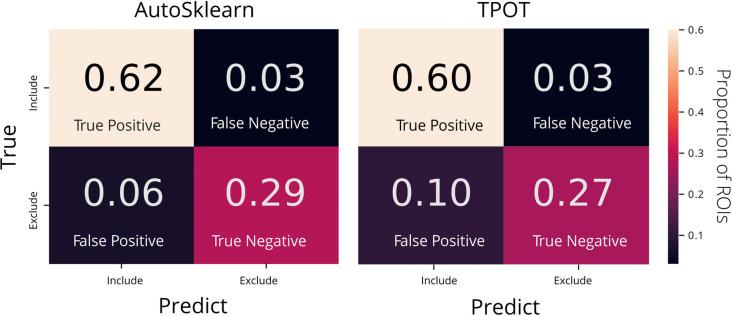
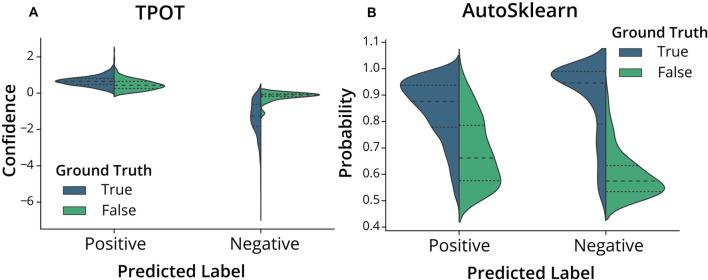
1-photon (1p) calcium imaging is an increasingly prevalent method in behavioral neuroscience. Numerous analysis pipelines have been developed to improve the reliability and scalability of pre-processing and ROI extraction for these large calcium imaging datasets. Despite these advancements in pre-processing methods, manual curation of the extracted spatial footprints and calcium traces of neurons remains important for quality control. Here, we propose an additional semi-automated curation step for sorting spatial footprints and calcium traces from putative neurons extracted using the popular constrained non-negative matrixfactorization for microendoscopic data (CNMF-E) algorithm. We used the automated machine learning (AutoML) tools TPOT and AutoSklearn to generate classifiers to curate the extracted ROIs trained on a subset of human-labeled data. AutoSklearn produced the best performing classifier, achieving an F1 score >92% on the ground truth test dataset. This automated approach is a useful strategy for filtering ROIs with relatively few labeled data points and can be easily added to pre-existing pipelines currently using CNMF-E for ROI extraction.
1 光子(1p)钙成像在行为神经科学中是一种越来越流行的方法。为了提高这些大型钙成像数据集的预处理和 ROI 提取的可靠性和可扩展性,已经开发了许多分析管道。尽管在预处理方法方面取得了这些进展,但对于质量控制,手动整理提取的神经元的空间足迹和钙迹仍然很重要。在这里,我们提出了一种额外的半自动整理步骤,用于对使用流行的微内窥镜数据约束非负矩阵分解(CNMF-E)算法提取的假定神经元的空间足迹和钙迹进行分类。我们使用自动化机器学习(AutoML)工具 TPOT 和 AutoSklearn 生成分类器,以在人类标记数据的子集上对提取的 ROI 进行训练。AutoSklearn 生成的分类器性能最佳,在真实测试数据集上的 F1 得分>92%。这种自动化方法是一种有用的策略,用于过滤具有相对较少标记数据点的 ROI,并且可以轻松添加到当前使用 CNMF-E 进行 ROI 提取的现有管道中。

 Zotero 插件