
生殖医学中由干细胞生成人工配子和胚胎
Generation of Artificial Gamete and Embryo From Stem Cells in Reproductive Medicine.
作者信息
Zhang Pu-Yao, Fan Yong, Tan Tao, Yu Yang
机构信息
Clinical Stem Cell Research Center, Peking University Third Hospital, Beijing, China.
Beijing Key Laboratory of Reproductive Endocrinology and Assisted Reproductive Technology and Key Laboratory of Assisted Reproduction, Ministry of Education, Center for Reproductive Medicine, Department of Obstetrics and Gynecology, Peking University Third Hospital, Beijing, China.
出版信息
Front Bioeng Biotechnol. 2020 Jul 22;8:781. doi: 10.3389/fbioe.2020.00781. eCollection 2020.
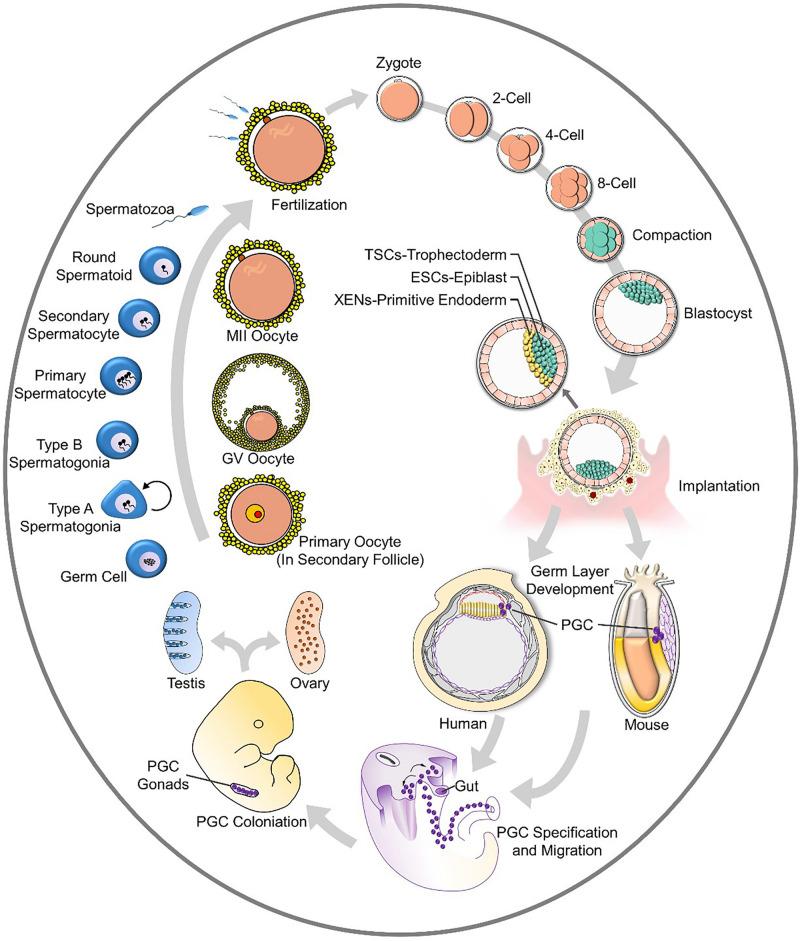
In addition to the great growing need for assisted reproduction technologies (ART), additional solutions for patients without functional gametes are strongly needed. Due to ethical restrictions, limited studies can be performed on human gametes and embryos; however, artificial gametes and embryos represent a new hope for clinical application and basic research in the field of reproductive medicine. Here, we provide a review of the research progress and possible application of artificial gametes and embryos from different species, including mice, monkeys and humans. Gametes specification from adult stem cells and embryonic stem cells (ESCs) as well as propagation of stem cells from the reproductive system and from organized embryos, which are similar to blastocysts, have been realized in some nonhuman mammals, but not all achievements can be replicated in humans. This area of research remains noteworthy and requires further study and effort to achieve the reconstitution of the entire cycle of gametogenesis and embryo development .
除了对辅助生殖技术(ART)的巨大需求不断增长外,对于没有功能性配子的患者,还迫切需要其他解决方案。由于伦理限制,对人类配子和胚胎的研究有限;然而,人工配子和胚胎为生殖医学领域的临床应用和基础研究带来了新的希望。在此,我们综述了不同物种(包括小鼠、猴子和人类)人工配子和胚胎的研究进展及可能的应用。在一些非人类哺乳动物中已实现从成体干细胞和胚胎干细胞(ESC)生成配子,以及从生殖系统和类似囊胚的组织化胚胎中增殖干细胞,但并非所有成果都能在人类中复制。该研究领域仍然值得关注,需要进一步研究和努力以实现配子发生和胚胎发育整个周期的重构。
 Zotero 插件