
应对活性氯胁迫:革兰氏阴性菌对次氯酸的反应
Surviving Reactive Chlorine Stress: Responses of Gram-Negative Bacteria to Hypochlorous Acid.
作者信息
da Cruz Nizer Waleska Stephanie, Inkovskiy Vasily, Overhage Joerg
机构信息
Department of Health Sciences, Carleton University, Ottawa, ON K1S 5B6, Canada.
出版信息
Microorganisms. 2020 Aug 11;8(8):1220. doi: 10.3390/microorganisms8081220.
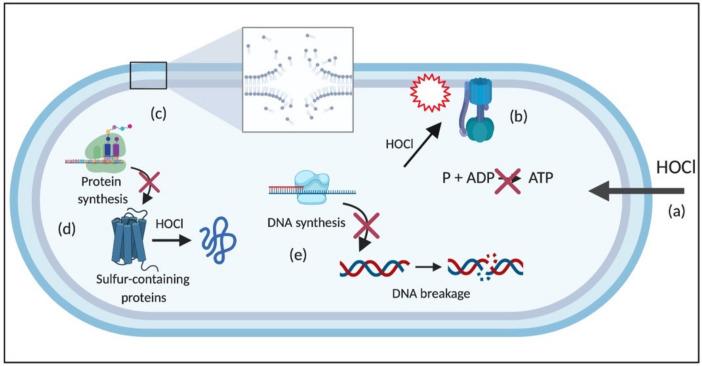
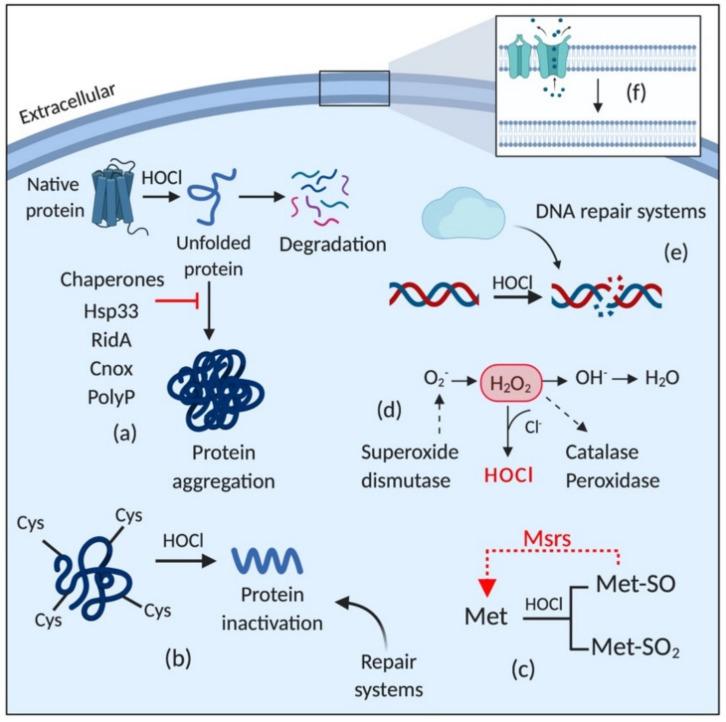
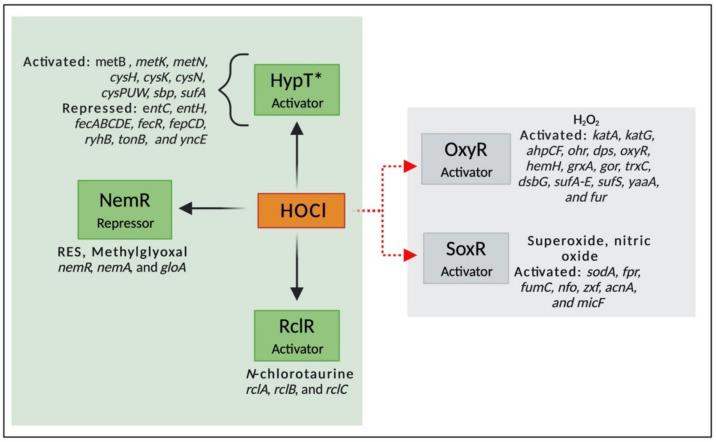
Sodium hypochlorite (NaOCl) and its active ingredient, hypochlorous acid (HOCl), are the most commonly used chlorine-based disinfectants. HOCl is a fast-acting and potent antimicrobial agent that interacts with several biomolecules, such as sulfur-containing amino acids, lipids, nucleic acids, and membrane components, causing severe cellular damage. It is also produced by the immune system as a first-line of defense against invading pathogens. In this review, we summarize the adaptive responses of Gram-negative bacteria to HOCl-induced stress and highlight the role of chaperone holdases (Hsp33, RidA, Cnox, and polyP) as an immediate response to HOCl stress. We also describe the three identified transcriptional regulators (HypT, RclR, and NemR) that specifically respond to HOCl. Besides the activation of chaperones and transcriptional regulators, the formation of biofilms has been described as an important adaptive response to several stressors, including HOCl. Although the knowledge on the molecular mechanisms involved in HOCl biofilm stimulation is limited, studies have shown that HOCl induces the formation of biofilms by causing conformational changes in membrane properties, overproducing the extracellular polymeric substance (EPS) matrix, and increasing the intracellular concentration of cyclic-di-GMP. In addition, acquisition and expression of antibiotic resistance genes, secretion of virulence factors and induction of the viable but nonculturable (VBNC) state has also been described as an adaptive response to HOCl. In general, the knowledge of how bacteria respond to HOCl stress has increased over time; however, the molecular mechanisms involved in this stress response is still in its infancy. A better understanding of these mechanisms could help understand host-pathogen interactions and target specific genes and molecules to control bacterial spread and colonization.
次氯酸钠(NaOCl)及其活性成分次氯酸(HOCl)是最常用的氯基消毒剂。HOCl是一种速效且强效的抗菌剂,它与多种生物分子相互作用,如含硫氨基酸、脂质、核酸和膜成分,导致严重的细胞损伤。它也是免疫系统产生的抵御入侵病原体的第一道防线。在本综述中,我们总结了革兰氏阴性菌对HOCl诱导的应激的适应性反应,并强调了伴侣蛋白保持酶(Hsp33、RidA、Cnox和多聚磷酸盐)作为对HOCl应激的即时反应所起的作用。我们还描述了三种已确定的特异性响应HOCl的转录调节因子(HypT、RclR和NemR)。除了伴侣蛋白和转录调节因子的激活外,生物膜的形成已被描述为对包括HOCl在内的多种应激源的重要适应性反应。尽管关于HOCl刺激生物膜形成的分子机制的知识有限,但研究表明,HOCl通过引起膜性质的构象变化、过量产生细胞外聚合物(EPS)基质以及增加细胞内环二鸟苷酸的浓度来诱导生物膜的形成。此外,抗生素抗性基因的获得和表达、毒力因子的分泌以及活的但不可培养(VBNC)状态的诱导也被描述为对HOCl的适应性反应。总体而言,随着时间的推移,人们对细菌如何应对HOCl应激的了解有所增加;然而,这种应激反应所涉及的分子机制仍处于起步阶段。更好地理解这些机制有助于理解宿主-病原体相互作用,并针对特定基因和分子来控制细菌的传播和定植。



 Zotero 插件