
1 型和 2 型糖尿病与英格兰 COVID-19 相关死亡率的关联:一项全人群研究。
Associations of type 1 and type 2 diabetes with COVID-19-related mortality in England: a whole-population study.
机构信息
Public Health England, York, UK.
NHS England and NHS Improvement, London, UK.
出版信息
Lancet Diabetes Endocrinol. 2020 Oct;8(10):813-822. doi: 10.1016/S2213-8587(20)30272-2. Epub 2020 Aug 13.
BACKGROUND
Although diabetes has been associated with COVID-19-related mortality, the absolute and relative risks for type 1 and type 2 diabetes are unknown. We assessed the independent effects of diabetes status, by type, on in-hospital death in England in patients with COVID-19 during the period from March 1 to May 11, 2020.
METHODS
We did a whole-population study assessing risks of in-hospital death with COVID-19 between March 1 and May 11, 2020. We included all individuals registered with a general practice in England who were alive on Feb 16, 2020. We used multivariable logistic regression to examine the effect of diabetes status, by type, on in-hospital death with COVID-19, adjusting for demographic factors and cardiovascular comorbidities. Because of the absence of data on total numbers of people infected with COVID-19 during the observation period, we calculated mortality rates for the population as a whole, rather than the population who were infected.
FINDINGS
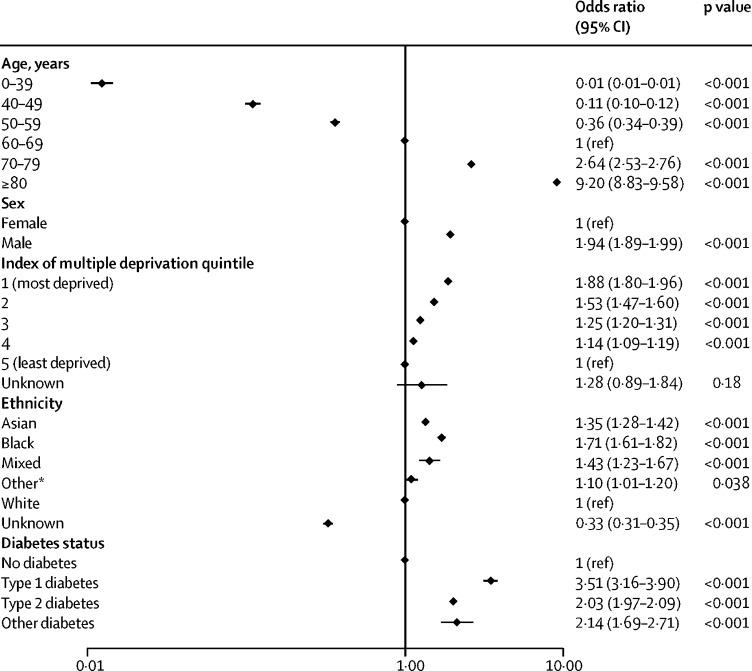
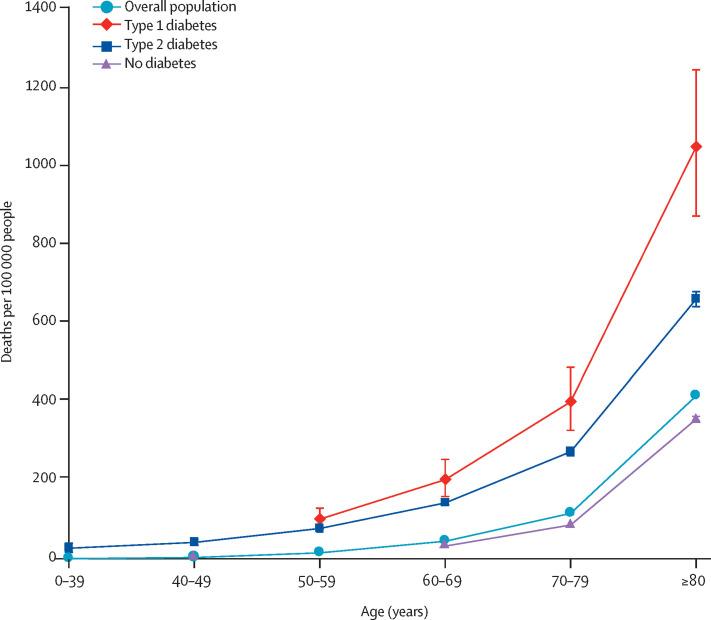
Of the 61 414 470 individuals who were alive and registered with a general practice on Feb 16, 2020, 263 830 (0·4%) had a recorded diagnosis of type 1 diabetes, 2 864 670 (4·7%) had a diagnosis of type 2 diabetes, 41 750 (0·1%) had other types of diabetes, and 58 244 220 (94·8%) had no diabetes. 23 698 in-hospital COVID-19-related deaths occurred during the study period. A third occurred in people with diabetes: 7434 (31·4%) in people with type 2 diabetes, 364 (1·5%) in those with type 1 diabetes, and 69 (0·3%) in people with other types of diabetes. Unadjusted mortality rates per 100 000 people over the 72-day period were 27 (95% CI 27-28) for those without diabetes, 138 (124-153) for those with type 1 diabetes, and 260 (254-265) for those with type 2 diabetes. Adjusted for age, sex, deprivation, ethnicity, and geographical region, compared with people without diabetes, the odds ratios (ORs) for in-hospital COVID-19-related death were 3·51 (95% CI 3·16-3·90) in people with type 1 diabetes and 2·03 (1·97-2·09) in people with type 2 diabetes. These effects were attenuated to ORs of 2·86 (2·58-3·18) for type 1 diabetes and 1·80 (1·75-1·86) for type 2 diabetes when also adjusted for previous hospital admissions with coronary heart disease, cerebrovascular disease, or heart failure.
INTERPRETATION
The results of this nationwide analysis in England show that type 1 and type 2 diabetes were both independently associated with a significant increased odds of in-hospital death with COVID-19.
FUNDING
None.
背景
尽管糖尿病与 COVID-19 相关死亡率有关,但 1 型和 2 型糖尿病的绝对和相对风险尚不清楚。我们评估了 2020 年 3 月 1 日至 5 月 11 日期间英格兰 COVID-19 住院患者中,按类型划分的糖尿病状态对住院死亡的独立影响。
方法
我们进行了一项全人群研究,评估了 2020 年 3 月 1 日至 5 月 11 日期间 COVID-19 住院死亡的风险。我们纳入了所有在 2020 年 2 月 16 日仍存活并在英格兰普通科医生处登记的个体。我们使用多变量逻辑回归来检查 1 型和 2 型糖尿病对 COVID-19 住院死亡的影响,同时调整了人口统计学因素和心血管合并症。由于缺乏观察期间 COVID-19 总感染人数的数据,我们计算了整个人群的死亡率,而不是感染人群的死亡率。
结果
在 2020 年 2 月 16 日仍存活且在普通科医生处登记的 61414470 人中,有 263830 人(0.4%)有 1 型糖尿病的记录诊断,28646700 人(4.7%)有 2 型糖尿病的诊断,41750 人(0.1%)有其他类型的糖尿病,58244420 人(94.8%)没有糖尿病。在研究期间发生了 23698 例与 COVID-19 相关的住院死亡。三分之一发生在患有糖尿病的人群中:2 型糖尿病患者中 7434 例(31.4%),1 型糖尿病患者中 364 例(1.5%),其他类型糖尿病患者中 69 例(0.3%)。在 72 天的时间内,未患有糖尿病的患者每 10 万人的死亡率为 27(95%CI 27-28),1 型糖尿病患者为 138(124-153),2 型糖尿病患者为 260(254-265)。与未患有糖尿病的患者相比,经年龄、性别、贫困、种族和地理区域调整后,1 型糖尿病患者的 COVID-19 相关住院死亡比值比(OR)为 3.51(95%CI 3.16-3.90),2 型糖尿病患者为 2.03(1.97-2.09)。当还调整了先前因冠心病、脑血管病或心力衰竭而住院的情况后,1 型糖尿病的 OR 降至 2.86(2.58-3.18),2 型糖尿病的 OR 降至 1.80(1.75-1.86)。
结论
这项在英格兰进行的全国性分析结果表明,1 型和 2 型糖尿病均与 COVID-19 住院死亡的风险显著增加独立相关。
资助
无。
 Zotero 插件