
通过限制葡萄糖摄入来延长寿命的作用会被蛋氨酸补充所削弱:葡萄糖和蛋氨酸之间的相互作用以及蛋氨酸作为寿命关键调节剂的意义。
Life span extension by glucose restriction is abrogated by methionine supplementation: Cross-talk between glucose and methionine and implication of methionine as a key regulator of life span.
机构信息
Department of Biochemistry and Biophysics, University of California, San Francisco, San Francisco, CA 94158, USA.
The State Key Laboratory for Artificial Microstructures and Mesoscopic Physics, School of Physics, Peking University, Beijing, China.
出版信息
Sci Adv. 2020 Aug 5;6(32):eaba1306. doi: 10.1126/sciadv.aba1306. eCollection 2020 Aug.
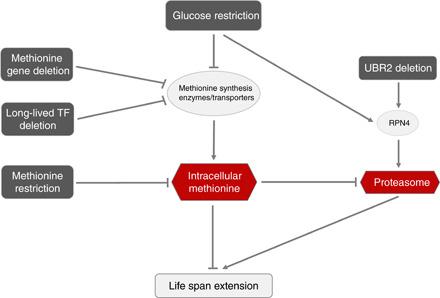
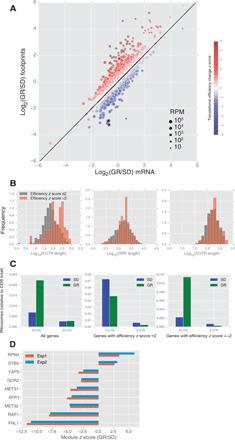
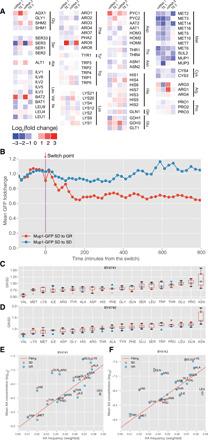
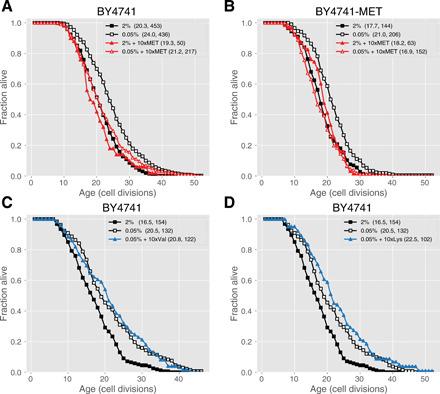
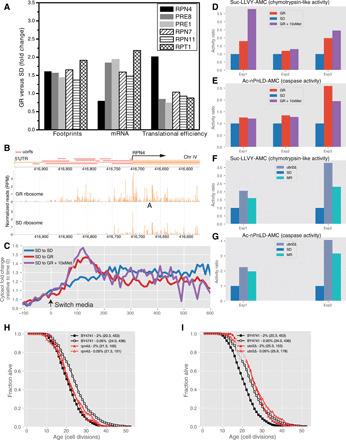
Caloric restriction (CR) is known to extend life span across species; however, the molecular mechanisms are not well understood. We investigate the mechanism by which glucose restriction (GR) extends yeast replicative life span, by combining ribosome profiling and RNA-seq with microfluidic-based single-cell analysis. We discovered a cross-talk between glucose sensing and the regulation of intracellular methionine: GR down-regulated the transcription and translation of methionine biosynthetic enzymes and transporters, leading to a decreased intracellular methionine concentration; external supplementation of methionine cancels the life span extension by GR. Furthermore, genetic perturbations that decrease methionine synthesis/uptake extend life span. These observations suggest that intracellular methionine mediates the life span effects of various nutrient and genetic perturbations, and that the glucose-methionine cross-talk is a general mechanism for coordinating the nutrient status and the translation/growth of a cell. Our work also implicates proteasome as a downstream effector of the life span extension by GR.
热量限制(CR)已知可延长多种物种的寿命;然而,其分子机制尚不清楚。我们通过结合核糖体图谱和 RNA-seq 与基于微流控的单细胞分析来研究葡萄糖限制(GR)延长酵母复制寿命的机制。我们发现了葡萄糖感应与细胞内蛋氨酸调节之间的交叉对话:GR 下调了蛋氨酸生物合成酶和转运蛋白的转录和翻译,导致细胞内蛋氨酸浓度降低;外源性补充蛋氨酸可消除 GR 引起的寿命延长。此外,降低蛋氨酸合成/摄取的遗传扰动可延长寿命。这些观察结果表明,细胞内蛋氨酸介导了各种营养和遗传扰动对寿命的影响,而葡萄糖-蛋氨酸的相互作用是协调细胞营养状态和翻译/生长的一般机制。我们的工作还表明蛋白酶体是 GR 延长寿命的下游效应物。

 Zotero 插件