
严重呼吸道病毒感染的表观遗传易感性及其治疗意义:叙事性综述。
Epigenetic susceptibility to severe respiratory viral infections and its therapeutic implications: a narrative review.
机构信息
College of Medicine, University of Central Florida, Orlando, FL, USA; Department of Anesthesiology and Critical Care Medicine, Ocala Health, Ocala, FL, USA.
Department of Advanced Medical and Surgical Sciences (DAMSS), University of Campania Luigi Vanvitelli, Naples, Italy.
出版信息
Br J Anaesth. 2020 Dec;125(6):1002-1017. doi: 10.1016/j.bja.2020.06.060. Epub 2020 Aug 20.
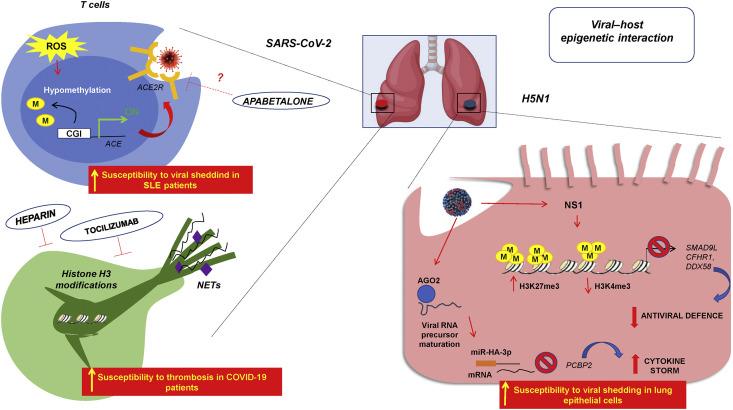
The emergence of highly pathogenic strains of influenza virus and coronavirus (CoV) has been responsible for large epidemic and pandemic outbreaks characterised by severe pulmonary illness associated with high morbidity and mortality. One major challenge for critical care is to stratify and minimise the risk of multi-organ failure during the stay in the intensive care unit (ICU). Epigenetic-sensitive mechanisms, including deoxyribonucleic acid (DNA) and ribonucleic acid (RNA) methylation, histone modifications, and non-coding RNAs may lead to perturbations of the host immune-related transcriptional programmes by regulating chromatin structure and gene expression patterns. Viruses causing severe pulmonary illness can use epigenetic-regulated mechanisms during host-pathogen interaction to interfere with innate and adaptive immunity, adequacy of inflammatory response, and overall outcome of viral infections. For example, Middle East respiratory syndrome-CoV and H5N1 can affect host antigen presentation through DNA methylation and histone modifications. The same mechanisms would presumably occur in patients with coronavirus disease 2019, in which tocilizumab may epigenetically reduce microvascular damage. Targeting epigenetic pathways by immune modulators (e.g. tocilizumab) or repurposed drugs (e.g. statins) may provide novel therapeutic opportunities to control viral-host interaction during critical illness. In this review, we provide an update on epigenetic-sensitive mechanisms and repurposed drugs interfering with epigenetic pathways which may be clinically suitable for risk stratification and beneficial for treatment of patients affected by severe viral respiratory infections.
高致病性流感病毒株和冠状病毒(CoV)的出现导致了大规模的流行和大流行爆发,其特征是严重的肺部疾病,伴有高发病率和死亡率。重症监护的一个主要挑战是在重症监护病房(ICU)住院期间对多器官衰竭进行分层和最小化风险。包括脱氧核糖核酸(DNA)和核糖核酸(RNA)甲基化、组蛋白修饰和非编码 RNA 在内的表观遗传敏感机制,可能通过调节染色质结构和基因表达模式,导致宿主免疫相关转录程序的紊乱。引起严重肺部疾病的病毒可以在宿主-病原体相互作用过程中利用表观遗传调控机制,干扰先天和适应性免疫、炎症反应的充分性以及病毒感染的总体结局。例如,中东呼吸综合征 CoV 和 H5N1 可以通过 DNA 甲基化和组蛋白修饰影响宿主抗原呈递。在 2019 冠状病毒病患者中,可能会发生同样的机制,其中托珠单抗可能通过表观遗传降低微血管损伤。免疫调节剂(如托珠单抗)或重新利用的药物(如他汀类药物)靶向表观遗传途径可能为控制危重病期间的病毒-宿主相互作用提供新的治疗机会。在这篇综述中,我们提供了关于表观遗传敏感机制和干扰表观遗传途径的重新利用药物的最新信息,这些信息可能在临床上适合风险分层,并有利于治疗受严重病毒性呼吸道感染影响的患者。
 Zotero 插件