
SARS-CoV-2 和 SARS-CoV 的比较嗜性、复制动力学和细胞损伤特征分析及其对 COVID-19 临床表现、传染性和实验室研究的影响:一项观察性研究。
Comparative tropism, replication kinetics, and cell damage profiling of SARS-CoV-2 and SARS-CoV with implications for clinical manifestations, transmissibility, and laboratory studies of COVID-19: an observational study.
机构信息
State Key Laboratory of Emerging Infectious Diseases, Carol Yu Centre for Infection, Department of Microbiology, Li Ka Shing Faculty of Medicine, The University of Hong Kong, Pokfulam, Hong Kong Special Administrative Region, China.
Department of Clinical Microbiology and Infection Control, The University of Hong Kong-Shenzhen Hospital, Shenzhen, China.
出版信息
Lancet Microbe. 2020 May;1(1):e14-e23. doi: 10.1016/S2666-5247(20)30004-5. Epub 2020 Apr 21.
BACKGROUND
Severe acute respiratory syndrome coronavirus 2 (SARS-CoV-2) was reported from China in January, 2020. SARS-CoV-2 is efficiently transmitted from person to person and, in 2 months, has caused more than 82 000 laboratory-confirmed cases of coronavirus disease 2019 (COVID-19) and 2800 deaths in 46 countries. The total number of cases and deaths has surpassed that of the 2003 severe acute respiratory syndrome coronavirus (SARS-CoV). Although both COVID-19 and severe acute respiratory syndrome (SARS) manifest as pneumonia, COVID-19 is associated with apparently more efficient transmission, fewer cases of diarrhoea, increased mental confusion, and a lower crude fatality rate. However, the underlying virus-host interactive characteristics conferring these observations on transmissibility and clinical manifestations of COVID-19 remain unknown.
METHODS
We systematically investigated the cellular susceptibility, species tropism, replication kinetics, and cell damage of SARS-CoV-2 and compared findings with those for SARS-CoV. We compared SARS-CoV-2 and SARS-CoV replication in different cell lines with one-way ANOVA. For the area under the curve comparison between SARS-CoV-2 and SARS-CoV replication in Calu3 (pulmonary) and Caco2 (intestinal) cells, we used Student's test. We analysed cell damage induced by SARS-CoV-2 and SARS-CoV with one-way ANOVA.
FINDINGS
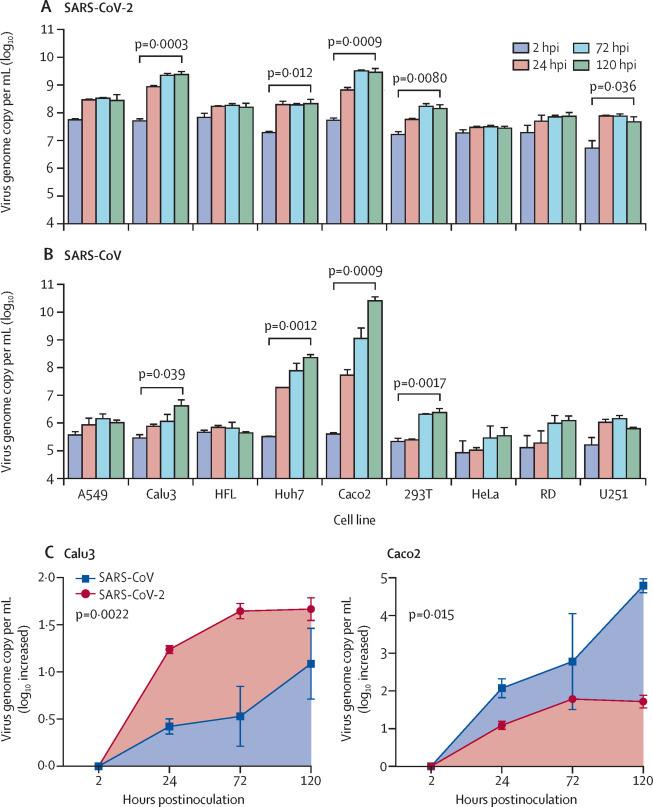
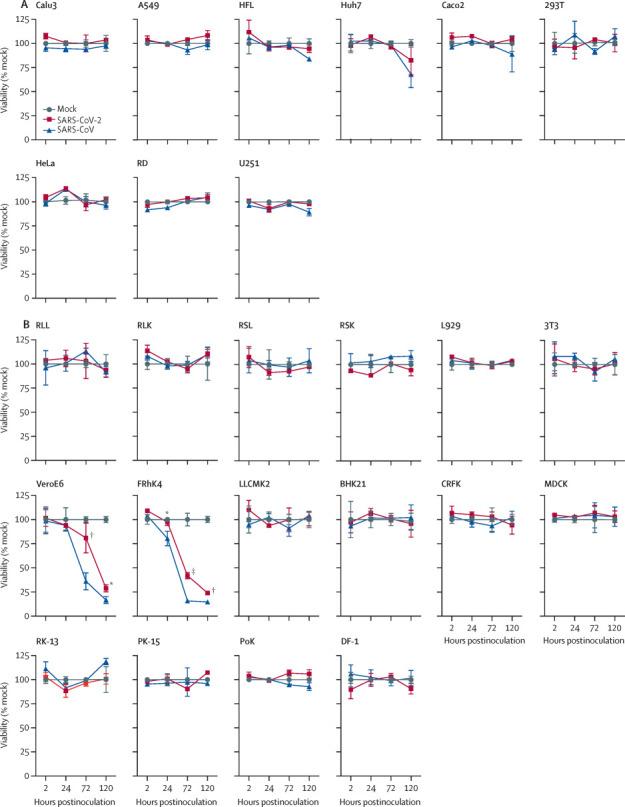
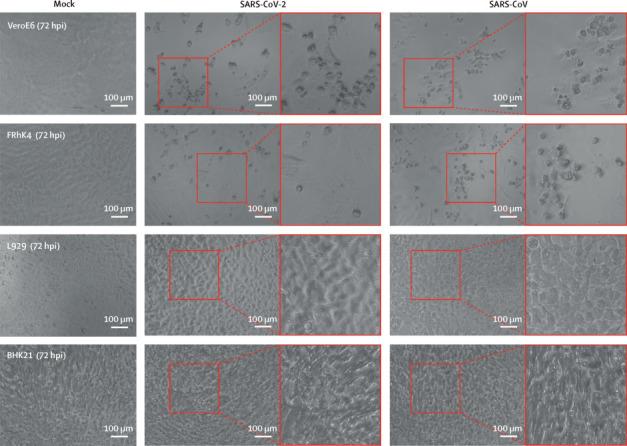
SARS-CoV-2 infected and replicated to comparable levels in human Caco2 cells and Calu3 cells over a period of 120 h (p=0·52). By contrast, SARS-CoV infected and replicated more efficiently in Caco2 cells than in Calu3 cells under the same multiplicity of infection (p=0·0098). SARS-CoV-2, but not SARS-CoV, replicated modestly in U251 (neuronal) cells (p=0·036). For animal species cell tropism, both SARS-CoV and SARS-CoV-2 replicated in non-human primate, cat, rabbit, and pig cells. SARS-CoV, but not SARS-CoV-2, infected and replicated in bat kidney cells. SARS-CoV-2 consistently induced significantly delayed and milder levels of cell damage than did SARS-CoV in non-human primate cells (VeroE6, p=0·016; FRhK4, p=0·0004).
INTERPRETATION
As far as we know, our study presents the first quantitative data for tropism, replication kinetics, and cell damage of SARS-CoV-2. These data provide novel insights into the lower incidence of diarrhoea, decreased disease severity, and reduced mortality in patients with COVID-19, with respect to the pathogenesis and high transmissibility of SARS-CoV-2 compared with SARS-CoV.
FUNDING
May Tam Mak Mei Yin, The Shaw Foundation Hong Kong, Richard Yu and Carol Yu, Michael Seak-Kan Tong, Respiratory Viral Research Foundation, Hui Ming, Hui Hoy and Chow Sin Lan Charity Fund, Chan Yin Chuen Memorial Charitable Foundation, Marina Man-Wai Lee, The Hong Kong Hainan Commercial Association South China Microbiology Research Fund, The Jessie & George Ho Charitable Foundation, Perfect Shape Medical, The Consultancy Service for Enhancing Laboratory Surveillance of Emerging Infectious Diseases and Research Capability on Antimicrobial Resistance for the Department of Health of the Hong Kong Special Administrative Region Government, The Theme-Based Research Scheme of the Research Grants Council, Sanming Project of Medicine in Shenzhen, and The High Level-Hospital Program, Health Commission of Guangdong Province, China.
背景
2020 年 1 月,中国报告了严重急性呼吸综合征冠状病毒 2(SARS-CoV-2)。SARS-CoV-2 在人与人之间高效传播,在两个月内导致超过 82000 例实验室确诊的 2019 年冠状病毒病(COVID-19)病例和 46 个国家的 2800 例死亡。病例总数和死亡人数已经超过了 2003 年的严重急性呼吸综合征冠状病毒(SARS-CoV)。虽然 COVID-19 和严重急性呼吸综合征(SARS)都表现为肺炎,但 COVID-19 与明显更高的传播效率、较少的腹泻病例、更高的精神混乱以及更低的粗死亡率有关。然而,导致这些观察结果的潜在病毒-宿主相互作用特征,以及 COVID-19 的传染性和临床表现仍不清楚。
方法
我们系统地研究了 SARS-CoV-2 的细胞易感性、物种嗜性、复制动力学和细胞损伤,并将研究结果与 SARS-CoV 进行了比较。我们使用单向方差分析比较了不同细胞系中 SARS-CoV-2 和 SARS-CoV 的复制情况。对于 Calu3(肺)和 Caco2(肠)细胞中 SARS-CoV-2 和 SARS-CoV 复制的曲线下面积比较,我们使用了学生 t 检验。我们使用单向方差分析比较了 SARS-CoV-2 和 SARS-CoV 引起的细胞损伤。
结果
SARS-CoV-2 在 120 小时的时间内以可比的水平感染并复制人类 Caco2 细胞和 Calu3 细胞(p=0·52)。相比之下,在相同的感染复数下,SARS-CoV 在 Caco2 细胞中的感染和复制效率更高,而在 Calu3 细胞中则较低(p=0·0098)。SARS-CoV-2 但不是 SARS-CoV,适度复制神经元 U251 细胞(p=0·036)。对于动物物种细胞嗜性,SARS-CoV 和 SARS-CoV-2 均在非人类灵长类动物、猫、兔和猪细胞中复制。SARS-CoV,但不是 SARS-CoV-2,感染并在蝙蝠肾脏细胞中复制。SARS-CoV-2 始终比 SARS-CoV 在非人类灵长类细胞(VeroE6,p=0·016;FRhK4,p=0·0004)中引起更迟缓和更轻微的细胞损伤。
结论
据我们所知,我们的研究首次提供了 SARS-CoV-2 的嗜性、复制动力学和细胞损伤的定量数据。这些数据为 COVID-19 患者腹泻发生率较低、疾病严重程度降低和死亡率降低提供了新的见解,与 SARS-CoV-2 的高传染性和高致病性相比,SARS-CoV-2 的发病机制和低致病性。
资金
梅艳芳、邵逸夫、余卓文和余翠怡、Michael Seak-Kan Tong、呼吸病毒研究基金会、许明、许焕明和周善兰慈善基金、陈燕民慈善基金、李漫娜、香港特别行政区政府卫生署提高新发传染病监测和抗菌药物耐药性研究能力的咨询服务计划、香港研究资助局专题研究计划、深圳市三明明项目和广东省高水平医院项目。


 Zotero 插件