
使用去细胞人羊膜移植人脂肪干细胞可改善大鼠宫腔粘连模型损伤子宫内膜组织中的血管生成。
Transplantation of Human Adipose Stem Cells Using Acellular Human Amniotic Membrane Improves Angiogenesis in Injured Endometrial Tissue in a Rat Intrauterine Adhesion Model.
机构信息
Hysteroscopic Center, Fuxing Hospital, Capital Medical University, Beijing, China.
Department of Cell Biology, Municipal Laboratory for Liver Protection and Regulation of Regeneration, 12517Capital Medical University, Beijing, China.
出版信息
Cell Transplant. 2020 Jan-Dec;29:963689720952055. doi: 10.1177/0963689720952055.
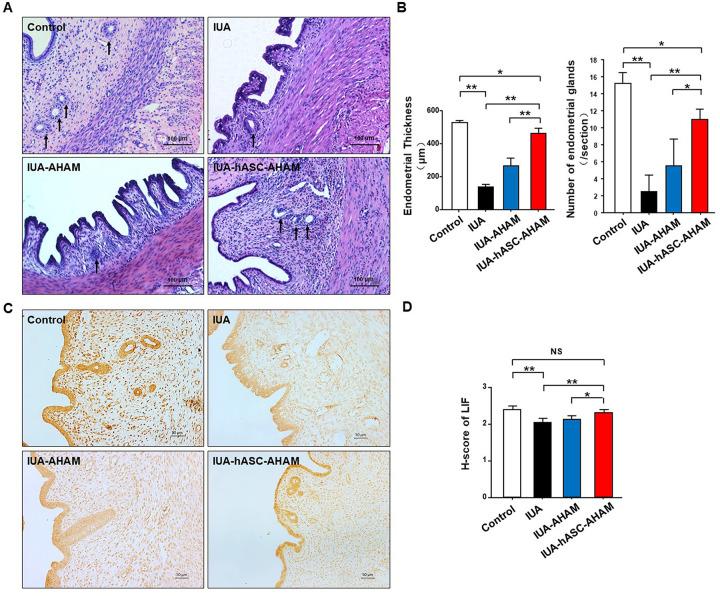
Endometrial injury resulting in intrauterine adhesion is associated with extensive damage to the regenerative basal layer of the endometrium and represents a major therapeutic challenge. Human adipose stem cells (hASCs) hold promise for future clinical use in the individualized therapy of injured endometrial tissue. Here, we observed that the use of the acellular human amniotic membrane (AHAM) significantly increased the expression of angiogenic factors, including angiogenin (ANG) and vascular endothelial growth factor (VEGF), in hASCs . The three-dimensional engineered hASC-AHAM grafts significantly increased the endometrial receptivity, as increased endometrial thickness, greater numbers of endometrial glands, and higher protein levels of leukemia inhibitory factor were observed in injured endometrial tissue that was treated with these grafts compared to those detected in injured endometrial tissue that was treated with AHAM alone. In addition, the hASC-AHAM grafts significantly increased the vascular density in the injured endometrial tissue in rats, when transplanted into an injured uterine cavity. Using the EGFP-hASC-AHAM grafts for transplantation, we confirmed that the hASCs maintained higher protein levels of ANG and VEGF in the injured uterine cavity . The results of this study suggest that the ability of the engineered hASC-AHAM grafts to repair injured endometrial tissue may be associated with their ability to promote angiogenesis through the upregulated expression of angiogenic factors in hASCs. These findings may support individualized stem cell-based therapy for endometrial disease using bioartificial grafts.
子宫内膜损伤导致宫腔粘连与子宫内膜再生基底层的广泛损伤有关,是一个主要的治疗挑战。人脂肪干细胞(hASCs)在受伤子宫内膜组织的个体化治疗中有希望在未来的临床应用中使用。在这里,我们观察到使用去细胞人羊膜(AHAM)可显著增加 hASCs 中血管生成因子的表达,包括血管生成素(ANG)和血管内皮生长因子(VEGF)。三维工程 hASC-AHAM 移植物显著增加了子宫内膜的接受性,因为与单独用 AHAM 处理的受伤子宫内膜组织相比,用这些移植物处理的受伤子宫内膜组织中子宫内膜厚度增加、子宫内膜腺体数量增加以及白血病抑制因子的蛋白水平更高。此外,当 hASC-AHAM 移植物移植到受伤的子宫腔中时,可显著增加受伤子宫内膜组织中的血管密度。使用 EGFP-hASC-AHAM 移植物进行移植,我们证实 hASCs 在受伤的子宫腔中保持更高水平的 ANG 和 VEGF 蛋白。这项研究的结果表明,工程化 hASC-AHAM 移植物修复受伤子宫内膜组织的能力可能与其通过上调 hASCs 中血管生成因子的表达促进血管生成的能力有关。这些发现可能支持使用生物人工移植物对子宫内膜疾病进行个体化的基于干细胞的治疗。


 Zotero 插件