
一系列涵盖 6 至 60 岁年龄的五个特定于印度人群的大脑模板和图谱。
A series of five population-specific Indian brain templates and atlases spanning ages 6-60 years.
机构信息
National Institute of Mental Health and Neuro Sciences, Bengaluru, India.
Scientific and Statistical Computing Core, NIMH, NIH, Bethesda, Maryland, USA.
出版信息
Hum Brain Mapp. 2020 Dec 15;41(18):5164-5175. doi: 10.1002/hbm.25182. Epub 2020 Aug 26.
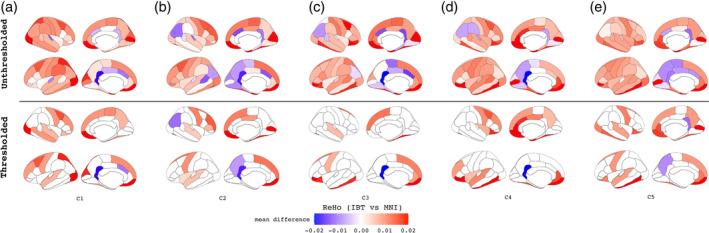
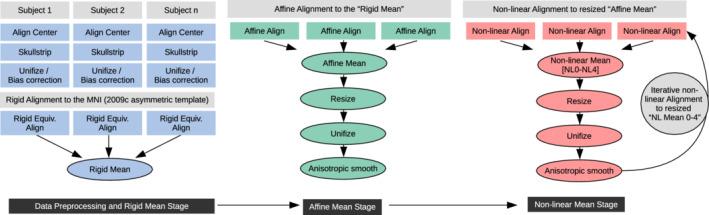
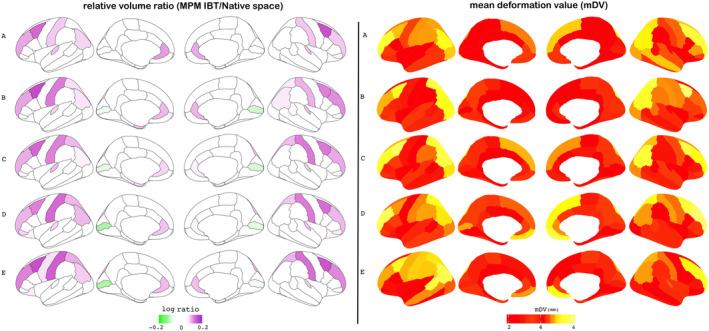
Anatomical brain templates are commonly used as references in neurological MRI studies, for bringing data into a common space for group-level statistics and coordinate reporting. Given the inherent variability in brain morphology across age and geography, it is important to have templates that are as representative as possible for both age and population. A representative-template increases the accuracy of alignment, decreases distortions as well as potential biases in final coordinate reports. In this study, we developed and validated a new set of T1w Indian brain templates (IBT) from a large number of brain scans (total n = 466) acquired across different locations and multiple 3T MRI scanners in India. A new tool in AFNI, make_template_dask.py, was created to efficiently make five age-specific IBTs (ages 6-60 years) as well as maximum probability map (MPM) atlases for each template; for each age-group's template-atlas pair, there is both a "population-average" and a "typical" version. Validation experiments on an independent Indian structural and functional-MRI dataset show the appropriateness of IBTs for spatial normalization of Indian brains. The results indicate significant structural differences when comparing the IBTs and MNI template, with these differences being maximal along the Anterior-Posterior and Inferior-Superior axes, but minimal Left-Right. For each age-group, the MPM brain atlases provide reasonably good representation of the native-space volumes in the IBT space, except in a few regions with high intersubject variability. These findings provide evidence to support the use of age and population-specific templates in human brain mapping studies.
解剖学脑模板通常被用作神经 MRI 研究的参考,以便将数据带入群组统计和坐标报告的公共空间。鉴于大脑形态在年龄和地理上存在固有差异,因此模板对于年龄和人群具有代表性非常重要。代表性模板可以提高配准的准确性,减少最终坐标报告中的扭曲和潜在偏差。在这项研究中,我们从印度各地多个地点和多台 3T MRI 扫描仪采集的大量脑扫描中开发并验证了一组新的 T1w 印度脑模板 (IBT)。在 AFNI 中创建了一个新工具,make_template_dask.py,可高效地生成五个年龄特定的 IBT(6-60 岁)以及每个模板的最大概率图谱 (MPM) 图谱;对于每个年龄组的模板-图谱对,既有“人群平均”版本,也有“典型”版本。对独立的印度结构和功能 MRI 数据集的验证实验表明,IBT 适用于印度人脑的空间归一化。结果表明,在比较 IBT 和 MNI 模板时存在显著的结构差异,这些差异在前后轴和上下轴上最大,但左右轴最小。对于每个年龄组,MPM 脑图谱在 IBT 空间中提供了对原始空间体积的合理表示,除了在一些具有高个体间变异性的区域。这些发现为在人类大脑映射研究中使用年龄和人群特定模板提供了证据支持。



 Zotero 插件