
MUC16 突变与实体瘤免疫检查点抑制剂反应的关联。
Association of MUC16 Mutation With Response to Immune Checkpoint Inhibitors in Solid Tumors.
机构信息
Beijing Key Laboratory of Clinical Study on Anticancer Molecular Targeted Drugs, National Cancer Center, National Clinical Research Center for Cancer, Cancer Hospital, Department of Medical Oncology, Chinese Academy of Medical Sciences & Peking Union Medical College, Beijing, China.
Clinical Pharmacology Research Center, Peking Union Medical College Hospital, Chinese Academy of Medical Sciences & Peking Union Medical College, Beijing, China.
出版信息
JAMA Netw Open. 2020 Aug 3;3(8):e2013201. doi: 10.1001/jamanetworkopen.2020.13201.
IMPORTANCE
As the third most frequently mutated gene in cancers, the association between MUC16 mutation and response to immune checkpoint inhibitors (ICIs) in solid tumors remains unclear.
OBJECTIVE
To examine whether MUC16 mutation is associated with genomic factors in ICI response in solid tumors and with outcomes in ICI-treated patients.
DESIGN, SETTING, AND PARTICIPANTS: This cohort study used multidimensional genomic data of 10 195 patients from The Cancer Genome Atlas (TCGA) across 30 solid tumor types, 56 patients from a non-small cell lung cancer (NSCLC) cohort, and 145 patients from a melanoma cohort. Genomic factors associated with ICI response covered tumor mutational burden, neoantigens, immune-related gene signatures, and tumor immune microenvironment. Both NSCLC and melanoma cohorts included ICI-treated patients. The TCGA cohort was used to examine the association of MUC16 mutation with genomic factors. Two ICI-treated cohorts were used to explore the significance of outcomes associated with MUC16 mutation, using Kaplan-Meier curves and Cox models with adjusting for potential confounders. Gene set enrichment analysis was used to identify MUC16 mutation-associated biological processes. Data were obtained from October 1 through October 10, 2019, and were analyzed from October 11 through December 31, 2019.
MAIN OUTCOMES AND MEASURES
Genomic factors associated with ICI response, overall survival, and clinical response.
RESULTS
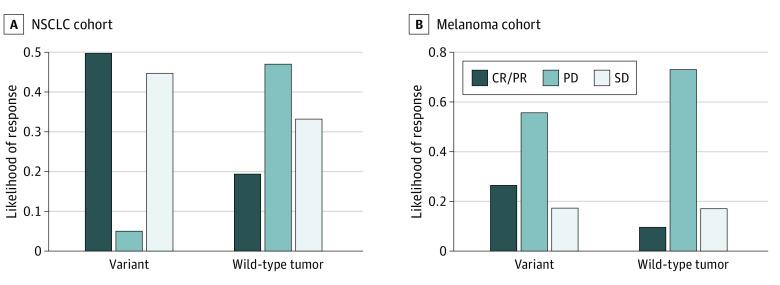
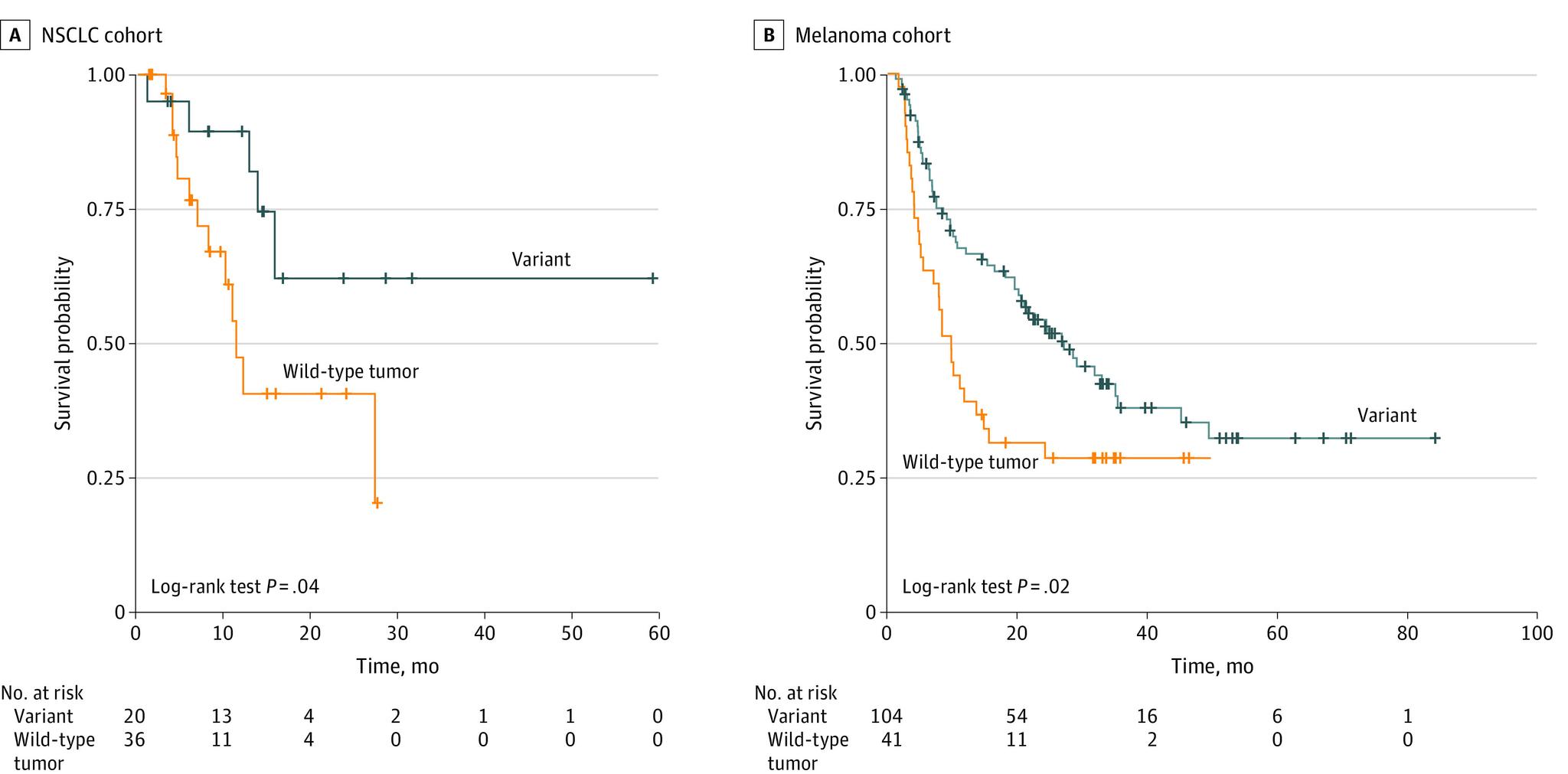
Of the 10 195 patients, 4821 (47.6%) were men (median [interquartile range {IQR}] age, 60 [50-70] years). MUC16 was mutated in 2006 of 10 195 patients (19.68%). In this pan-cancer data set, patients with MUC16 mutation had higher tumor mutational burden (median [IQR], 230 [93-595] mutations vs 48 [25-92] mutations; difference, 182 mutations; 95% CI, 164-199 mutations; P < .001) and neoantigen load (median [IQR], 179 [74-394.5] neoantigens vs 48 [24-89] neoantigens; difference, 131 antigens; 95% CI, 116.5-145 neoantigens; P < .001) than those without mutations. The tumor immune microenvironment with dual-positive CD8A and PD-L1 was overrepresented in MUC16-mutated tumors compared with wild-type ones (43.8% vs 32.4%; odds ratio, 1.63; 95% CI, 1.46-1.80; P < .001). Of the 40 immune-related genes, 37 (92.5%) exhibited differential expression between 2 states. MUC16 mutation was associated with improved overall survival in both the NSCLC (hazard ratio, 0.34; 95% CI, 0.12-0.99; P = .04) and melanoma (hazard ratio, 0.57; 95% CI, 0.36-0.90; P = .02) cohorts. The improvement persisted after adjusting for age, sex, and dominant mutational signatures in the melanoma cohort (hazard ratio, 0.57; 95% CI, 0.33-0.96; P = .04). MUC16 mutation was associated with greater response rates in the NSCLC cohort (odds ratio, 4.03; 95% CI, 1.06-16.43; P = .03) and the melanoma cohort (odds ratio, 3.38; 95% CI, 1.07-14.25; P = .03). Gene set enrichment analysis revealed that gene sets regarding cell proliferation and immune response were enriched in MUC16-mutated tumors (false discovery rate, <.001).
CONCLUSIONS AND RELEVANCE
MUC16 mutation appears to be associated with reported genomic factors associated with response to and improved outcomes for ICI treatment in solid tumors. It may hold promise as a marker for guiding immunotherapeutic responsiveness.
重要性
MUC16 突变是癌症中第三大最常突变的基因,其与实体瘤中免疫检查点抑制剂 (ICI) 反应之间的关联仍不清楚。
目的
研究 MUC16 突变是否与实体瘤中 ICI 反应的基因组因素以及 ICI 治疗患者的结局相关。
设计、地点和参与者:这项队列研究使用了来自癌症基因组图谱 (TCGA) 的 10195 名患者的多维基因组数据,涵盖 30 种实体肿瘤类型、56 名非小细胞肺癌 (NSCLC) 患者和 145 名黑色素瘤患者。与 ICI 反应相关的基因组因素包括肿瘤突变负担、新抗原、免疫相关基因特征和肿瘤免疫微环境。NSCLC 和黑色素瘤队列均包括接受 ICI 治疗的患者。TCGA 队列用于研究 MUC16 突变与基因组因素的关联。两个接受 ICI 治疗的队列用于探索与 MUC16 突变相关的结局的意义,使用 Kaplan-Meier 曲线和 Cox 模型,并调整了潜在混杂因素。进行了基因集富集分析以确定 MUC16 突变相关的生物学过程。数据于 2019 年 10 月 1 日至 10 月 10 日获得,并于 2019 年 10 月 11 日至 12 月 31 日进行分析。
主要结局和测量指标
与 ICI 反应、总生存和临床反应相关的基因组因素。
结果
在 10195 名患者中,4821 名(47.6%)为男性(中位数[四分位距 {IQR}]年龄,60 [50-70]岁)。在这个泛癌数据集,MUC16 突变患者的肿瘤突变负担(中位数 [IQR],230 [93-595] 突变 vs 48 [25-92] 突变;差异,182 个突变;95%CI,164-199 个突变;P <.001)和新抗原负荷(中位数 [IQR],179 [74-394.5] 新抗原 vs 48 [24-89] 新抗原;差异,131 个抗原;95%CI,116.5-145 个新抗原;P <.001)高于未突变患者。与野生型相比,MUC16 突变肿瘤的双阳性 CD8A 和 PD-L1 肿瘤免疫微环境更为常见(43.8% vs 32.4%;比值比,1.63;95%CI,1.46-1.80;P <.001)。在 40 个免疫相关基因中,有 37 个(92.5%)在两种状态之间表现出差异表达。在 NSCLC(危险比,0.34;95%CI,0.12-0.99;P =.04)和黑色素瘤(危险比,0.57;95%CI,0.36-0.90;P =.02)队列中,MUC16 突变与总生存改善相关。在黑色素瘤队列中,经过年龄、性别和主导突变特征调整后,这种改善仍然存在(危险比,0.57;95%CI,0.33-0.96;P =.04)。MUC16 突变与 NSCLC 队列(比值比,4.03;95%CI,1.06-16.43;P =.03)和黑色素瘤队列(比值比,3.38;95%CI,1.07-14.25;P =.03)的反应率更高相关。基因集富集分析显示,与细胞增殖和免疫反应相关的基因集在 MUC16 突变肿瘤中富集(错误发现率,<.001)。
结论和相关性
MUC16 突变似乎与实体瘤中与 ICI 反应和改善 ICI 治疗结局相关的报道基因组因素有关。它可能有望成为指导免疫治疗反应性的标志物。



 Zotero 插件