
靶向深度测序揭示蜜蜂肠道微生物组的结构和动态。
Strain Structure and Dynamics Revealed by Targeted Deep Sequencing of the Honey Bee Gut Microbiome.
机构信息
Department of Biology, University of North Carolina at Greensboro, Greensboro, North Carolina, USA
Department of Biology, University of North Carolina at Greensboro, Greensboro, North Carolina, USA.
出版信息
mSphere. 2020 Aug 26;5(4):e00694-20. doi: 10.1128/mSphere.00694-20.
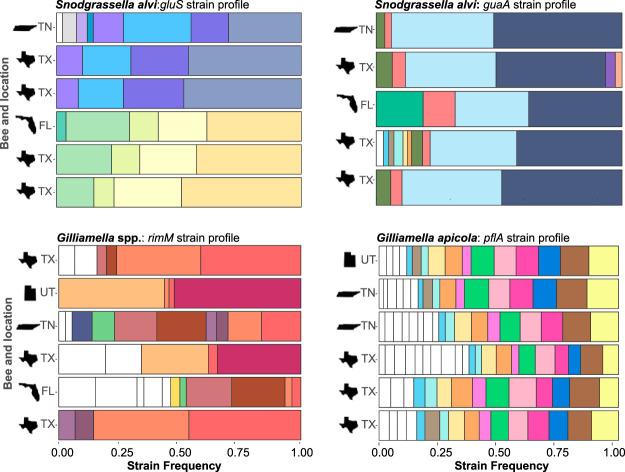
Host-associated microbiomes can be critical for the health and proper development of animals and plants. The answers to many fundamental questions regarding the modes of acquisition and microevolution of microbiome communities remain to be established. Deciphering strain-level dynamics is essential to fully understand how microbial communities evolve, but the forces shaping the strain-level dynamics of microbial communities remain largely unexplored, mostly because of methodological issues and cost. Here, we used targeted strain-level deep sequencing to uncover the strain dynamics within a host-associated microbial community using the honey bee gut microbiome as a model system. Our results revealed that amplicon sequencing of conserved protein-coding gene regions using species-specific primers is a cost-effective and accurate method for exploring strain-level diversity. In fact, using this method we were able to confirm strain-level results that have been obtained from whole-genome shotgun sequencing of the honey bee gut microbiome but with a much higher resolution. Importantly, our deep sequencing approach allowed us to explore the impact of low-frequency strains (i.e., cryptic strains) on microbiome dynamics. Results show that cryptic strain diversity is not responsible for the observed variations in microbiome composition across bees. Altogether, the findings revealed new fundamental insights regarding strain dynamics of host-associated microbiomes. The factors driving fine-scale composition and dynamics of gut microbial communities are poorly understood. In this study, we used metagenomic amplicon deep sequencing to decipher the strain dynamics of two key members of the honey bee gut microbiome. Using this high-throughput and cost-effective approach, we were able to confirm results from previous large-scale whole-genome shotgun (WGS) metagenomic sequencing studies while also gaining additional insights into the community dynamics of two core members of the honey bee gut microbiome. Moreover, we were able to show that cryptic strains are not responsible for the observed variations in microbiome composition across bees.
宿主相关微生物组对动植物的健康和正常发育至关重要。许多关于微生物组群落获取和微观进化模式的基本问题的答案仍有待确定。解析菌株水平的动态变化对于充分了解微生物群落如何进化至关重要,但塑造微生物群落菌株水平动态变化的力量在很大程度上仍未得到探索,这主要是由于方法学问题和成本问题。在这里,我们使用靶向菌株水平深度测序,以揭示以蜜蜂肠道微生物组为模型系统的宿主相关微生物群落中的菌株动态。我们的研究结果表明,使用物种特异性引物对保守蛋白编码基因区域进行扩增子测序是一种经济高效且准确的方法,可用于探索菌株水平的多样性。事实上,使用这种方法,我们能够证实从蜜蜂肠道微生物组的全基因组鸟枪法测序中获得的菌株水平结果,但分辨率要高得多。重要的是,我们的深度测序方法使我们能够探索低频菌株(即隐匿菌株)对微生物组动态的影响。结果表明,隐匿菌株多样性并不是导致蜜蜂间微生物组组成变化的原因。总的来说,这些发现揭示了宿主相关微生物组菌株动态的新的基本见解。驱动肠道微生物群落精细组成和动态变化的因素尚未得到很好的理解。在这项研究中,我们使用宏基因组扩增子深度测序来破译蜜蜂肠道微生物组的两个关键成员的菌株动态。使用这种高通量且具有成本效益的方法,我们不仅能够证实之前大规模全基因组鸟枪法(WGS)宏基因组测序研究的结果,还能够深入了解蜜蜂肠道微生物组的两个核心成员的群落动态。此外,我们能够表明隐匿菌株并不是导致蜜蜂间微生物组组成变化的原因。


 Zotero 插件