
创伤性脑损伤诱导的迟发性感觉超敏和谷氨酸神经传递的性别依赖性变化。
Traumatic Brain Injury-Induced Sex-Dependent Changes in Late-Onset Sensory Hypersensitivity and Glutamate Neurotransmission.
作者信息
Krishna Gokul, Bromberg Caitlin, Connell Emily Charlotte, Mian Erum, Hu Chengcheng, Lifshitz Jonathan, Adelson P David, Thomas Theresa Currier
机构信息
Department of Child Health, University of Arizona College of Medicine - Phoenix, Phoenix, AZ, United States.
Barrow Neurological Institute at Phoenix Children's Hospital, Phoenix, AZ, United States.
出版信息
Front Neurol. 2020 Aug 5;11:749. doi: 10.3389/fneur.2020.00749. eCollection 2020.
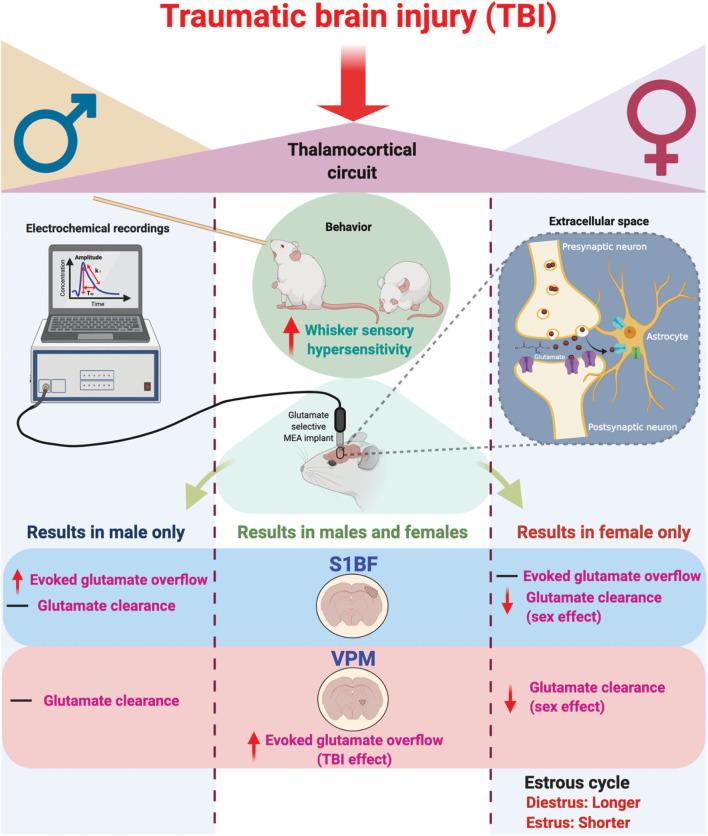
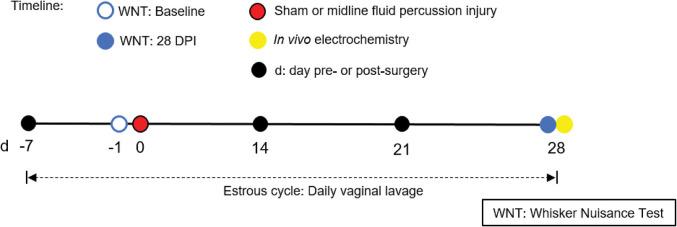
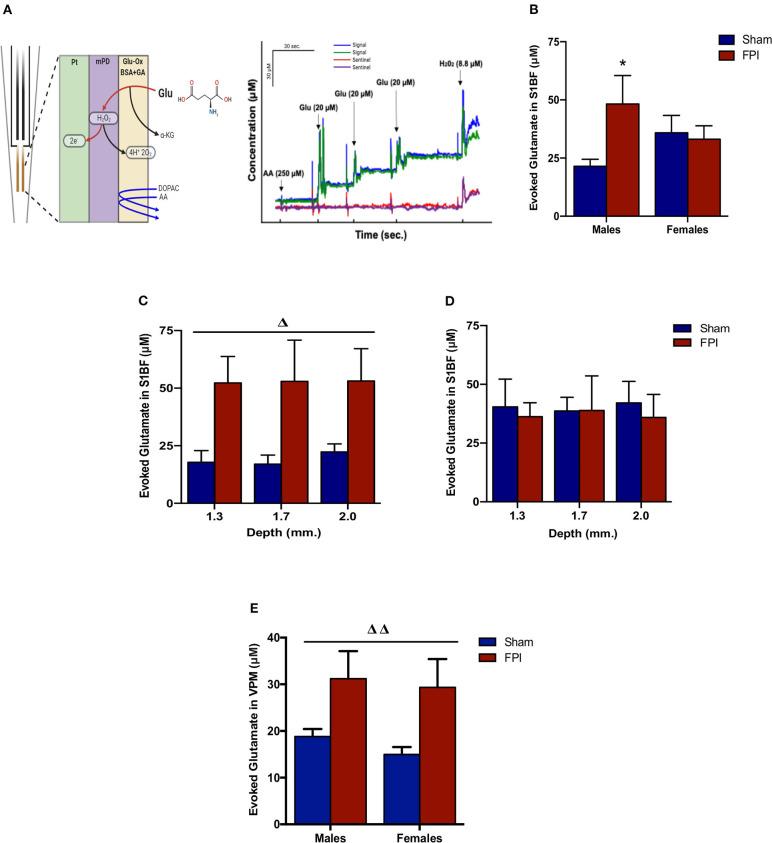
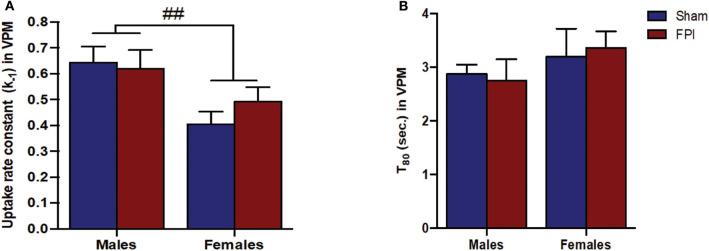
Women approximate one-third of the annual 2.8 million people in the United States who sustain traumatic brain injury (TBI). Several clinical reports support or refute that menstrual cycle-dependent fluctuations in sex hormones are associated with severity of persisting post-TBI symptoms. Previously, we reported late-onset sensory hypersensitivity to whisker stimulation that corresponded with changes in glutamate neurotransmission at 1-month following diffuse TBI in male rats. Here, we incorporated intact age-matched naturally cycling females into the experimental design while monitoring daily estrous cycle. We hypothesized that sex would not influence late-onset sensory hypersensitivity and associated amperometric extracellular recordings of glutamate neurotransmission within the behaviorally relevant thalamocortical circuit. At 28 days following midline fluid percussion injury (FPI) or sham surgery, young adult Sprague-Dawley rats were tested for hypersensitivity to whisker stimulation using the whisker nuisance task (WNT). As predicted, both male and female rats showed significantly increased sensory hypersensitivity to whisker stimulation after FPI, with females having an overall decrease in whisker nuisance scores (sex effect), but no injury and sex interaction. In males, FPI increased potassium chloride (KCl)-evoked glutamate overflow in primary somatosensory barrel cortex (S1BF) and ventral posteromedial nucleus of the thalamus (VPM), while in females the FPI effect was discernible only within the VPM. Similar to our previous report, we found the glutamate clearance parameters were not influenced by FPI, while a sex-specific effect was evident with female rats showing a lower uptake rate constant both in S1BF and VPM and longer clearance time (in S1BF) in comparison to male rats. Fluctuations in estrous cycle were evident among brain-injured females with longer diestrus (low circulating hormone) phase of the cycle over 28 days post-TBI. Together, these findings add to growing evidence indicating both similarities and differences between sexes in a chronic response to TBI. A better understanding of the influence of gonadal hormones on behavior, neurotransmission, secondary injury and repair processes after TBI is needed both clinically and translationally, with potential impact on acute treatment, rehabilitation, and symptom management.
在美国,每年有280万人遭受创伤性脑损伤(TBI),其中女性约占三分之一。几份临床报告支持或反驳了性激素的月经周期依赖性波动与TBI后持续症状的严重程度有关。此前,我们报告了雄性大鼠弥漫性TBI后1个月,对触须刺激的迟发性感觉超敏反应与谷氨酸神经传递的变化相对应。在这里,我们将年龄匹配的自然发情周期的完整雌性大鼠纳入实验设计,同时监测每日发情周期。我们假设性别不会影响迟发性感觉超敏反应以及行为相关的丘脑皮质回路中谷氨酸神经传递的相关安培细胞外记录。在中线液压冲击伤(FPI)或假手术后28天,使用触须干扰任务(WNT)测试年轻成年Sprague-Dawley大鼠对触须刺激的超敏反应。如预期的那样,FPI后,雄性和雌性大鼠对触须刺激的感觉超敏反应均显著增加,雌性大鼠的触须干扰得分总体下降(性别效应),但没有损伤和性别相互作用。在雄性大鼠中,FPI增加了原发性躯体感觉桶状皮质(S1BF)和丘脑腹后内侧核(VPM)中氯化钾(KCl)诱发的谷氨酸溢出,而在雌性大鼠中,FPI效应仅在VPM中明显。与我们之前的报告相似,我们发现谷氨酸清除参数不受FPI影响,而存在性别特异性效应,雌性大鼠在S1BF和VPM中的摄取速率常数均低于雄性大鼠,且在S1BF中的清除时间更长。脑损伤雌性大鼠的发情周期波动明显,TBI后28天内发情后期(循环激素水平低)阶段更长。总之,这些发现进一步证明了TBI慢性反应中性别之间的异同。临床上和转化医学上都需要更好地了解性腺激素对TBI后行为、神经传递、继发性损伤和修复过程的影响,这可能对急性治疗、康复和症状管理产生影响。


 Zotero 插件