
有前途的治疗策略应对微生物生物膜挑战。
Promising Therapeutic Strategies Against Microbial Biofilm Challenges.
机构信息
Department of Infectious Diseases, First Hospital of Jilin University, Changchun, China.
Department of Pediatrics, University of Oklahoma Health Sciences Center, Oklahoma City, OK, United States.
出版信息
Front Cell Infect Microbiol. 2020 Jul 28;10:359. doi: 10.3389/fcimb.2020.00359. eCollection 2020.
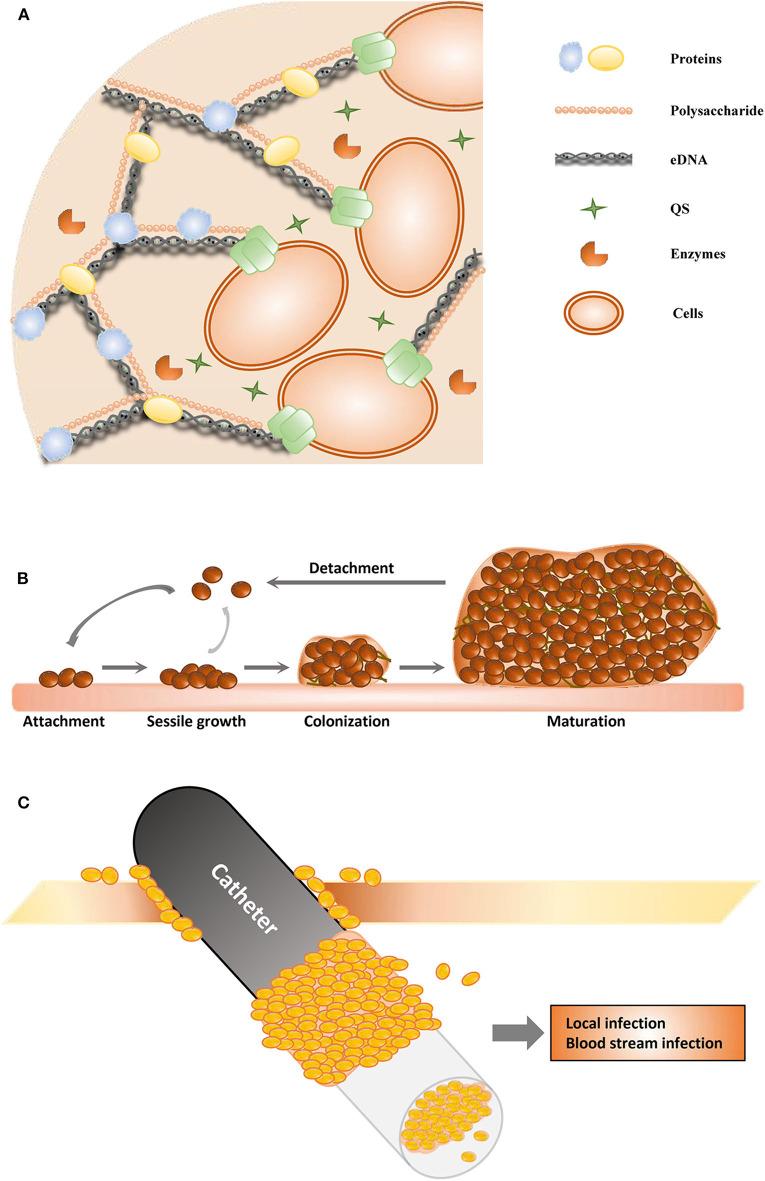
Biofilms are communities of microorganisms that are attached to a biological or abiotic surface and are surrounded by a self-produced extracellular matrix. Cells within a biofilm have intrinsic characteristics that are different from those of planktonic cells. Biofilm resistance to antimicrobial agents has drawn increasing attention. It is well-known that medical device- and tissue-associated biofilms may be the leading cause for the failure of antibiotic treatments and can cause many chronic infections. The eradication of biofilms is very challenging. Many researchers are working to address biofilm-related infections, and some novel strategies have been developed and identified as being effective and promising. Nevertheless, more preclinical studies and well-designed multicenter clinical trials are critically needed to evaluate the prospects of these strategies. Here, we review information about the mechanisms underlying the drug resistance of biofilms and discuss recent progress in alternative therapies and promising strategies against microbial biofilms. We also summarize the strengths and weaknesses of these strategies in detail.
生物膜是微生物附着在生物或非生物表面并被自身产生的细胞外基质包围的群落。生物膜内的细胞具有不同于浮游细胞的固有特性。生物膜对抗生素的耐药性引起了越来越多的关注。众所周知,医疗器械和组织相关的生物膜可能是抗生素治疗失败的主要原因,并可导致许多慢性感染。生物膜的清除极具挑战性。许多研究人员正在致力于解决与生物膜相关的感染问题,一些新的策略已经被开发出来并被证明是有效和有前途的。然而,仍迫切需要更多的临床前研究和精心设计的多中心临床试验来评估这些策略的前景。在这里,我们综述了生物膜耐药性的机制信息,并讨论了针对微生物生物膜的替代疗法和有希望的策略的最新进展。我们还详细总结了这些策略的优缺点。


 Zotero 插件