
对PD-1/PD-L1阻断癌症免疫疗法的耐药性:机制、预测因素及未来展望。
Resistance to PD-1/PD-L1 blockade cancer immunotherapy: mechanisms, predictive factors, and future perspectives.
作者信息
Sun Jin-Yu, Zhang Dengke, Wu Songquan, Xu Min, Zhou Xiao, Lu Xiao-Jie, Ji Jiansong
机构信息
The First College of Clinical Medicine, the First Affiliated Hospital of Nanjing Medical University, Nanjing Medical University, Nanjing, China.
Key Laboratory of Imaging Diagnosis and Minimally Invasive Intervention Research, Lishui Hospital of Zhejiang University/ The Fifth Affiliated Hospital of Wenzhou Medical University/ Clinical Medicine of Center Hospital of Lishui College, Lishui, 323000 China.
出版信息
Biomark Res. 2020 Aug 26;8:35. doi: 10.1186/s40364-020-00212-5. eCollection 2020.
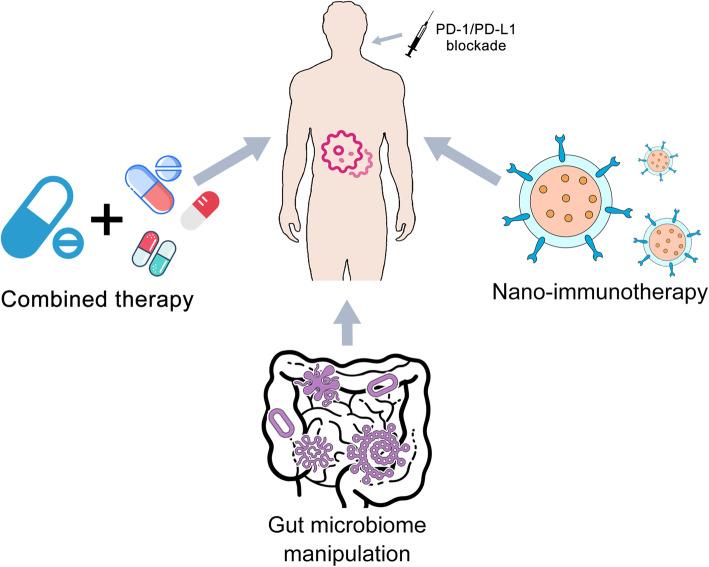
PD-1/PD-L1 blockade therapy is a promising cancer treatment strategy, which has revolutionized the treatment landscape of malignancies. Over the last decade, PD-1/PD-L1 blockade therapy has been trialed in a broad range of malignancies and achieved clinical success. Despite the potentially cure-like survival benefit, only a minority of patients are estimated to experience a positive response to PD-1/PD-L1 blockade therapy, and the primary or acquired resistance might eventually lead to cancer progression in patients with clinical responses. Accordingly, the resistance to PD-1/PD-L1 blockade remains a significant challenge hindering its further application. To overcome the limitation in therapy resistance, substantial effort has been made to improve or develop novel anti-PD-1/PD-L1 based immunotherapy strategies with better clinical response and reduced immune-mediated toxicity. In this review, we provide an overview on the resistance to PD-1/PD-L1 blockade and briefly introduce the mechanisms underlying therapy resistance. Moreover, we summarize potential predictive factors for the resistance to PD-1/PD-L1 blockade. Furthermore, we give an insight into the possible solutions to improve efficacy and clinical response. In the following research, combined efforts of basic researchers and clinicians are required to address the limitation of therapy resistance.
程序性死亡蛋白1(PD-1)/程序性死亡配体1(PD-L1)阻断疗法是一种很有前景的癌症治疗策略,它彻底改变了恶性肿瘤的治疗格局。在过去十年中,PD-1/PD-L1阻断疗法已在多种恶性肿瘤中进行试验并取得了临床成功。尽管有潜在的类似治愈的生存益处,但据估计只有少数患者对PD-1/PD-L1阻断疗法有阳性反应,而原发性或获得性耐药最终可能导致有临床反应的患者癌症进展。因此,对PD-1/PD-L1阻断的耐药性仍然是阻碍其进一步应用的重大挑战。为了克服治疗耐药性的局限性,人们已付出巨大努力来改进或开发基于抗PD-1/PD-L1的新型免疫治疗策略,以获得更好的临床反应并降低免疫介导的毒性。在本综述中,我们概述了对PD-1/PD-L1阻断的耐药性,并简要介绍了治疗耐药性的潜在机制。此外,我们总结了对PD-1/PD-L1阻断耐药的潜在预测因素。此外,我们深入探讨了提高疗效和临床反应的可能解决方案。在接下来的研究中,基础研究人员和临床医生需要共同努力来解决治疗耐药性的局限性。
 Zotero 插件