
瑜伽与非运动或物理治疗运动对慢性下腰痛患者疼痛、残疾和生活质量的比较:随机对照试验的系统评价和荟萃分析。
Yoga compared to non-exercise or physical therapy exercise on pain, disability, and quality of life for patients with chronic low back pain: A systematic review and meta-analysis of randomized controlled trials.
机构信息
The Affiliated Xuzhou Rehabilitation Hospital of Xuzhou Medical University, Xuzhou Rehabilitation Hospital, Xuzhou, China.
Department of Rehabilitation Medicine, XuZhou Central Hospital, Xuzhou, China.
出版信息
PLoS One. 2020 Sep 1;15(9):e0238544. doi: 10.1371/journal.pone.0238544. eCollection 2020.
BACKGROUND
Chronic low back pain (CLBP) is a common and often disabling musculoskeletal condition. Yoga has been proven to be an effective therapy for chronic low back pain. However, there are still controversies about the effects of yoga at different follow-up periods and compared with other physical therapy exercises.
OBJECTIVE
To critically compare the effects of yoga for patients with chronic low back pain on pain, disability, quality of life with non-exercise (e.g. usual care, education), physical therapy exercise.
METHODS
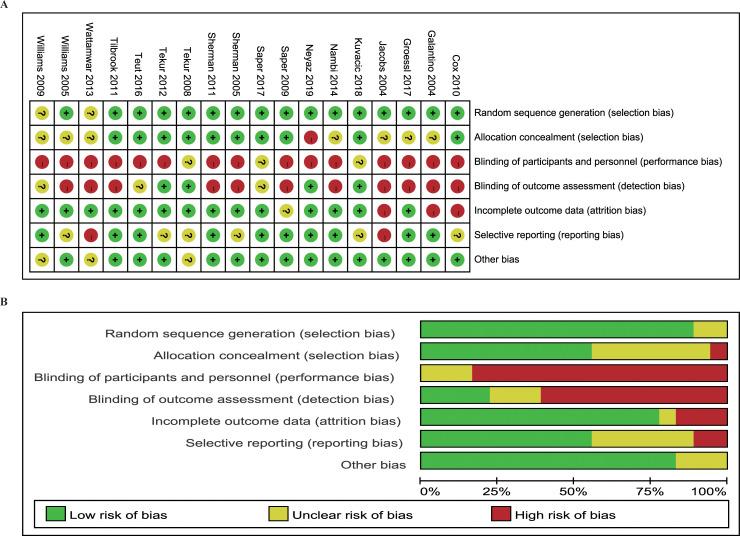
This study was registered in PROSPERO, and the registration number was CRD42020159865. Randomized controlled trials (RCTs) of online databases included PubMed, Web of Science, Cochrane Central Register of Controlled Trials, Embase which evaluated effects of yoga for patients with chronic low back pain on pain, disability, and quality of life were searched from inception time to November 1, 2019. Studies were eligible if they assessed at least one important outcome, namely pain, back-specific disability, quality of life. The Cochrane risk of bias tool was used to assess the methodological quality of included randomized controlled trials. The continuous outcomes were analyzed by calculating the mean difference (MD) or standardized mean difference (SMD) with 95% confidence intervals (CI) according to whether combining outcomes measured on different scales or not.
RESULTS
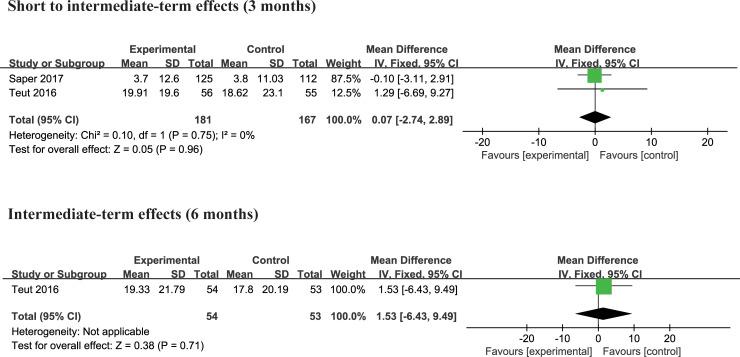
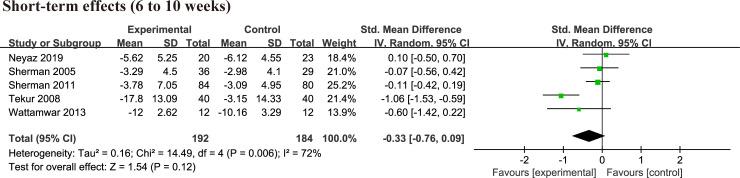
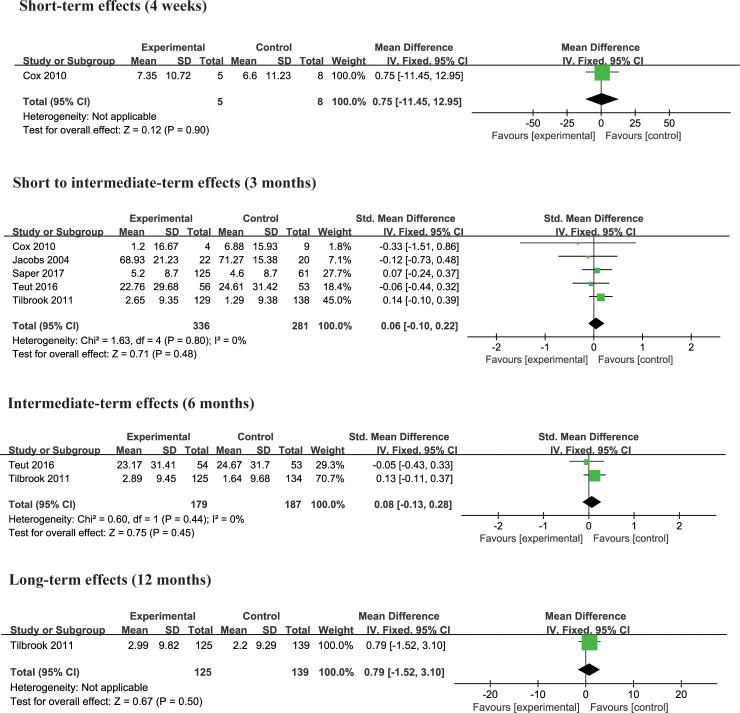
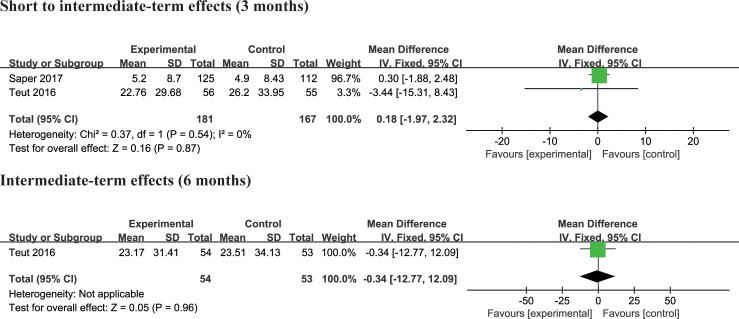
A total of 18 randomized controlled trials were included in this meta-analysis. Yoga could significantly reduce pain at 4 to 8 weeks (MD = -0.83, 95% CI = -1.19 to -0.48, p<0.00001, I2 = 0%), 3 months (MD = -0.43, 95% CI = -0.64 to -0.23, p<0.0001, I2 = 0%), 6 to 7 months (MD = -0.56, 95% CI = -1.02 to -0.11, p = 0.02, I2 = 50%), and was not significant in 12 months (MD = -0.52, 95% CI = -1.64 to 0.59, p = 0.36, I2 = 87%) compared with non-exercise. Yoga was better than non-exercise on disability at 4 to 8 weeks (SMD = -0.30, 95% CI = -0.51 to -0.10, p = 0.003, I2 = 0%), 3 months (SMD = -0.31, 95% CI = -0.45 to -0.18, p<0.00001, I2 = 30%), 6 months (SMD = -0.38, 95% CI = -0.53 to -0.23, p<0.00001, I2 = 0%), 12 months (SMD = -0.33, 95% CI = -0.54 to -0.12, p = 0.002, I2 = 9%). There was no significant difference on pain, disability compared with physical therapy exercise group. Furthermore, it suggested that there was a non-significant difference on physical and mental quality of life between yoga and any other interventions.
CONCLUSION
This meta-analysis provided evidence from very low to moderate investigating the effectiveness of yoga for chronic low back pain patients at different time points. Yoga might decrease pain from short term to intermediate term and improve functional disability status from short term to long term compared with non-exercise (e.g. usual care, education). Yoga had the same effect on pain and disability as any other exercise or physical therapy. Yoga might not improve the physical and mental quality of life based on the result of a merging.
背景
慢性下背痛(CLBP)是一种常见且常使人丧失能力的肌肉骨骼疾病。瑜伽已被证明是治疗慢性下背痛的有效疗法。然而,对于瑜伽在不同随访期的效果,以及与其他物理治疗运动相比,仍存在争议。
目的
批判性地比较瑜伽对慢性下背痛患者的影响,包括疼痛、残疾、生活质量,与非运动(如常规护理、教育)、物理治疗运动相比。
方法
本研究在 PROSPERO 上注册,注册号为 CRD42020159865。检索了包括 PubMed、Web of Science、Cochrane 对照试验中心注册库、Embase 在内的在线数据库中的随机对照试验(RCTs),评估了瑜伽对慢性下背痛患者的影响,包括疼痛、残疾和生活质量。检索时间从开始时间到 2019 年 11 月 1 日。如果研究评估了至少一个重要结果,即疼痛、背部特异性残疾、生活质量,则符合纳入标准。使用 Cochrane 偏倚风险工具评估纳入的随机对照试验的方法学质量。对于不同量表测量的结果,连续结果通过计算平均值差(MD)或标准化平均值差(SMD)及其 95%置信区间(CI)进行分析。
结果
共有 18 项随机对照试验纳入本荟萃分析。瑜伽在 4 至 8 周(MD = -0.83,95%CI = -1.19 至 -0.48,p<0.00001,I2 = 0%)、3 个月(MD = -0.43,95%CI = -0.64 至 -0.23,p<0.0001,I2 = 0%)、6 至 7 个月(MD = -0.56,95%CI = -1.02 至 -0.11,p = 0.02,I2 = 50%)时,疼痛明显减轻,但在 12 个月时不显著(MD = -0.52,95%CI = -1.64 至 0.59,p = 0.36,I2 = 87%),与非运动相比。瑜伽在 4 至 8 周(SMD = -0.30,95%CI = -0.51 至 -0.10,p = 0.003,I2 = 0%)、3 个月(SMD = -0.31,95%CI = -0.45 至 -0.18,p<0.00001,I2 = 30%)、6 个月(SMD = -0.38,95%CI = -0.53 至 -0.23,p<0.00001,I2 = 0%)、12 个月(SMD = -0.33,95%CI = -0.54 至 -0.12,p = 0.002,I2 = 9%)时,残疾情况明显改善,与非运动相比。与物理治疗运动相比,在疼痛和残疾方面没有显著差异。此外,瑜伽与任何其他干预措施在身体和心理健康生活质量方面没有显著差异。
结论
这项荟萃分析提供了从非常低到中等的证据,研究了瑜伽在不同时间点对慢性下背痛患者的有效性。与非运动(如常规护理、教育)相比,瑜伽可能在短期至中期减轻疼痛,在短期至长期改善功能残疾状况。瑜伽在疼痛和残疾方面的效果与任何其他运动或物理治疗相同。基于合并结果,瑜伽可能不会改善身体和心理健康生活质量。




 Zotero 插件