
二氯乙酸盐对青年和成年大鼠肝及肝外组织 GSTZ1 表达和活性的多次给药影响。
Effects of Multiple Doses of Dichloroacetate on GSTZ1 Expression and Activity in Liver and Extrahepatic Tissues of Young and Adult Rats.
机构信息
Departments of Medicinal Chemistry (E.J.S., M.G.S., L.R.-F., M.O.J.), Medicine (L.P.H., P.W.S.), and Biochemistry and Molecular Biology (P.W.S.), University of Florida, Gainesville, Florida.
Departments of Medicinal Chemistry (E.J.S., M.G.S., L.R.-F., M.O.J.), Medicine (L.P.H., P.W.S.), and Biochemistry and Molecular Biology (P.W.S.), University of Florida, Gainesville, Florida
出版信息
Drug Metab Dispos. 2020 Nov;48(11):1217-1223. doi: 10.1124/dmd.120.000142. Epub 2020 Sep 1.
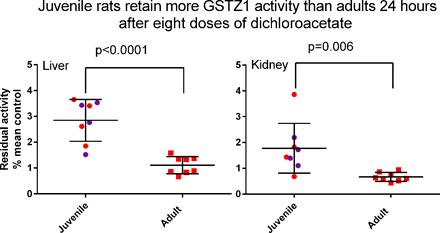
Glutathione transferase zeta 1 (GSTZ1), expressed in liver and several extrahepatic tissues, catalyzes dechlorination of dichloroacetate (DCA) to glyoxylate. DCA inactivates GSTZ1, leading to autoinhibition of its metabolism. DCA is an investigational drug for treating several congenital and acquired disorders of mitochondrial energy metabolism, including cancer. The main adverse effect of DCA, reversible peripheral neuropathy, is more common in adults treated long-term than in children, who metabolize DCA more quickly after multiple doses. One dose of DCA to Sprague Dawley rats reduced GSTZ1 expression and activity more in liver than in extrahepatic tissues; however, the effects of multiple doses of DCA that mimic its therapeutic use have not been studied. Here, we examined the expression and activity of GSTZ1 in cytosol and mitochondria of liver, kidney, heart, and brain 24 hours after completion of 8-day oral dosing of 100 mg/kg per day sodium DCA to juvenile and adult Sprague Dawley rats. Activity was measured with DCA and with 1,2-epoxy-3-(4-nitrophenoxy)propane (EPNPP), reported to be a GSTZ1-selective substrate. In DCA-treated rats, liver retained higher expression and activity of GSTZ1 with DCA than other tissues, irrespective of rodent age. DCA-treated juvenile rats retained more GSTZ1 activity with DCA than adults. Consistent with this finding, there was less measurable DCA in tissues of juvenile than adult rats. DCA-treated rats retained activity with EPNPP, despite losing over 98% of GSTZ1 protein. These data provide insight into the differences between children and adults in DCA elimination under a therapeutic regimen and confirm that the liver contributes more to DCA metabolism than other tissues. SIGNIFICANCE STATEMENT: Dichloroacetate (DCA) is one of few drugs exhibiting higher clearance from children than adults, after repeated doses, for reasons that are unclear. We hypothesized that juveniles retain more glutathione transferase zeta 1 (GSTZ1) than adults in tissues after multiple DCA doses and found this was the case for liver and kidney, with rat as a model to assess GSTZ1 protein expression and activity with DCA. Although 1,2-epoxy-3-(4-nitrophenoxy)propane was reported to be a selective GSTZ1 substrate, its activity was not reduced in concert with GSTZ1 protein.
谷胱甘肽转移酶 ζ1(GSTZ1)在肝脏和几种肝外组织中表达,催化二氯乙酸(DCA)的脱氯反应生成乙醛酸。DCA 可使 GSTZ1 失活,从而自动抑制其代谢。DCA 是一种用于治疗多种先天性和获得性线粒体能量代谢紊乱的研究药物,包括癌症。DCA 的主要不良反应是可逆性周围神经病,在长期接受治疗的成人中比在儿童中更为常见,因为儿童在多次给药后更快速地代谢 DCA。DCA 对 Sprague Dawley 大鼠的单次剂量给药使肝脏中 GSTZ1 的表达和活性比肝外组织中的降低更明显;然而,尚未研究模仿其治疗用途的多次 DCA 剂量的影响。在这里,我们研究了谷胱甘肽转移酶 ζ1(GSTZ1)在接受 100mg/kg/天的 DCA 钠口服治疗 8 天后,幼龄和成年 Sprague Dawley 大鼠的肝、肾、心和脑中的细胞质和线粒体中的表达和活性。用 DCA 和 1,2-环氧-3-(4-硝基苯氧基)丙烷(EPNPP)测量活性,EPNPP 被报道为 GSTZ1 选择性底物。在接受 DCA 治疗的大鼠中,无论啮齿动物的年龄如何,肝脏中与其他组织相比,DCA 处理后的 GSTZ1 表达和活性保留更高。与成年大鼠相比,接受 DCA 治疗的幼龄大鼠的 GSTZ1 对 DCA 的活性保留更高。与这一发现一致的是,幼龄大鼠组织中的 DCA 可测量性低于成年大鼠。尽管 GSTZ1 蛋白丢失了 98%以上,但接受 DCA 治疗的大鼠仍保留了对 EPNPP 的活性。这些数据提供了关于儿童和成人在治疗方案下 DCA 消除率差异的见解,并证实肝脏比其他组织对 DCA 代谢的贡献更大。
意义陈述
二氯乙酸(DCA)是少数几种在重复剂量后,儿童清除率高于成人的药物之一,原因尚不清楚。我们假设,在多次 DCA 剂量后,与成人相比,幼鼠在组织中保留更多的谷胱甘肽转移酶 ζ1(GSTZ1),并发现这种情况在肝脏和肾脏中均存在,大鼠是一种评估 GSTZ1 蛋白表达和活性与 DCA 的模型。尽管 1,2-环氧-3-(4-硝基苯氧基)丙烷被报道为 GSTZ1 的选择性底物,但它的活性并没有与 GSTZ1 蛋白一起降低。
 Zotero 插件