
验证用于视锥光感受器变性研究的荧光Chrnb4.EGFP小鼠模型
Validating Fluorescent Chrnb4.EGFP Mouse Models for the Study of Cone Photoreceptor Degeneration.
作者信息
Brunet Alicia A, Fuller-Carter Paula I, Miller Annie L, Voigt Valentina, Vasiliou Sophia, Rashwan Rabab, Hunt David M, Carvalho Livia S
机构信息
Centre for Ophthalmology and Visual Sciences, The University of Western Australia, Nedlands, Western Australia, Australia.
Lions Eye Institute, Nedlands, Western Australia, Australia.
出版信息
Transl Vis Sci Technol. 2020 Aug 18;9(9):28. doi: 10.1167/tvst.9.9.28. eCollection 2020 Aug.
PURPOSE
To validate the application of a known transgenic mouse line with green fluorescent cones (Chrnb4.EGFP) to study cone photoreceptor biology and function in health and disease.
METHODS
Chrnb4.EGFP retinas containing GFP cones were compared with retinas without the GFP transgene via immunohistochemistry, quantitative real-time polymerase chain reaction, electroretinograms, and flow cytometry. The Chrnb4.EGFP line was backcrossed to the mouse models of cone degeneration, and , generating the new lines .GFP and .GFP, which were also studied as described.
RESULTS
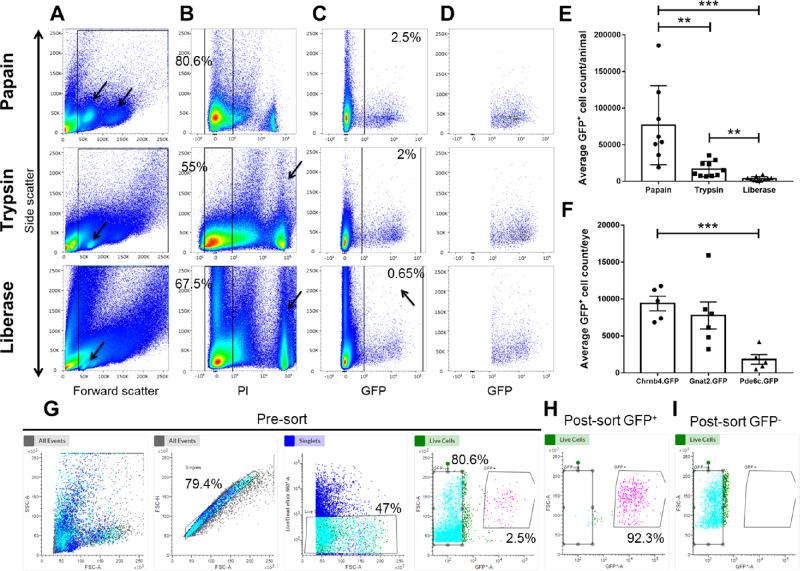
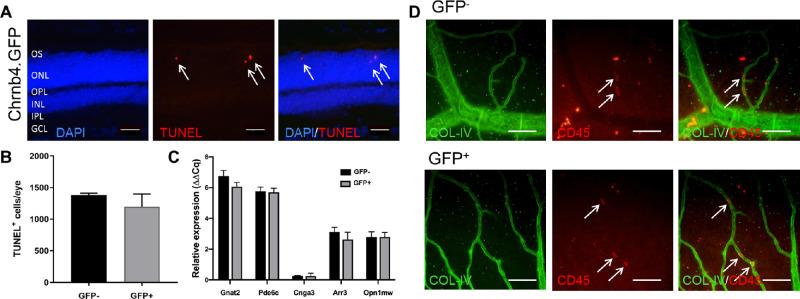
GFP expression spanned the length of the cone cell in the Chrnb4.EGFP line, as well as in the novel .GFP and .GFP lines. The effect of GFP expression showed no significant changes to outer nuclear layer cell death, cone-specific gene expression, and immune response activation. A temporal decrease in GFP expression over time was observed, but GFP fluorescence was still detected through flow cytometry as late as 6 months. Furthermore, a functional analysis of photopic and scotopic electroretinogram responses of the Chrnb4 mouse showed no significant difference between GFP and GFP mice, whereas electroretinogram recordings for the .GFP and .GFP lines matched previous reports from the original lines.
CONCLUSIONS
This study demonstrates that the Chrnb4.EGFP mouse can be a powerful tool to overcome the limitations of studying cone biology, including the use of this line to study different types of cone degeneration.
TRANSLATIONAL RELEVANCE
This work validates research tools that could potentially offer more reliable preclinical data in the development of treatments for cone-mediated vision loss conditions, shortening the gap to clinical translation.
目的
验证一种已知的具有绿色荧光视锥细胞的转基因小鼠品系(Chrnb4.EGFP)在研究视锥光感受器在健康和疾病状态下的生物学特性及功能方面的应用。
方法
通过免疫组织化学、定量实时聚合酶链反应、视网膜电图和流式细胞术,将含有绿色荧光视锥细胞的Chrnb4.EGFP视网膜与无绿色荧光蛋白转基因的视网膜进行比较。将Chrnb4.EGFP品系与视锥细胞退化的小鼠模型进行回交,产生新的品系.GFP和.GFP,并按上述方法进行研究。
结果
在Chrnb4.EGFP品系以及新的.GFP和.GFP品系中,绿色荧光蛋白(GFP)表达贯穿视锥细胞全长。GFP表达对视神经节细胞层细胞死亡、视锥细胞特异性基因表达和免疫反应激活无显著影响。观察到GFP表达随时间呈暂时性下降,但通过流式细胞术最晚在6个月时仍能检测到GFP荧光。此外,对Chrnb4小鼠明视觉和暗视觉视网膜电图反应的功能分析表明,GFP小鼠和GFP小鼠之间无显著差异,而.GFP和.GFP品系的视网膜电图记录与原始品系先前的报道相符。
结论
本研究表明,Chrnb4.EGFP小鼠可成为克服视锥细胞生物学研究局限性的有力工具,包括利用该品系研究不同类型的视锥细胞退化。
转化相关性
本研究验证的研究工具可能在视锥细胞介导的视力丧失疾病治疗开发中提供更可靠的临床前数据,缩短向临床转化的差距。



 Zotero 插件